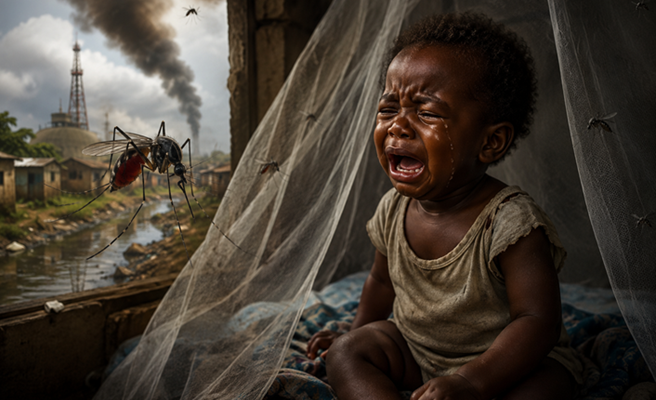

The fiercest condemnation of a nation is rarely written in the statutes of its courts or proclaimed from the chambers of its legislature. It is heard in the inconsolable cries of a one year old child clawing at inflamed skin after another mosquito bite. In Nigeria especially the country side, countless parents remain awake through interminable nights, imprisoned by anxiety as they wonder whether an ordinary bite will culminate in malaria, cerebral complications, or the unthinkable loss of a child. Such anguish is neither accidental nor inevitable. It is the predictable consequence of decades of environmental dereliction, institutional lassitude, and political myopia.
Mosquitoes are no longer mere nuisances. They have become biological assassins, exploiting every stagnant drain, refuse dump, flooded gutter, and neglected community. Their proliferation reflects a wider civic pathology in which sanitation collapses, preventive healthcare is underfunded, and public accountability evaporates. The smallest insect now exposes the greatest fissures in governance. Every swollen arm, every feverish forehead, and every grieving household stands as an indictment of collective failure rather than biological misfortune.
The contrast with parts of the United States is instructive. When surveillance detects dangerous increases in mosquito populations or outbreaks of mosquito borne disease, local authorities can deploy integrated mosquito control programmes that include helicopters or aircraft to spray carefully regulated larvicides or adulticides over large areas. These operations are conducted by licensed vector control agencies under strict environmental and public health regulations, with communities notified in advance. According to the United States Centers for Disease Control and Prevention, aerial spraying is employed only when necessary to reduce disease carrying mosquitoes and lower the risk of illnesses such as West Nile virus. It is one component of a broader strategy that also includes surveillance, environmental management, and public education.

Nigeria does not lack scientific knowledge. It lacks sustained implementation. Environmental sanitation campaigns often disappear as quickly as political slogans. Drainage systems remain obstructed. Waste accumulates. Mosquito breeding sites multiply unchecked. The result is a vicious epidemiological cycle in which preventable infections continue to exact an intolerable toll on children under five, whose developing immune systems render them especially susceptible to severe malaria and its devastating complications.
Equally corrosive is the crisis of public trust. In some communities, misinformation has become as dangerous as the mosquito itself. Rumours circulate that free malaria medicines or government health interventions are concealed attempts to reduce fertility or diminish the population of children. There is no credible scientific evidence supporting such claims. Yet distrust, fuelled by historical failures, poor communication, and the rapid spread of falsehoods through informal networks and social media, persuades some families to reject medicines that could save a child’s life. When confidence in public institutions collapses, even the most effective intervention struggles to reach those who need it most.
This is the true paradox of Nigeria’s malaria burden. Science has advanced. Effective medicines exist. Insecticide treated nets save lives. Rapid diagnostic tests improve treatment. Indoor residual spraying and targeted vector control have demonstrated measurable benefits in many settings. Yet these proven interventions cannot fulfil their promise where governance is inconsistent, infrastructure is fragile, and misinformation eclipses evidence. A society that permits fear to triumph over fact condemns its most vulnerable citizens to needless suffering.
The mosquito is not invincible. Nations have demonstrated that disciplined surveillance, environmental stewardship, strategic insecticide application, community participation, and transparent public communication can dramatically suppress mosquito populations and reduce disease transmission. The obstacle is therefore not biology but political resolve. It is easier to inaugurate monuments than to maintain drainage systems. It is easier to deliver eloquent speeches than to organise year round vector control.
History will not measure Nigeria by the grandeur of its rhetoric or the splendour of its ambitions. It will remember whether it defended the child who could not defend himself. A civilisation forfeits a portion of its moral legitimacy each time a toddler spends another sleepless night scratching infected bites while preventable disease stalks the darkness. The tears of a child should never become the soundtrack of national indifference. Until Nigeria wages an uncompromising war against malaria through science, sanitation, accountability, and public trust, every mosquito bite will remain a minute but merciless reminder that the smallest predator continues to expose the greatest failures of the state.
– Inah Boniface Ocholi writes from Ayah – Igalamela/Odolu LGA, Kogi state.
08152094428 (SMS Only)