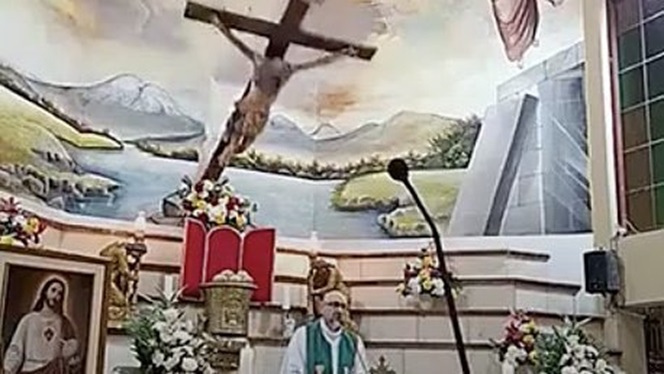

A priest was celebrating Mass when death descended from behind the altar. Worshippers had gathered to pray. The service was being livestreamed. Then a massive wooden crucifix broke loose and struck Father Patricio Alfredo Sánchez Molinari on the head. Cries of alarm shattered the solemnity of the sanctuary as congregants rushed to help him. The 53 year old Redemptorist priest died in the tragedy at Our Lady of Perpetual Help Church in Guayaquil, Ecuador, on October 17, 2026. What should have been a sacred moment became an international story of grief, shock and unanswered questions.
The disturbing irony is difficult to ignore: a priest devoted to proclaiming the Christian message of sacrifice and salvation lost his life when the very symbol at the centre of that faith fell upon him. But the tragedy must not become an invitation to superstition. Its significance lies not in any unproven claim about divine anger or supernatural intervention, but in the questions it forces religious communities to confront about mortality, responsibility and the protection of human life.
The first question is painfully practical: how did a heavy crucifix detach from its mounting and kill a man standing at the altar? The cause has not been conclusively established. Reports indicate that a technical assessment was expected to help determine what happened, while investigators examined the circumstances surrounding the accident. Until the findings are made public, it would be premature to assign blame or declare that negligence occurred. But the absence of definitive answers makes a thorough investigation more important, not less.

There is a danger, however, that the search for meaning will overshadow the search for facts. When tragedy strikes a church, some people instinctively ask whether God is sending a warning, punishing a sinner or revealing a hidden spiritual conflict. Such interpretations may attract attention online, but they can turn an unexplained death into an accusation against the victim. In Luke 13:1–5, Jesus challenged the assumption that people who suffered sudden death were more sinful than those who survived. A tragic accident does not establish divine condemnation, and grief should never be exploited to manufacture certainty where none exists.
For Christians, the cross represents the suffering and sacrifice of Jesus Christ. Its spiritual meaning, however, does not make its physical form immune to the laws of gravity, structural weakness or human error. A heavy religious object requires secure installation. A church building requires inspection and maintenance. Equipment suspended above an altar must be assessed with the same seriousness as any other structure capable of injuring or killing someone. Reverence cannot replace engineering, and prayer cannot serve as a substitute for reasonable precautions.
This is where the tragedy reaches beyond Ecuador. Churches are places of worship, but they are also buildings occupied by clergy, children, elderly people, workers and visitors. Their safety cannot depend on hope alone. Religious institutions should routinely inspect heavy fixtures, verify their mounting systems and engage qualified professionals when structural concerns arise. Where a hazard is identified, corrective action should follow. These are not expressions of doubt in God. They are expressions of responsibility towards the people whom religious institutions exist to serve.
The distinction matters because religious language can sometimes discourage ordinary questions. When a building is regarded as sacred, examining its physical condition should not be mistaken for questioning its spiritual authority. A church may be holy to its congregation, but its walls, fittings and suspended objects remain subject to physical risks. Good stewardship requires recognising both realities. Protecting worshippers is not a distraction from ministry; it is part of the duty to care for them.
The livestream has introduced another troubling dimension. The priest’s final moments were captured on camera, and the footage spread rapidly across social media. The parish subsequently removed the original video containing sensitive material. The episode illustrates how digital technology can turn private grief into global spectacle within minutes.
The public has a legitimate interest in understanding what happened, particularly if the investigation reveals preventable failures. But that interest does not require the repeated circulation of graphic footage. Responsible journalism should establish the facts, explain the institutional implications and demand accountability where evidence supports it. It should not reduce a man’s death to a shocking clip designed to generate clicks. Father Sánchez deserves to be remembered as a priest and a human being, not merely as the victim of an extraordinary accident.
His final homily gives the story an additional poignancy. According to reports, he had urged parishioners to put God first and use their time wisely, reminding them that life is finite. Those words resonate because of what happened moments later. Yet their significance should not be twisted into a claim that he somehow predicted his own death. They are a reminder of the fragility he shared with everyone in that congregation.
No calling makes a person invulnerable. Priests and pastors may devote their lives to spiritual service, but they remain human beings exposed to accidents, illness and the uncertainties of existence. Faith can sustain people through suffering without explaining every tragedy. It can offer hope in bereavement without requiring the bereaved to accept simplistic answers. To suggest that devotion guarantees protection from death is to misunderstand both human vulnerability and the nature of faith.
Father Sánchez’s death should therefore prompt two responses, not one. The first is compassion: prayer for his eternal rest, support for those who mourn him and respect for the dignity of his final moments. The second is responsibility: a careful investigation, transparent communication of the findings and a renewed commitment to safety wherever people gather for worship. Neither response diminishes the other. Together, they honour both the dead and the living.
The cross fell. A priest died. A congregation was left grieving. The temptation will be to search for a dramatic explanation and move on once public attention fades. That would be a mistake. The more enduring question is whether religious institutions will use this tragedy to examine the ordinary safeguards that protect extraordinary human trust. The deepest expression of reverence is not simply the prominence of sacred symbols, but the seriousness with which human life is protected beneath them.
– Inah Boniface Ocholi writes from Ayah – Igalamela/Odolu LGA, Kogi state.
08152094428 (SMS Only)