

By Abah Benjamin Eneojoh
The Chairman of the Occasion at the 2026 World Architecture Day and Annual General Meeting of the Nigerian Institute of Architects (NIA), Kogi State Chapter, Arc. Kayode Oloninisi, Ph.D, FNIA, has challenged architects, policymakers and stakeholders in the built environment to translate the recognition of housing as a human right into practical action capable of delivering decent, affordable and accessible homes to Nigerians.
Oloninisi, who was represented at the event by Associate Professor Okwenya Sunday, Head of the Department of Architecture, Federal University Lokoja, said the theme of this year’s celebration, “Housing is a Human Right. Build It,” was a timely reminder of the fundamental place of adequate housing in human welfare and national development.

Speaking at the event, he noted that the theme, adopted by the International Union of Architects (UIA), reinforces the provisions of the Universal Declaration of Human Rights and the International Covenant on Economic, Social and Cultural Rights, which recognise adequate housing as an essential component of a decent standard of living.
He stressed that housing, alongside food and clothing, remains one of humanity’s basic needs, providing not only physical protection but also contributing significantly to health, dignity, emotional security and overall wellbeing.
The chairman of the occasion commended the Kogi State Chapter of the NIA for designing a programme that moved beyond theoretical discussions to explore practical architectural, planning, financing and policy strategies capable of addressing the housing challenges confronting the people of Kogi State.
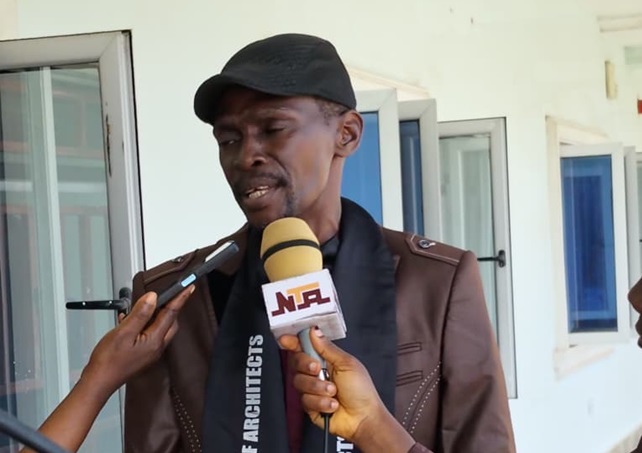
He particularly praised the Chapter for assembling five distinguished professionals to interrogate the theme from different perspectives. They include Arc. Dr. Mohammad Adamu, MNIA; Arc. Isah Obenege Suleiman, MNIA; Arc. Dr. Jibrin Olanusi, MNIA; Bdr. Adoke Ismaila Ibrahim, MNIOB; and Bdr. Aisha Oruma-Sylvanus, MNIOB.
Oloninisi urged participants to listen carefully to the presentations, engage constructively in the discussions and use the platform not only for professional development but also for meaningful networking and collaboration capable of advancing the built environment.
The Chairman’s call resonated strongly with the position of the Kogi State Chapter Chairman, Arc. John O. Attah, MNIA, who declared that the housing question required professionals to move from rhetoric to practical and sustainable solutions.
Attah, in his opening remarks, said the Chapter had deliberately chosen to focus on “Exploiting Indigenous Building Techniques and Materials as a Sustainable Solution to our Housing Deficit,” arguing that Nigeria could no longer afford excessive dependence on imported building materials at the expense of affordable housing and economic self-reliance.
According to him, Nigeria possesses abundant raw materials that can be developed and deployed in the construction industry through stronger collaboration among government, academia, researchers, professionals, private investors and local communities.
He identified technologies and materials such as stabilised compressed earth blocks, bamboo composites, laterite-based finishes and pozzolana as examples of indigenous or locally adaptable solutions capable of reducing construction costs while responding to Nigeria’s climatic and economic realities.
Attah said embracing such technologies could produce benefits beyond housing delivery, including the creation of employment for youths and artisans, expansion of local manufacturing, development of mining and processing value chains, increased economic activity and reduced pressure on foreign exchange.
He therefore charged architects to assume leadership in promoting indigenous solutions by engaging government on enabling policies, academia on research, the private sector on investment and communities on the acceptance and ownership of locally developed building technologies.
He assured that the Kogi Chapter would continue to position itself at the forefront of efforts to promote sustainable, affordable and locally driven housing solutions in the state, urging architects to design, specify and supervise the appropriate use of indigenous materials in construction projects.