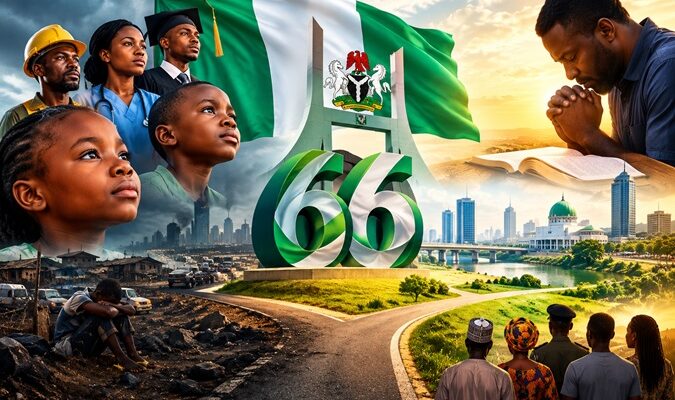

Nigeria turns 66 with a question that cannot be buried beneath anniversary speeches: what kind of country will Nigerians enter after 2027? The answer will not be written by politicians alone. It will emerge from the quality of the institutions, the integrity of the electoral process and the seriousness with which citizens exercise their constitutional power.
The stakes extend beyond another electoral contest. Elections transfer authority; governance gives that authority consequence. Nigeria possesses extraordinary human talent, natural resources and entrepreneurial energy, yet millions continue to confront insecurity, economic pressure, unemployment and institutional weakness. The contradiction is no longer theoretical. It is experienced daily.
That is the setting for the National Prayer Summit in Abuja on October 1, 2026, under the theme: “Nigeria at a Turning Point: O God, Give Us a Leader After Your Own Heart.” Its scriptural foundation, Daniel 2:21—“He removeth kings, and setteth up kings”—places the political moment beneath a larger theological claim: human authority is temporary, but moral accountability is enduring.

«“He removeth kings, and setteth up kings.”
— Daniel 2:21»
That verse should sharpen, not soften, civic responsibility. If authority ultimately stands beneath God’s sovereignty, then power cannot be treated as personal property. Public office becomes stewardship; authority becomes responsibility; leadership becomes answerability. Prayer, therefore, is not political escape. It is an appeal for divine direction accompanied by a demand for human integrity.
The spiritual argument is consequently deeper than asking God to choose a political personality. It is a plea for the moral conditions under which authority can be exercised justly. A leader “after God’s own heart” cannot be defined by religious language alone. The standard must be visible in truthfulness, justice, humility, protection of the vulnerable, responsible stewardship and respect for the rule of law.
That standard must also govern the approach to 2027. Credible elections require more than peaceful voting day ceremonies. They require transparent administration, lawful conduct, institutional independence, evidence-based dispute resolution and citizens who refuse to surrender their votes to intimidation, inducement or manipulation. Democracy becomes fragile when citizens demand accountability only from opponents and excuse it among their allies.
Nigeria’s economic crisis makes the stakes unmistakable. Inflation, unemployment, insecurity, infrastructure deficits and weakened purchasing power translate directly into household hardship and diminished opportunity. The response cannot be perpetual political rhetoric. It requires policies capable of expanding productive capacity, strengthening institutions, attracting investment, protecting livelihoods and subjecting public expenditure to serious scrutiny.
Peace and unity demand equal seriousness. National cohesion cannot be manufactured by slogans while citizens distrust institutions or perceive public opportunity as arbitrarily distributed. Stability is strengthened when justice is credible, rights are protected and citizens can participate in national life without fear. Security is not merely the absence of violence; it is the presence of institutions capable of preventing violence from becoming normal.
The danger, therefore, is not simply choosing poorly at the ballot box. It is allowing political culture itself to deteriorate until citizens cease demanding evidence, institutions cease resisting pressure and public office becomes an instrument of private accumulation. Once accountability becomes partisan, democracy retains its rituals while losing its substance.
Nigeria at 66 should reject that trajectory. The country needs neither political messiahs nor citizens permanently trapped in political spectatorship. It needs a culture in which candidates are interrogated on records and policies, institutions are defended irrespective of partisan affiliation, public promises are measured against outcomes and elected officials remain answerable after election day.
This is where prayer acquires its greatest civic force. To ask God for righteous leadership is also to ask for the courage to reject corruption. To pray for credible elections is to accept the responsibility of defending electoral integrity. To seek peace is to refuse political violence. To ask for national restoration is to become unwilling to participate in the practices that perpetuate national decay.
The National Prayer Summit should therefore be understood not as an alternative to civic action but as a summons to it. The prayer rises toward heaven; the responsibility returns to earth. Institutions must perform their constitutional duties. Political actors must respect lawful processes. Citizens must scrutinise rather than worship personalities.
The challenge before Nigerians is concrete: before 2027, investigate before you endorse; compare before you choose; question before you believe; vote without intimidation; reject inducement; document abuses; use lawful channels to challenge irregularities; and demand accountability after the ballots are counted.
At 66, Nigeria cannot afford another generation of passive citizenship dressed in patriotic language. If the nation truly seeks leadership after God’s own heart, then Nigerians must demand the earthly evidence of that prayer: truth over propaganda, stewardship over self-enrichment, justice over impunity, institutions over personalities and public interest over political possession.
Let the nation pray. Let citizens act. Let institutions stand. And let every holder of public power remember: authority may be conferred by an election, but its moral legitimacy is tested by what is done with it.
– Inah Boniface Ocholi writes from Ayah – Igalamela/Odolu LGA, Kogi state.
08152094428 (SMS Only)