
Nigeria does not lack talent. It lacks the systems capable of converting talent into economic power. Nowhere is this contradiction more visible than in the lives of millions of Nigerian women and girls. A country desperate for productivity, enterprise and growth cannot afford to educate, employ, finance and empower only a fraction of its human capital.
The argument for women’s development is therefore larger than feminism, representation or social justice. It is an economic argument about wasted capacity. When a girl is pushed out of school, a worker is denied opportunity, an entrepreneur is starved of capital or a qualified woman is excluded from decision-making, Nigeria loses more than an individual opportunity. It loses productivity, income, innovation and future wealth.
The contradiction is stark. The World Bank estimates Nigeria’s 2025 labour-force participation rate at about 80.7% for women and 84.3% for men. Those figures demonstrate substantial participation, but they do not answer the deeper question: what kinds of work are available to women, what level of productivity do those jobs generate, what access do women have to capital, and what economic returns can they realistically achieve? Participation alone is not empowerment.

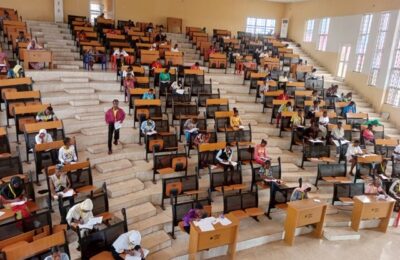
Education is the first economic gate. Nigeria still has about 10.5 million children aged 5–14 outside school, according to UNICEF, while girls face particularly severe educational exclusion in parts of northern Nigeria. In some northern states, female secondary-school attendance remains exceptionally low. Every year of lost education narrows the pipeline of skilled workers, professionals, entrepreneurs, researchers and leaders that Nigeria will need to compete.
Education policy should therefore be treated as economic infrastructure, not charity. Nigeria needs sustained investment in girls’ secondary and tertiary education, technical and vocational training, digital skills and employability. The objective should not merely be to put girls in classrooms, but to ensure that education produces capabilities that can translate into laboratories, factories, offices, farms, technology companies and competitive businesses.
Then comes capital. A woman may possess an idea, a skill and a market, yet remain economically trapped because she cannot obtain affordable finance, acquire productive assets or expand beyond subsistence enterprise. The question is brutally simple: how many viable businesses never become substantial enterprises because their owners cannot cross the financing barrier? An economy that starves entrepreneurs of capital should not be surprised when businesses remain small.
The same logic applies to ownership and economic security. Women need meaningful access to land, property, financial services, markets and business networks. These are not ornamental privileges; they are foundations of productive investment. When ownership is insecure, collateral becomes difficult to establish. When collateral is unavailable, finance becomes more expensive. When finance becomes expensive, expansion becomes harder. When businesses cannot expand, jobs, incomes and tax revenues are lost.
Political participation matters for the same reason. Nigeria’s current parliament remains overwhelmingly male, with women holding only a small share of seats in the National Assembly. This is not merely a question of who occupies political office. Representation affects which experiences enter policy debates and whose economic constraints become visible when budgets, infrastructure and development priorities are designed.
Yet the solution should not be reduced to placing women in positions simply because they are women. The serious objective is to remove structural barriers so that capable Nigerians can compete, lead and create value. Political institutions should widen genuine access to leadership while maintaining standards of competence, accountability and measurable performance. Gender inclusion and institutional standards should reinforce, not undermine, each other.
Safety is also economic policy. A woman who cannot travel safely, work freely, operate a business securely or remain in school because of violence cannot participate fully in the economy. UNICEF identifies poverty, insecurity, restrictive social norms and other structural barriers among the forces limiting girls’ educational opportunities in Nigeria. Protection from violence is therefore not peripheral to development; it is part of the infrastructure of productivity.
Nigeria should stop treating women’s development as a collection of isolated social programmes. Education ministries, financial institutions, labour agencies, agricultural programmes, technology initiatives and economic planners should measure how their policies affect women’s ability to acquire skills, own assets, obtain finance, enter markets and build productive enterprises. What gets measured can be financed; what gets financed can be scaled; what gets scaled can transform an economy.
The hardest truth is that Nigeria cannot complain simultaneously about unemployment, weak productivity, low industrialisation, inadequate innovation and slow economic transformation while leaving enormous reservoirs of human capability underdeveloped. A country that wastes talent cannot manufacture prosperity through rhetoric. It cannot legislate its way around lost skills. It cannot borrow its way out of structural exclusion.
The choice before Nigeria is therefore not between women’s advancement and economic development. That is a false choice. The real choice is whether Nigeria will continue tolerating barriers that prevent millions of citizens from converting ability into productivity or build institutions that make talent economically usable. The country does not need to give women a place in Nigeria’s economy. Women are already part of it. Nigeria needs to stop making their full economic contribution unnecessarily difficult.
Nigeria’s greatest economic resource is not beneath the soil. It is the capacity of its people to learn, build, invent, produce and lead. Every girl denied education, every entrepreneur denied capital and every capable woman excluded from opportunity represents more than a personal loss. It is a subtraction from national wealth. Nigeria cannot build a high-productivity economy with a low-ceiling system for human potential.
– Inah Boniface Ocholi writes from Ayah – Igalamela/Odolu LGA, Kogi state.
08152094428 (SMS Only)