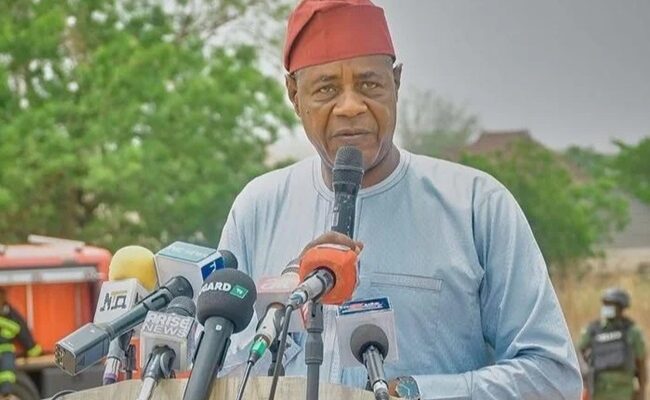

The Security Adviser to the Kogi State Government, Commander Jerry Omodara (Rtd), has called on opposition political figures to strip politics from national security matters and acknowledge the tangible achievements recorded by President Bola Tinubu’s administration in safeguarding the country.
Omodara made the call during an interview with the News Agency of Nigeria (NAN) in Lokoja while evaluating the President’s security record in the last three years as the nation marks its 66th Independence Anniversary. He stated that national security remains an evolving, work-in-progress enterprise requiring a well-defined architecture where sub-national governments and the federal authority collaborate seamlessly.
According to him, President Tinubu inherited an existing security arrangement but strategically assembled solid experts who thoroughly reviewed the operational structures, identified emerging threats, and outlined a clear way forward. He stressed that any state currently experiencing severe security challenges should be critically examined regarding its level of cooperation with the central security umbrella, noting that alignment with federal policy remains fundamental to achieving stability across the federation.

Reflecting on the nation’s security trajectory, the retired military commander noted that public safety will improve further when opposition leaders begin to recognize and commend the positive outcomes of federal interventions. He pointed out that overall security has improved significantly compared to previous years when frequent insurgent and criminal attacks breached the Federal Capital Territory, Abuja, adding that instances of school kidnappings across the country have also recorded a notable decline.
Detailing the local framework in Kogi State, Omodara highlighted that the administration of Governor Ahmed Usman Ododo has aligned completely with the federal strategy while designing a tailored local security network based on the state’s specific topography. This regional mechanism integrates local hunters, vigilantes, professional tracking groups, and newly recruited forest guards into a unified force.
He revealed that the state government has established grassroots intelligence units across all 239 political wards to feed real-time information to local government authorities and the state headquarters. This setup allows embedded local operatives to actively join joint clearance operations alongside the Nigerian Army, Nigerian Navy, Nigeria Police Force, and the Department of State Services.
Explaining the operational strategies deployed in Kogi, the Security Adviser noted that the state applies both kinetic and non-kinetic methods. While kinetic operations involve sustained forest raids and tactical patrols, the non-kinetic approach provides criminals a strict window to surrender rather than offering a platform for negotiation.
He disclosed that state forces have systematically blocked access roads, closed periodic markets, and shut down motor parks in criminal strongholds, particularly within the Kogi West Senatorial District. These blockade tactics have denied logistics and food supplies to bandits hiding deep inside the forests, effectively forcing several elements to abandon their hideouts.
Omodara asserted that Kogi State is by no means at the mercy of kidnappers or armed bandits. He reiterated that while the state government provides an avenue for repentant criminals to lay down their arms and integrate into society, security forces will remain unrelenting in tracking down and neutralizing those who refuse to surrender.
He commended President Tinubu for bolstering manpower across federal security agencies through continuous recruitment drives, a development that enabled Kogi State to recently reopen several police stations that had remained defunct for 10 to 15 years.
Furthermore, Omodara described as unprecedented the ongoing platform established by the National Security Adviser, Mallam Nuhu Ribadu, which facilitates regular collaborative meetings with the 36 State Security Advisers to share intelligence. He recalled that the Office of the National Security Adviser was previously inaccessible to state-level officials, hampering joint national strategy.
On existing operational gaps, Omodara emphasized that threat patterns constantly shift, moving from traditional armed robbery and house-breaking a decade ago to highway abductions and cyber-enabled crimes today. He affirmed that Kogi State will continue to plug operational gaps through enhanced synergy, robust intelligence collection, and advanced technological deployments, noting that the state now utilizes surveillance drones and modern tactical equipment that were unavailable two years ago.