
- Declares war on foreign theoretical models, exposes cultural betrayal in Nigerian literature with fiery call to decolonize the English language
In a fiery, ground-breaking discourse that rocked the academic community, Professor of Stylistics and Text Linguistics, Muhammed-Badar Salihu Jibrin, has launched a fierce challenge against long-standing reliance on inherited Western theoretical models, calling for an urgent revolution toward context-sensitive, systemic text-linguistic frameworks to analyze Nigerian literary expression.
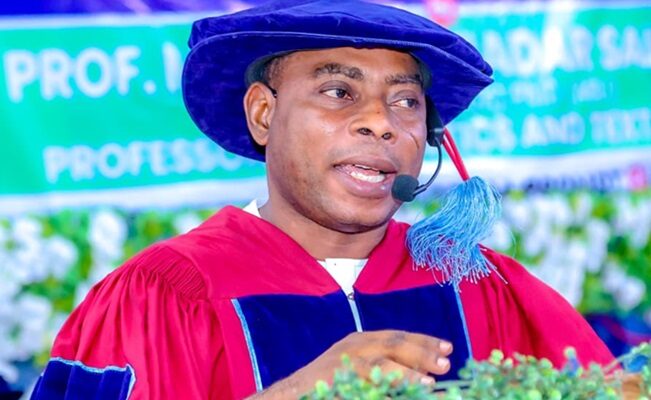
Delivering the highly anticipated 28th Inaugural Lecture of Prince Abubakar Audu University (PAAU), Anyigba, titled “From Stylolinguistic Domestication to Systemic Text Linguistics: A Journey Through the Sphere of Nigerian Literary Text Analysis,” on Tuesday at the packed University Auditorium, the erudite scholar declared that rigid foreign paradigms must yield to analytical tools deeply rooted in local linguistic and cultural realities.
Prof. Jibrin dismantled traditional stylistic approaches, explaining that style and stylistics have long suffered from confusing definitions, creating a methodological puzzle for scholars attempting to decode writers’ choices within specific social contexts. He stressed that Nigerian literature embodies a unique crucible of experiences, histories, cultures, and worldviews, asserting that language is not merely an abstract system of grammar, but a dynamic resource for meaning-making that must examine why a writer makes a specific choice and what functional purpose it serves.

Highlighting the historic “language question” in African literature, the Inaugural Lecturer demonstrated how English, despite initial cultural mismatches, has been boldly nativized and restructured to carry the profound weight of the Nigerian experience. Citing his empirical findings on Chukwuemeka Ike’s novel Our Children Are Coming, Prof. Jibrin illustrated how linguistic devices such as parallelism, collocations, and striking coinages like “Whitemail,” “Youthquake,” and “Chop-Chop Mentality” were weaponized to expose societal vices, hypocrisies, and moral decay, while simultaneously showcasing the creative resistance of African writers using English as a second language.
Further analyzing Olu Obafemi’s Wheels, the Don revealed how code-mixing, lexical repetition, and nativization force the English language to surrender to modification by indigenous oral traditions and Afro-Nigerian thought processes. He maintained that these linguistic adaptations prove that nativized English is a flexible, living medium capable of preserving national heritage and reflecting the true social conditions of the people.
Proposing a comprehensive Systemic Text-Linguistic approach to replace outdated models, Prof. Jibrin anchored his paradigm on M.A.K. Halliday’s Systemic Functional Linguistics (SFL), Beaugrande & Dressler’s Seven Standards of Textuality—including cohesion, coherence, and intertextuality—and the multi-layered analytical levels of Adejare’s model. He demonstrated that applying systematic analysis across individual author styles and broader literary dialects unifies meaning and bridges basic language choices with complex social realities.
Prof. Jibrin forcefully advocated that indigenous expressions, loan words, discourse particles, and local varieties of English must be prioritized as vital instruments for authentic expression and cultural confidence, arguing that academic scholarship must directly enrich classroom practice and curriculum design.
Reacting to the presentation, the Vice-Chancellor of PAAU, Professor Salisu Ogbo Usman, speaking through the Deputy Vice-Chancellor (Administration), Prof. Rufai Sani Abdullahi, hailed the lecture as a monumental institutional milestone. The Vice-Chancellor praised Prof. Jibrin for addressing the vital nexus between language, identity, and knowledge production, emphasizing that academia bears an urgent responsibility to ensure theoretical scholarship moves beyond university walls to serve humanity and inform public policy.
The memorable event climaxed with the ceremonial presentation of an inaugural lecture certificate, commemorative plaque, and medal to Prof. Jibrin, amidst loud cheers from a distinguished audience comprising members of the University Governing Council, Management, Senate, staff, students, traditional rulers, and academic dignitaries from across the country.