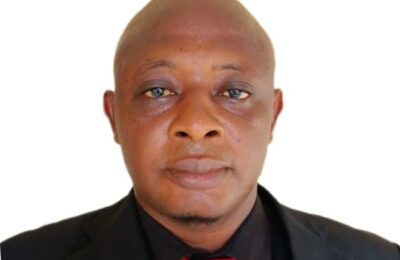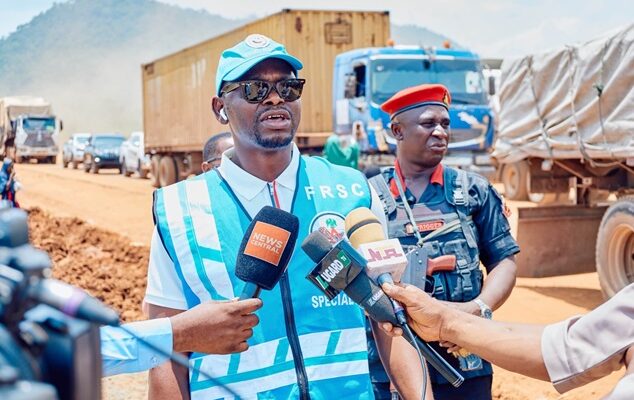

The Deputy Corridor Commander of the Federal Road Safety Corps, FRSC, Abraham Daniel, has blamed construction companies handling federal highway projects for failing to consider the motoring public during construction, leading to persistent gridlock on the Lokoja-Abuja corridor.
Daniel spoke during a stakeholders meeting organised by the Special Adviser to Governor Ahmed Ododo on Road Safety Matters, Dr. Suberu Yusuf-John, where he gave a Federal Highway Situation Report.
He said contractors often close long stretches of road without providing alternative passage for motorists, a practice that triggers gridlock.

“People always talk about the construction companies but what was discovered is that the construction companies do not sometimes put into cognizance the motoring public when they are doing their construction,” Daniel said.
The FRSC commander also appealed to VIPs to cooperate with traffic officers on the road.
“If there is any senior officer present, I want to solicit that you please help us talk to the VIPs. They need to obey officers on the road, they need to understand the situation and we must all be patient while travelling,” he said.
He urged motorists to plan their journeys ahead of time and called on transport unions to educate their drivers, noting that gridlock on highways is caused by three factors: human, mechanical and environmental.
According to him, while mechanical failure cannot be predicted, poor driver education and impatience remain major causes.
On interventions, Daniel said the Corps engaged construction companies and succeeded in freeing the Banda axis of the highway.
“Presently, Banda is free. There’s no problem at that axis,” he said.
He however lamented that efforts to reach contractors at the Amariya and Karara axis during the recent week-long gridlock on the Lokoja-Abuja road were unsuccessful.
“We looked for the contractors at Karara to help us provide a good opening at the other side that they are not constructing but we were not able to see them. Because the road was degraded and because of potholes, vehicles move slowly and if they don’t move slowly they may fall,” he explained.
Daniel called on contractors to urgently rehabilitate and open the side of the road not under active construction to ease movement.
He commended sister security agencies including the military, navy and police for their support during gridlock situations, and called for more synergy.
“Road safety is not just an FRSC problem but everybody’s. We need the navy, army, correctional centre, immigration to assist us by deploying their officers so we can synergize to clear blockages,” he said.
Also speaking, the Special Adviser to Governor Ododo on Federal Project Implementation, Obasi Emmanuel, said his office monitors all ongoing federal roads and infrastructure projects in the state daily, including how contractors relate with host communities and road users.
He noted that almost all traffic gridlocks in Kogi occur on federal roads, particularly the strategic Abuja-Lokoja corridor which connects travelers from the North to the South.
“If we are able to design a proper solution that can tackle this axis, we would have solved the major traffic problems on the highways. This situation gives a very bad image to the state,” Emmanuel said.
He accused federal road contractors of being responsible for over 30 percent of gridlock on federal roads and of disobeying directives of the Minister of Works.
He recalled that the Minister of Works during a visit to Kogi in August directed that no contractor should close beyond one to two kilometres within a construction corridor, but some contractors still close as much as 25 kilometres, even on sections already constructed.
“Two weeks ago I was at a construction company and asked why they still closed about 15 kilometres of road already constructed. They said they have not been paid. The Minister gave one week directive, but one month after, the road was still not open,” he said.
Emmanuel however said the blame should not be on President Bola Tinubu or the Minister of Works but on delayed payments by the Ministry of Finance and the Central Bank of Nigeria, CBN.
“Contractors are generating certificates and they are not paid, how do you expect them to continue? Even when the President has approved funds, the authorities concerned refuse to pay or bring up so much protocol that makes payment last for months,” he said.
He added that the Federal Emergency Road Maintenance Agency, FERMA, had complained of lack of funds to carry out comprehensive palliatives and is also constrained by its rule of not intervening on roads already contracted out.
Emmanuel identified breakdown of heavy-duty trucks as another major contributor to gridlock, disclosing that over 500 trucks were counted on the highway within two hours.
He said the state government has offered about 40 hectares of land to the Nigerian Shippers’ Council for the construction of a Transit Park where trucks can park, refuel, carry out maintenance and rest, to reduce static loads that damage roads and cause obstructions.
He said officials of the Council are expected in the state next Saturday to inspect the site.
Earlier in his remarks, Special Adviser (SA) to Gov. Ahmed Ododo on Road Safety Matters, Dr. Suberu Yusuf-John,
said that Kogi government will deploy mobile courts and other enforcement mechanisms on highways across the state to ensure traffic offenders face the consequences of causing gridlocks during the Ember months.
Yusuf-John said the government would enforce strict traffic management measures to ensure free flow of traffic and prevent motorists and travellers from being stranded.
He regretted the recent week-long gridlock along the Lokoja-Abuja road and said the state government is coordinating traffic management efforts to ensure that “nobody sleeps on the road” during the festive period.
According to him, the meeting was convened to engage all critical stakeholders, noting that collective effort is required to achieve effective traffic control and road safety.
“I am very happy today that the compliance of the stakeholders is very high, which gives the impression that we are going to succeed in this plan,” he said.
“While this government recognises the need for an enabling environment for businesses to thrive, operators cannot be regulators at the same time.
“It is very important to have an enabling environment for business to thrive, but at the same time, an operator cannot be a regulator.
“Therefore, we are going to ensure that as the state government, we regulate the movement of articulated vehicles by telling them when to move and when not to move, for the safety of the people on the road,” he said.