
By Dr Williams Charles Oluwatoyin
There is a significant difference between assistance that offers temporary relief and an investment that permanently changes the direction of a person’s life. Food may address today’s hunger, while a financial gift may resolve an immediate difficulty. Education, however, equips people with the knowledge and capacity to improve their circumstances.
When a young person is helped to remain in school, complete a degree or acquire digital competence, the benefit extends beyond that individual. The family gains hope, the community gains a trained professional, and society develops the human resources required for progress.

It is from this perspective that Senator Sunday Steve Karimi’s interventions in education should be examined. His scholarships, classroom projects, institutional support and digital-learning facilities represent an investment in people and in the future of Kogi State.
Public leadership is best assessed by the opportunities created, the lives affected and the extent to which interventions respond to the actual needs of the people. In education, Senator Karimi has established a record that deserves serious consideration.
Education in a Difficult Economic Period
Education remains one of the most dependable routes out of poverty, but it is becoming increasingly difficult for many Nigerian families to afford. Tuition, accommodation, textbooks, transportation, digital devices and examination charges continue to rise.
For many young people, securing admission is no longer the greatest challenge. Remaining in school has become the real struggle.
Behind every student who suspends or abandons a programme is often a difficult family story. Some parents can no longer meet the expenses. Some guardians support several dependants, while many students combine demanding jobs with academic work. Others postpone examinations because they cannot complete the required payments.
It is within this economic reality that Senator Karimi’s bursary programme should be understood.
From Kogi West to the Entire State
Through the Senator Sunday Steve Karimi Education Foundation, an annual bursary programme was established to support students in public tertiary institutions.
In 2024, the Foundation reportedly committed N100 million to supporting students from Kogi West. The intervention provided financial assistance to students facing the growing cost of tertiary education.
The programme was significantly expanded in 2025. In conjunction with the Tinubu Support Group, the Foundation introduced a N300 million bursary scheme for 3,000 students across the three senatorial districts of Kogi State.
- 1,390 students from Kogi West
- 1,000 students from Kogi East
- 610 students from Kogi Central
Each successful beneficiary was allocated N100,000. More than 10,000 applications were reportedly received, demonstrating the depth of financial need among students and the importance of sustained educational support.
The expansion is significant. Although Senator Karimi represents Kogi West, the programme was extended to Kogi East and Kogi Central. This reflects an understanding that educational development can rise above geography and local political boundaries.
Supporting students from every part of the state strengthens Kogi as a whole. It also promotes a shared sense of progress by demonstrating that investment in education benefits society wherever the beneficiaries come from.
What N100,000 Means to a Student
Public programmes are often discussed only in aggregate figures. The actual value of a bursary becomes clearer when considered from the perspective of an individual student.
To a student experiencing financial difficulty, N100,000 may cover tuition, departmental charges, examination registration, textbooks, accommodation, transportation, internet access or essential research materials.
The amount may not settle every educational expense, but it can close a critical financial gap. In some cases, that gap determines whether a student continues with a programme or withdraws.
Parents and guardians also experience the impact. A widow educating several children receives relief when one child is supported. A farmer may avoid selling productive assets to pay school fees. A low-income worker can redirect limited resources to other essential family needs.
The true beneficiary of a bursary is therefore not always one student. Its effect can reach an entire household.
Scholarships and bursaries should not be regarded merely as charitable gestures. They are investments in human capital.
A beneficiary who becomes a teacher may influence hundreds of children. A trained nurse may care for countless patients. An agricultural specialist can improve food production, while an engineer can contribute to infrastructure development. An entrepreneur may establish a business that provides employment to others.
The financial assistance may be received once, but the knowledge and professional capacity it helps to produce can serve society for many years.
Building Classrooms and Improving Learning Conditions
Financial assistance is only one part of Senator Karimi’s educational record. His interventions have also included facilities for teaching and learning.
His earlier record includes the construction of five three-classroom blocks in Odo-Ere, Mopa, Ife-Olukotun, Isanlu and Odo-Eri. Two additional furnished three-classroom blocks were provided at Titcombe College, Egbe.
- facilitation of an ICT school in Egbe
- rehabilitation initiatives at Amuro Community Secondary School
- improvements to student hostel facilities at Titcombe College, Egbe
- interventions at St Kizito’s College, Isanlu
- preparatory lessons for WAEC and NECO candidates
- preparatory support for JAMB candidates
More recent educational interventions include classroom projects in Odo-Ape, St Barnabas and Iluke, together with other forms of support within Kabba-Bunu and Ijumu.
Classroom construction may appear routine until one considers the conditions under which many children learn. Overcrowded, damaged or poorly ventilated classrooms affect attendance, concentration and teacher effectiveness.
A functional classroom provides an organised environment, protects learners from harsh weather and gives teachers better conditions in which to perform their responsibilities. It also communicates to the students that their education matters.
Strengthening Agricultural Education
Another notable intervention is the classroom project delivered to the College of Agriculture, Ahmadu Bello University, Kabba Division.
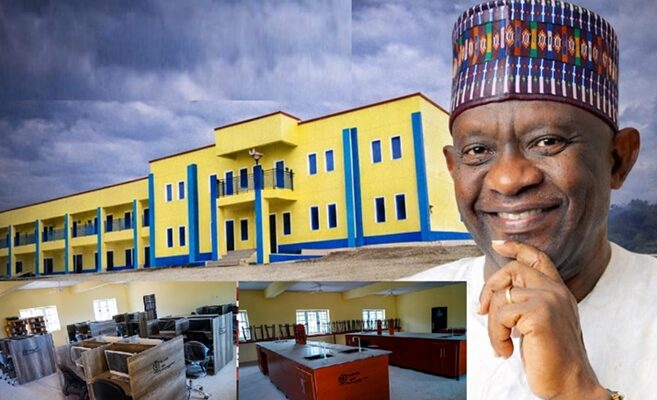
The facility was conceived to include well-ventilated classrooms, toilets, a laboratory and an information and communications technology centre.
Its importance extends beyond the building itself. Kogi State possesses considerable agricultural potential. Strengthening agricultural education can help produce technicians, entrepreneurs and extension personnel capable of improving food production and rural livelihoods.
A laboratory supports practical learning, while an ICT centre connects students to modern knowledge and technological developments. Together, these facilities can prepare young people for productive careers in agriculture and related industries.
This is particularly important at a time when Nigeria is searching for practical solutions to unemployment, food insecurity and rural poverty.
Supporting Healthcare Education
Senator Karimi has also reportedly donated N10 million to the Anglican Church Nursing School in Iyara.
Supporting nursing education creates professional opportunities for young people while helping to strengthen the healthcare workforce. This is especially important outside major cities, where communities frequently experience shortages of qualified health personnel.
A trained nurse earns a livelihood, but the value of that training extends much further. It is reflected in every patient treated, every emergency managed and every family supported through illness.
The intervention therefore connects education with two important development objectives: youth advancement and improved community healthcare.
Preparing Students for the Digital Age
One of the most important aspects of Senator Karimi’s educational interventions is the development of digital-learning and Computer-Based Testing facilities.
Nigeria’s examination system is becoming increasingly digital. JAMB examinations are already computer-based, while other examination and recruitment bodies are moving in the same direction.
This transition creates serious difficulties for students in communities where access to computers, electricity and reliable internet services remains limited. A student may understand the subject but still perform poorly because of unfamiliarity with the keyboard, computer or examination platform. Digital inequality can therefore become educational inequality.
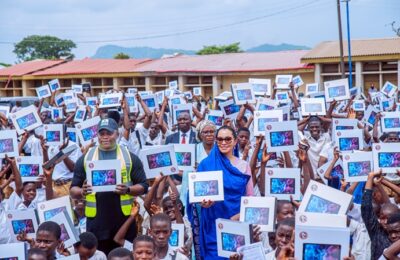
The 288-seat digital-learning and CBT centre at Titcombe College, Egbe, was established to help close this gap. The facility was equipped with hundreds of computers and supported by solar and backup-power infrastructure. It reportedly accommodated more than 1,200 candidates during the 2026 JAMB examinations.
The centre can reduce the burden of long-distance travel, transportation and accommodation for candidates and their families. It also allows students to become more familiar with computer-based examinations within their own environment.
Its value extends beyond examination periods. Such infrastructure can support computer training, online learning, teacher development, professional examinations and technology-based entrepreneurship.
Reports further indicate that three additional CBT centres have been earmarked for different parts of Kogi West. If completed and properly managed, they could significantly improve digital access across the senatorial district.
Reaching Different Communities
Kogi West consists of communities with different educational and economic needs. Effective representation must therefore spread opportunities across the district rather than concentrate every intervention in one location.
The documented projects in Egbe, Isanlu, Mopa, Kabba, Iyara, Iluke, Odo-Ere, Odo-Eri, Odo-Ape, Ife-Olukotun and other communities indicate a broad geographical reach.
The statewide bursary programme extended this inclusive outlook to students from Kogi East and Kogi Central.
Education offers common ground in a diverse state. Regardless of political affiliation, ethnicity, religion or place of origin, parents want their children to learn, succeed and enjoy better opportunities. When educational assistance reaches different communities, it promotes inclusion and gives more families a sense of participation in development.
The Next Opportunity
Senator Karimi’s educational interventions cover important stages of the learning process. Bursaries help students remain in school. Classrooms improve learning conditions. Laboratories promote practical education. ICT facilities develop digital competence, while CBT centres prepare candidates for modern examinations.
The next opportunity is to connect these investments more closely with employability, entrepreneurship and self-reliance.
Kogi State has many intelligent and energetic young people. Some possess university and polytechnic qualifications but remain unemployed. Others could not progress to tertiary education. Many women and young people are willing to work but lack the specialised skills and structured opportunities required to participate effectively in the economy.
A carefully designed skills and enterprise initiative would complement the educational foundation already established. It could help translate learning into employment, productive enterprise and sustainable livelihoods.
The full concept should be professionally developed and protected until the necessary technical and institutional arrangements have been concluded. What matters in the public discussion is the possibility of expanding an existing commitment to education into a broader platform for economic empowerment.
When Education Becomes a Legacy
No single individual can solve every educational challenge facing Kogi State. The task requires the combined efforts of government, families, communities, educational institutions, businesses and development organisations.
Public officials can, however, determine the priorities to which they devote their influence and resources. Senator Karimi’s bursaries, classroom projects, institutional assistance and digital-learning facilities show sustained attention to human development.
Their beneficiaries are not mere statistics. They are young men and women carrying personal ambitions and the expectations of their families. Among them may be future teachers, entrepreneurs, engineers, nurses, agricultural specialists, technologists and public administrators.
Senator Karimi’s educational interventions have opened doors for students, brought relief to families and strengthened institutions. Their enduring value lies not only in what has been provided today, but in the futures those investments are helping to make possible.
When leadership places knowledge and opportunity within the reach of the people, education becomes more than a public intervention. It becomes a legacy.
– Dr Williams Charles Oluwatoyin writes from Lokoja.