
For decades, the standard playbook of Nigerian public discourse has been simple: when the economy bites, look straight to Aso Rock. Today, as household budgets strain under the weight of necessary structural reforms—from the removal of the petrol subsidy to the unification of foreign exchange windows—the default response remains unchanged. President Bola Ahmed Tinubu bears the brunt of national outrage, cast as the sole architect of the citizen’s daily struggle.
Yet, this relentless focus on the center ignores a fundamental reality of our federal system. The federal government does not govern your local roads, your community primary health center, or the elementary school down your street. While public outrage remains fixated on Abuja, unprecedented financial resources are quietly pouring into state capital treasuries across the federation.
The numbers tell a staggering story. Following post-subsidy fiscal adjustments, monthly disbursements from the Federation Account Allocation Committee (FAAC) to sub-national governments have soared to levels never before seen in Nigerian history. Governors now command revenues that their predecessors could only dream of. Even local government councils, bolstered by recent legal pushes for fiscal autonomy, are receiving a historic windfall.

Where is the money going?
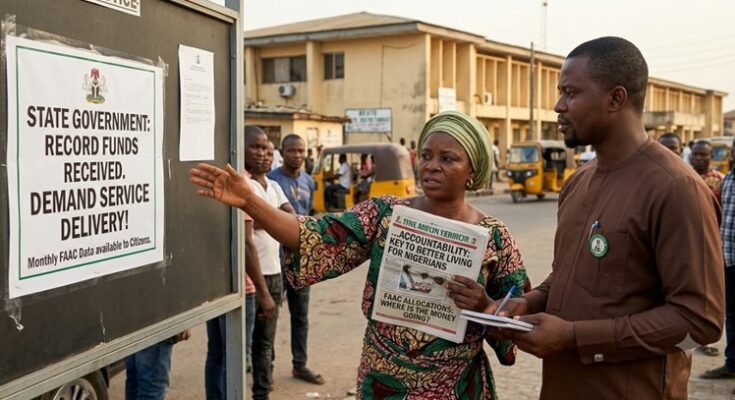
That is the question every Nigerian should be asking at the gates of their respective State Government Houses. It is an extraordinary irony that while state coffers overflow, the average citizen’s standard of living continues to slide. The contrast between record state revenues and declining public welfare beats reason. Yet, public anger is curiously misdirected, treating state governors as mere spectators rather than the primary custodians of local development.
Some critics fault the President for allowing these massive allocations to reach the states, suggesting the central government should somehow curb the payout. But such arguments betray a basic misunderstanding of the 1999 Constitution. The President lacks the legal or discretionary authority to arbitrarily withhold or cap constitutionally mandated FAAC allocations. The money pooled in the Federation Account does not belong to Aso Rock; it belongs jointly to the three tiers of government. Demanding that the President violate constitutional federalism by starving states of their legal due is not just misguided—it smacks of political mischief.
The truth, uncomfortable as it may be, is that our collective plight is largely a crisis of sub-national accountability.
Consider the primary responsibilities of state and local governments under Nigerian law: basic healthcare delivery, primary education, regional security support, intra-state transport infrastructure, and agricultural incentives. These are precisely the sectors that directly touch the day-to-day existence of the ordinary citizen. When a primary healthcare center lacks basic drugs, it is not an Abuja failure; it is a state house failure. When public school classrooms crumble, the governor—not the president—holds the purse strings to fix them.
For too long, state governors have enjoyed the ultimate political luxury: massive statutory revenues paired with zero public scrutiny. They operate in the shadow of the presidency, absorbing financial windfalls while allowing Aso Rock to take the political bullet for widespread poverty. High administrative overheads, opaque procurement processes, and unexamined security votes continue to swallow funds that ought to cushion the shock of economic reforms for vulnerable citizens.
It is time to change the national narrative.
If Nigerians genuinely want better living standards, the battleground for accountability must immediately shift from Abuja to state capitals like Ikeja, Kaduna, Port Harcourt, and Enugu. Citizens, civil society organizations, and the independent press must begin to track FAAC allocations with absolute rigor. State Houses of Assembly must be pressured to abandon their traditional roles as executive rubber stamps and begin exercising genuine oversight.
National economic policy sets the macro framework, but sub-national execution determines daily survival. Until we hold state governors strictly accountable for every naira disbursed from the Federation Account, complaining about national poverty is merely cutting leaves off a tree while leaving the roots untouched. The money to transform Nigerian lives is already in the states; it is up to us to demand that our governors use it.
– Ponle Adeniyi
ponleadeniyi457@gmail.com