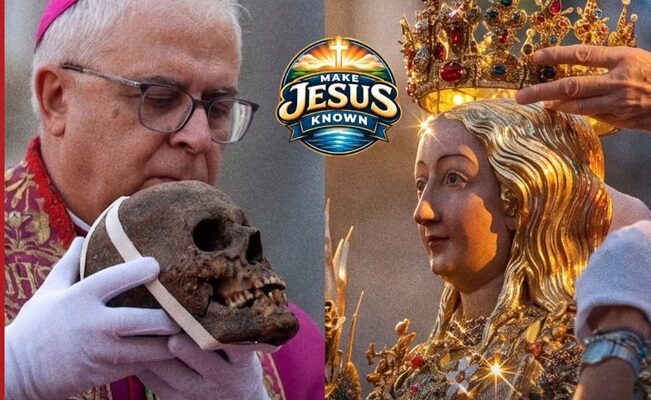

Catania, Sicily — Thousands of pilgrims gathered in Catania for a historic 7.5-kilometre pilgrimage marking the 900th anniversary of the return of Saint Agatha’s relics from Constantinople in 1126, in celebrations held under the pontificate of Pope Leo XIV.
The August 17 procession culminated in Piazza Duomo, where the relics were honoured during solemn celebrations led by Cardinal Pietro Parolin, the Vatican Secretary of State and papal legate appointed by Pope Leo XIV for the anniversary.
The occasion has also renewed an important theological question for Christians: Is remembering and honouring a saint the same as ancestral worship or idolatry? The Catholic understanding makes a distinction between venerating the memory and example of saints and offering worship, which belongs to God alone.

Saint Agatha, remembered as a third-century Christian martyr, was killed after refusing to renounce her faith during persecution under the Roman Emperor Decius. Pope Leo XIV described her martyrdom as a testimony to fidelity to Christ and a victory of grace over violence, faith over fear, and charity over death.
The historical significance of the celebration lies in the relics themselves. They were taken to Constantinople in the 11th century and returned to Catania on August 17, 1126, after approximately 86 years away. The 2026 celebrations therefore commemorate nine centuries of religious memory and devotion.
Yet Christian remembrance must never become a substitute for Christian worship. A saint may be remembered, respected and imitated; Christ must remain the centre. Scripture is unequivocal: “You shall love the Lord your God with all your heart.” — Mark 12:30.
This distinction matters especially in societies where ancestral veneration, traditional spirituality and Christian devotion sometimes overlap. Remembering the faithful dead is not automatically idolatry; the danger begins when created beings, objects or relics receive the worship, trust or ultimate allegiance that Christianity reserves for the Creator.
Cardinal Parolin emphasized that Saint Agatha’s strength came from her communion with Christ and her refusal to surrender her faith despite violence, threats and promises of power. Her story therefore points beyond herself—to the Christ for whom she was willing to suffer.
The lesson is bigger than Catania. A society that forgets courageous people loses moral memory; a church that remembers saints but neglects Christ loses theological direction. The purpose of Christian remembrance should therefore be imitation, not deification; inspiration, not idolatry; faithfulness, not superstition.
Shakespeare captured the paradox of human memory: “The evil that men do lives after them; the good is oft interred with their bones.” The Christian challenge is to ensure that the virtues of those who lived faithfully do not disappear with their graves, but continue through the lives of those who remember them.
Saint Agatha’s enduring legacy, therefore, should not merely be the preservation of relics but the preservation of character—courage under pressure, purity amid temptation, fidelity amid persecution and unwavering commitment to Christ. Pope Leo XIV similarly presented her as a witness calling Christians to evangelical consistency, hope and charity.
For Christians everywhere, the principle remains simple: remember the saints, learn from the saints, honour their testimony—but worship God alone. The safest compass is Jesus Christ, whose command remains unchanged: love God wholeheartedly and let every worthy human example lead back to Him.
Inah Stephen
– Inah Boniface Ocholi writes from Ayah – Igalamela/Odolu LGA, Kogi state.
08152094428 (SMS Only)