
The most sobering fact about evangelism is not that preaching the Gospel can provoke opposition. It is that the person who needs the Gospel may have far less time than we imagine. A sudden death can turn an ordinary morning into eternity. That is why the Great Commission cannot be treated as a ceremonial slogan.
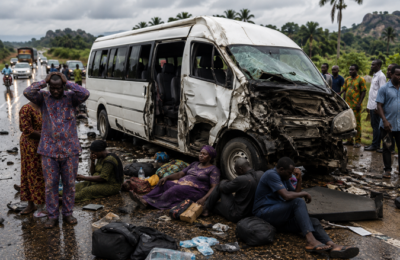
In Asaba, Delta State, a young Christian reportedly took a megaphone into the early morning streets to preach Christ. A serving police officer confronted her and ordered her to stop, reportedly accusing her of disturbing the peace. The confrontation escalated. She fled, leaving her megaphone behind. Later, tragedy struck: the officer was reportedly killed instantly after another officer inadvertently discharged a firearm at close range.
The most important question is not whether the officer expected death that day. He almost certainly did not. The question is whether he was spiritually prepared for the possibility that his earthly life could end without warning. None of us knows when ordinary time will become eternity. That uncertainty should make the Gospel urgent, not optional.

Jesus’ final command to His disciples was unequivocal: “Go ye therefore, and teach all nations.” The command did not come with a guarantee of comfort. It came with a promise of presence: “Lo, I am with you alway, even unto the end of the world.” Christianity therefore carries two realities at once: the mission can be costly, but the messenger is not abandoned.
We should resist turning this tragedy into a simplistic judgment about the dead. We cannot declare the eternal destiny of a particular person. Final judgment belongs to God. Nor should Christians interpret every tragedy as divine punishment for a particular act. Such claims exceed what the facts can establish. The proper response is humbler and more serious: death is unpredictable, and eternity demands preparation.
That distinction matters because evangelism without wisdom can become provocation. Christians are called to proclaim Christ boldly, but also peacefully, lawfully and intelligently. The Gospel does not require disorder. Courage is not recklessness. Faith does not abolish prudence. A mature evangelist knows when to speak, how to speak and how to preserve peace without surrendering the truth.
Yet prudence must never become an excuse for silence. The Church cannot wait for perfect conditions before fulfilling Christ’s command. If every Christian postponed witnessing until nobody could object, much of the world would never hear the message. The Gospel belongs in churches, homes, workplaces, schools, markets and every lawful public space where it can be proclaimed responsibly.
The deeper crisis is not that Christians sometimes face resistance. It is that many believers have become comfortable with postponement. We say we will evangelize tomorrow. We will reconcile tomorrow. We will call that person tomorrow. We will return to God tomorrow. But tomorrow is a promise nobody possesses. James called human life a vapour that appears briefly and disappears.
This is why the Great Commission is also a theology of urgency. Behind every face is a mortal life. Behind every argument is a person whose future is unknown. Behind every ordinary conversation may be an opportunity that will never return. Evangelism is not about manufacturing fear; it is about recognizing the eternal significance of human beings.
The preacher, however, must hear the message too. It is possible to preach salvation while neglecting one’s own soul. It is possible to carry a Bible while carrying unforgiveness. It is possible to speak about heaven while remaining spiritually unprepared. The messenger must therefore remain under the message. We cannot continually call others to repentance while refusing repentance ourselves.
The promise of Christ remains the foundation of Christian courage: “I am with you alway.” That promise does not mean that every missionary will escape danger or every believer will avoid suffering. It means that obedience does not occur in divine absence. The One who commissions His people accompanies them through the uncertainty of their assignment.
Sudden death should therefore produce neither superstition nor sensationalism. It should produce sobriety. We should become more deliberate about how we live, more compassionate toward those who disagree with us and more faithful in sharing the Gospel. We should also become more careful about judging the dead, because only God sees the heart and knows the final condition of a person’s soul.
The streets may become hostile. The microphone may be taken away. The preacher may be rejected. The message may be mocked. But the Church must not forget why it was sent. Christ did not commission His followers to collect applause. He commissioned them to bear witness.
So preach Christ—with courage, wisdom, humility and love.
Preach while your voice remains. Serve while your strength remains. Forgive while there is opportunity. Reconcile while the door is open. Tell people about Christ without assuming that you will always have another chance.
Because none of us knows when the ordinary will become final.
And when that hour comes, the only question that will matter is not how long we lived, how loudly we spoke or how many people knew our names.
It will be whether we were ready to meet God.
Until then, the command remains—and so does the promise:
“Lo, I am with you alway, even unto the end of the world.”
– Inah Boniface Ocholi writes from Ayah – Igalamela/Odolu LGA, Kogi state.
08152094428 (SMS Only)