
By Muhammed Sherifdeen Omeiza.
Africa has always been described as a continent of enormous potential. We hear about its young population, abundant natural resources, growing consumer market and strategic position in the global economy. But there is one part of this potential that deserves more attention: Africa already has the market. What it has struggled to build is the system that allows that market to work.
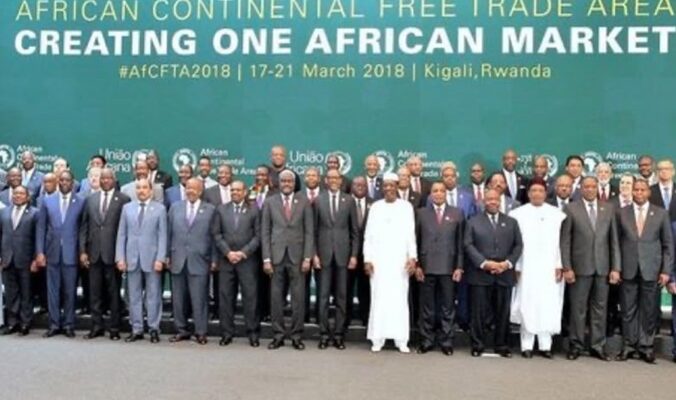
The African Continental Free Trade Area (AfCFTA) was created to address this problem. With 55 countries and a combined GDP of roughly $3.4 trillion, Africa possesses the foundation of one of the largest economic markets in the world. But the $3.4 trillion figure should not be misunderstood. It is the combined economic output of African economies, not money generated by AfCFTA. The real question is how much of this economic strength can be converted into greater trade, production, industrialisation and jobs within Africa itself.

For me, this is where the conversation about AfCFTA becomes more interesting. We often celebrate the agreement as if removing trade barriers automatically means African countries will begin trading more with one another. But free trade does not work simply because governments sign an agreement. A Nigerian farmer may have access to a market in Ghana, but what happens if transporting the produce there is too expensive? A manufacturer may want to sell to another African country, but what happens if electricity costs make production uncompetitive? A small business may have a good product, but what happens if the owner does not understand the customs requirements or cannot access the finance needed to expand production?
These are the realities that determine whether AfCFTA succeeds.
Africa’s problem is therefore not simply a lack of trade agreements. It is the gap between policy and implementation. Governments can negotiate at the continental level, but the real test begins when an ordinary producer tries to move a product across a border. If roads are poor, borders are slow, regulations differ and logistics are expensive, the existence of a free-trade agreement will not suddenly remove those problems.
There is also a deeper issue: what exactly are African countries producing for one another? For decades, many African economies have remained heavily dependent on exporting raw materials while importing finished products. This means that even when Africa participates in global trade, much of the higher value created from its resources happens outside the continent. AfCFTA presents an opportunity to change this pattern by encouraging African countries to produce, process and manufacture within the continent.
Take agriculture as an example. Africa has enormous agricultural potential, yet exporting raw agricultural commodities and importing processed versions of similar products does little to build industrial capacity. Instead of exporting raw cocoa and importing chocolate, why can more of the processing happen in Africa? Instead of exporting raw cotton, why can African countries not build stronger textile and garment industries that supply African consumers? Instead of simply producing agricultural commodities, why not develop regional value chains where production, processing, packaging and distribution happen across several African countries?
This is where AfCFTA could become genuinely transformative. It could give African industries something they have often lacked: scale. A company operating only within a small national market may struggle to expand, but access to a continental market of more than a billion people could create incentives for investment, manufacturing and innovation.
However, that opportunity will remain theoretical if Africa does not address its infrastructure deficit. Trade requires more than political agreements. It requires roads connecting markets, railways connecting production centres, ports that operate efficiently, reliable electricity for industries and digital systems that make cross-border transactions easier. It is difficult to build a competitive continental market when moving goods between neighbouring countries can be more complicated than exporting them outside Africa.
The same applies to non-tariff barriers. Even where tariffs are reduced, businesses can still face different standards, licensing requirements, customs procedures and regulatory systems. These barriers may not receive as much attention as tariffs, but for a small African business trying to enter another market, they can be just as important.
This is why I believe the success of AfCFTA should not be measured simply by how many countries have signed or ratified the agreement. We should ask more practical questions. Can a Nigerian business easily sell to Ghana? Can an agricultural producer in West Africa reach consumers in another African market without excessive costs? Can manufacturers source raw materials and components from other African countries? Can African businesses build regional supply chains instead of depending almost entirely on suppliers outside the continent?
If the answer to these questions is no, then Africa still has work to do.
AfCFTA has given Africa something important: a continental framework for economic integration. But a framework alone cannot transform an economy. The responsibility now is for individual countries to build the infrastructure, productive capacity, institutions and policies required to make continental trade a reality.
The irony is that Africa does not need to search for a market. It already has one. What it needs is the capacity to connect that market to its producers.
The $3.4 trillion figure therefore represents more than an impressive economic statistic. It represents an opportunity that Africa can either convert into productive power or continue to leave fragmented across national borders. The future of AfCFTA will depend not on what African leaders signed on paper, but on whether African businesses, farmers and consumers can actually feel the difference.
Africa’s next economic transformation may therefore not come from trading more with the rest of the world. It may begin with learning how to trade more effectively with itself.
– Muhammed Sherifdeen Omeiza is a Nigerian researcher and writer whose work explores the intersection of humanitarian action, human rights, gender equality and global governance. With a keen interest in public policy, democracy, and political economy, he examines how local experiences and global decisions shape humanitarian outcomes in times of crisis. His writings draw from African and international contexts, reflecting a commitment to justice, accountability, and people-centered governance in global affairs.
Email: sherifdeenmuhammed001@gmail.com