
A professor of Church History and Missiology has urged the Church and people of goodwill everywhere to pursue a broader mission — one built on human dignity, ethical leadership, peaceful coexistence and sustainable development.
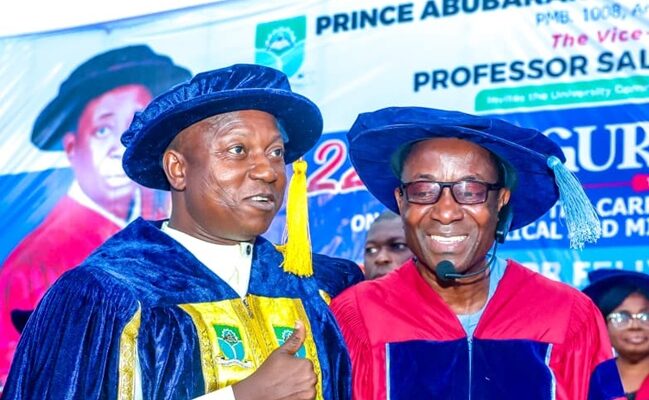
Professor Felix Ehimare Enegho made the appeal on Tuesday while delivering the 22nd Inaugural Lecture of Prince Abubakar Audu University (PAAU), Anyigba. The lecture, titled “On the Move for the Carpenter’s Son and Humanity in Historical and Missiological Contexts,” was held at the university auditorium and traced the historical development of Christianity, the growth of missionary work, and the continuing relevance of faith in tackling modern human challenges.
He told the gathering that the Church’s work goes beyond spreading the Gospel to include championing justice, peace, education, human development and responsible citizenship. He argued that genuine Christianity must leave a positive mark on both individuals and society.

He distinguished between the two disciplines central to his lecture: Church History, which he described as the systematic study of Christians’ activities and contributions through the ages, and Missiology, the academic study of the Church’s missionary mandate, methods and impact across cultures.
Tracing Christianity’s imprint on Nigeria, the professor pointed to its contributions to education, healthcare, national integration and leadership development, crediting early missionaries with laying groundwork for modern Nigerian society.
Effective evangelism, Enegho said, depends on sincerity of purpose, cultural sensitivity and genuine concern for people — with the Gospel communicated through both words and practical service that meets people’s physical and spiritual needs.
He also stressed the importance of language in missionary work, calling on religious organisations to preach in tongues that are accessible to the communities they serve, drawing a parallel to the biblical account of Pentecost.
On what drives church growth, he pointed to sound methodology, quality education, healthcare delivery, social welfare, vocational empowerment and community development as key ingredients for sustainable expansion of the faith.
The lecture also touched on Christian-Muslim relations in Nigeria, with Enegho calling for deeper interreligious dialogue, mutual respect and peaceful coexistence as essentials for national unity.
On governance, he said the Church has a continuing role to play in nation-building by promoting moral values, peace and responsible leadership, while urging citizens toward more active participation in the democratic process.
He further called on the Nigerian Church to better understand indigenous cultures and adapt Christian teaching to local contexts without diluting core Christian principles — a process he termed in-culturation.
Turning to the Catholic Charismatic Renewal, Enegho credited the movement with driving spiritual renewal through prayer, evangelisation and greater lay participation, while calling for stronger cooperation among different groups within the Christian community.
He also linked migration to missionary expansion, noting that the movement of peoples has historically shaped both the spread of Christianity and the development of nations.
On the environment, he warned that growing environmental degradation threatens humanity and challenged Christians to take seriously their role as stewards of creation through sustainable practices.
Enegho closed by describing “On the Move for the Carpenter’s Son” as a commitment that transcends religious identity — one rooted in integrity, service, hard work, justice and compassion. He added that education should shape graduates who combine professional competence with wisdom and moral responsibility.
Speaking earlier, the Chairman of the Inaugural Lecture Committee congratulated Prof. Enegho on the academic milestone and praised his scholarly contributions to Church History and Missiology.
PAAU Vice-Chancellor, Professor Salisu Ogbo Usman, described the event as another landmark in the university’s academic history, noting it was the fifth inaugural lecture delivered since he assumed office on February 11, 2026. He called the lecture’s theme timely, given its focus on compassion, justice, ethical leadership and human dignity, and highlighted the interdisciplinary reach of Church History and Missiology into sociology, philosophy, political science and communication.
Prof. Usman reaffirmed the university’s commitment to excellence in teaching, research and character development, thanked the Inaugural Lecture Committee for its work, and congratulated Enegho on his achievement.
The event’s highlight was the presentation of an inaugural lecture certificate, plaque and medal to Prof. Enegho. It drew members of university management, Senate, staff, students, religious leaders, traditional rulers, alumni and guests from within and outside the institution.