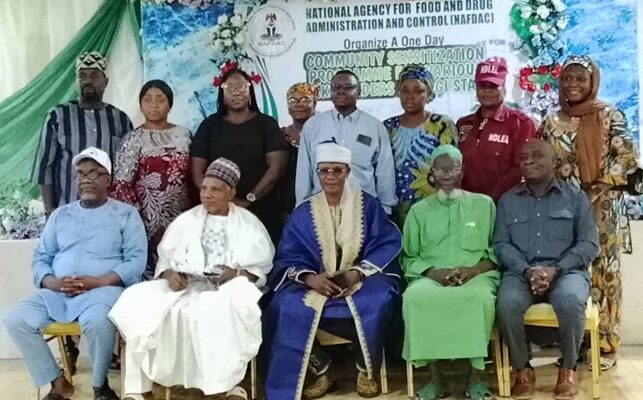

The National Agency for Food and Drug Administration and Control (NAFDAC) has called on communities to actively support pharmacovigilance efforts by reporting adverse drug reactions and avoiding unsafe medicines.
Pharm. Philip Benu, the Kogi Coordinator of NAFDAC, made the call on Thursday in Lokoja during a One-day Grassroots Community Sensitization Programme for Pharmacovigilance.
The coordinator emphasized the collective responsibility of ensuring medicine safety across Nigeria.

According to him, NAFDAC remains committed to safeguarding public health by ensuring that medicines, vaccines, medical devices, and other regulated products circulating within Nigeria are safe, effective, and of good quality.
He noted that despite strict regulatory measures, even safe medicines can sometimes cause unexpected adverse reactions, making pharmacovigilance a critical component of healthcare delivery and public safety.
The Coordinator expressed concern over the growing cases of self-medication, inappropriate drug use, and the circulation of substandard and falsified medical products within communities.
He added that many adverse drug reactions often go unreported because of limited awareness about reporting channels and procedures.
He explained that the programme was designed to deepen stakeholders’ understanding of reporting adverse drug reactions and medicine-related problems, improve collaboration between communities and NAFDAC, enhance early detection of safety concerns, and promote a culture where every report contributes to public health protection.
Participants were advised to use medicines only as prescribed by qualified health professionals, verify NAFDAC registration numbers before purchasing drugs, and avoid buying medicines from unauthorized sources such as open markets and hawkers.
The Coordinator also encouraged the public to promptly report any unusual reactions or problems noticed after taking medications through nearby health facilities, pharmacies, NAFDAC offices, the NAFDAC Med Safety Mobile App, e-reporting platforms, or the agency’s Adverse Drug Reaction (ADR) reporting forms.
He stressed that reporting adverse drug reactions not only protects individuals but also helps safeguard families, communities, and the nation at large.
Reaffirming NAFDAC’s commitment to public health, he called for stronger partnership and active participation from all stakeholders in ensuring that medicines available in communities remain safe, effective, and of high quality.
In her address, Oluwakemi Omeiza, the Chairperson of the International Federation of Women Lawyers, Kogi Chapter, commended NAFDAC for organizing the event, describing pharmacovigilance as crucial to preventing harm and protecting lives.
Omeiza said the safety of women, children and vulnerable persons remains a major concern for FIDA.
“We do not want people to become vulnerable because of what they consume.
“We are looking forward to a safer community for all,” she said.
She also called on members of the public to learn how to identify and report fake and substandard products in their communities.
In his remarks, HRM David Agbayi, the Etu of Adankolo, who represented the Maigari of Lokoja, praised NAFDAC for its efforts in monitoring, evaluating and withdrawing harmful products, especially drugs, from circulation to curb abuse.
Agbayi urged the Agency to intensify its enforcement activities by sanctioning drug dealers who operate outside the law across the state, noting that such actions would serve as a deterrent to others.
Also speaking, the Commander of the National Drug Law Enforcement Agency, (NDLEA) Kogi Command, Umar Yahuza, said fake drugs pose serious risks to public health, stressing the need for continuous sensitization campaigns.
Yahuza, who was represented by Zuwaira Abdullahi, assured NAFDAC of the Agency’s continued partnership in efforts to curb drug abuse and combat the circulation of fake drugs in Nigeria.
The sensitization programme brought together healthcare professionals, community leaders, market women, youth groups, media representatives, civil society organizations, and professional associations to strengthen awareness and collaboration on medicine safety.