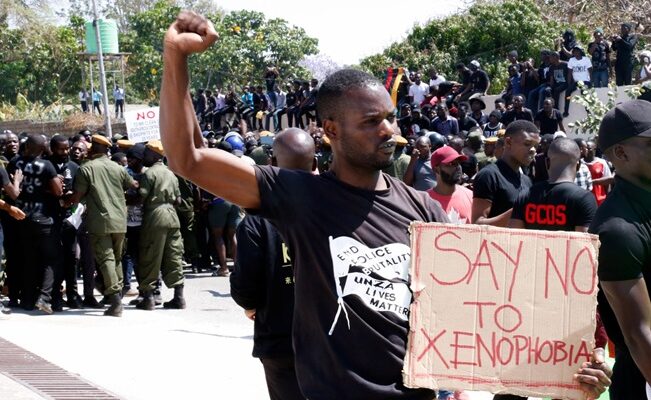

Xenophobic attacks are violence acts, harassment or intimidations directed at people because they are foreigners or perceived as outsiders. This is commonly triggered because of economic stress, high unemployment, political rhetoric and competition for resources, jobs and housing.
The attacks are usually based on prejudice rather than facts about the targeted groups. They target migrants, refugees, foreigners. They are singled out based on their nationality, ethnicity or language. The motivating factor is based on the beliefs that foreigners are taking their jobs, committing crimes, spreading diseases or changing local culture.
This takes the form of beating, killing, burning houses/shops, forced evictions and online hate campaigns.

Countries like Germany, South Africa have been notable for xenophobic attacks during periods of economic hardships where foreign owned shops or communities are targeted.
It is different from regular crime because the victims are chosen specifically because they are seen as foreigners.
In the case of South Africa
South Africa has had recurring waves of xenophobic violence since the end of apartheid, mostly targeting migrants from other African countries and Asia, the attacks are usually linked to unemployment, poverty with claims that foreigners take their jobs or commit crimes.
In 1994 and 1995 early post apartheid incidents
Soon after democracy began, an armed group gathered in Alexandra township, Johanesburg attacked migrants this is a pattern of blaming non nationals for social problems.
In May 2008 first nationwide wave of attacks
This started on the 12th may 2008 in Alexandra when local attacked migrants from Mozambique, Malawi and Zimbabwe, this also spread to Gantang, Durban, Capetown mpamalanga, North West and free state. This has resulted in death tolls of 62 people ,1400 arrest and people displaced with 42000 shattered in 95 make shifts sites. The victims included Zimbabwe, Somalia, Ethiopia and Mozambique.
In 2015 is the second wave. Widespread attacks across the country with foreigners shops looted and burned. Hundreds injured and displaced, government faced criticisms for poor accountability suspects were often released without change.
In September 2019, protests and mob violence attacks non nationals in multiple cities chanting anti foreigners slogans. Thousands of foreign owned businesses and homes destroyed. At least 18 foreigners were killed though the government initially said 10 of 12 dead were South Africans.
Victims describe their beatings and have been told they are foreigners, they should go home.
In 2021 Operation Dudula and ongoing tension
Vigilante group embarked on operation Dudula launched in 2021 a summit calling for mass deportations of undocumented migrants
Groups block immigrants from healthcare, raid foreign owned shops and use Dudula to push out
Recent flare ups continue in 2026, Kenya, Malawi, Lesotho, Zimbabwe, Ghana and Nigeria warned citizens or facilitated returns due to attacks.
Ghana protests after video showed a Ghanaian being harassed in kwazulu natal. Migrants from Zimbabwe, Mozambique, Malawi, Lesotho, Nigeria, Somalia, Ethiopia, DRC and Ghana including Pakistan. Bangladeshi shopkeepers, documented and undocumented migrants, refugees and asylum seekers were all affected.
Socio economic implications
Xenophobic attacks don’t just hurt the victims, it ripple through the whole economy and social fabric of the host country.
Economic implications
Foreign owned shops stalls and small businesses are often limited burned or forced to close. Refuge entrepreneurs lose stock, premises and customers overnight, many cannot re- establish and have to co- own with others to survive.
South African businesses also get caught up when violence spreads and those with supply / buyers links have to migrate businesses and also suffer spill over losses.
Reduced economic growth and investment
Migrants drive economic prosperity through jobs, remittance and investment in health care / education when they flee or go into hiding the host country loses
Labor skill and entrepreneurial activity
Attacks signed instability during covid 19 as xenophobic responses were linked to trade, small businesses and Fortune of 500 companies
Unemployment and poverty loops
Foreigners are often scapegoated for unemployment but attacks destroy jobs and reduce economic activity making unemployment worse
Exclusion from job reduces migrants ability to pursue economic activity, increase poverty and vulnerability
Impact on migrants and labor
Violence reduces migration intension after south Africa 2028 attacks Mozambiqans household heads intentions to migrate face from 37% to 33% especially for those with Young’s kids and no social networks
That means fewer workers in sectors like Agriculture, construction and informal trade that rely on migrant labor.
Social implications
Physical and psychological harm
Victims face death, injury, anxiety, depression and trauma
Families get separated, kids from parents, husband from wives and homes / belongings are abandoned during flights.
Isolation and loneliness make foreigners easy targets for radical group recruitment
Social comprehension break down
Inequality plus xenophobic increase hostility, reduce trust and lower social capital
Displaced aggressions means people devalue other weaker than to reassert status
Places with high Inequality see more racists, sexists and xenophobic views.
Integration and service delivery suffer
Xenophobic violence hinders refugees, socio economic integration
Blaming foreigners for poor services delivery is scapegoatism but the real issue is chronic delivery failures
National and international implications
Diplomatic and trade damage
Xenophobic gave the country a bad name on the continent
After 2015 attacks, South Africa appeared before the AU peace and security council alongside terrorists and coup leaders.
A boycott of business by other African nations with South Africa, Nigeria, Zimbabwe, Zambia, Malawi and Ethiopia saw reprisals or boycotts South African businesses aboard. South African were threatened for being South Africans abroad.
Security and cost to Government
Government interventions are often In effected which makes attacks worse
Police raids targeting foreign businesses can be abusive and arrests rarely lead to convictions
Vigilante group line operation Dudula blocks immigrants from healthcare and advocate their expulsions
In conclusion, xenophobic attacks create a cycle of economic stress, blame foreigners, encourage violence, destruction of businesses and lost investments, diplomatic fall out and also stress.
– Benjamin Ibrahim writes from Lokoja, Kogi state.
+2348069596250