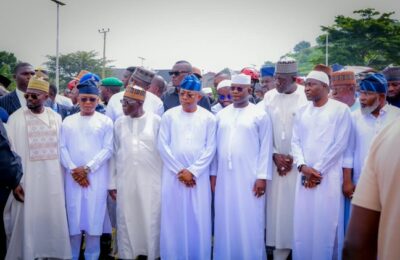

Distinguished Senator Sunday Steve Karimi (DSSK) stood alongside Prince Olatunji Olusoji at the All Progressives Congress National Convention – two respected voices from Kogi West reflecting different readings of the same political moment.
One perspective is anchored on immediacy. The other counsels patience.
Senator Sunday Karimi has aligned with 2027 as a moment to act. Prince Olatunji Olusoji has suggested a longer horizon toward 2031. Both positions speak to strategy. But only one aligns with the current realities of political momentum.

The difference is not personal. It is structural.
Politics does not reward deferred strength. It rewards activated capacity. When organisation is built, alliances are formed, and momentum is established, the system expects movement, not pause. Political capital is not something that can be stored without consequence. It either compounds through use or declines through delay.
The argument for 2031 assumes that what is being built today can be preserved untouched for years and then reactivated at will. Experience shows otherwise. Structures weaken when not deployed. Alliances shift. Energy disperses. And the landscape evolves in ways that cannot be reversed.
More importantly, deferral introduces a new variable: incumbency.
If Kogi West does not engage decisively in 2027, another political bloc will occupy that space. Governance between 2027 and 2031 will inevitably reshape the terrain, through influence, institutional positioning and the consolidation of loyalty structures. By the time 2031 arrives, the argument will no longer be about opportunity, but about overcoming an already established order.
This is the central reality that cannot be ignored.
What distinguishes Senator Karimi’s approach is not merely ambition, but alignment with present conditions. His role within the national APC convention structure, his active coalition-building across Kogi East and West, and his demonstrated capacity for mobilisation all point to a strategy rooted in immediacy and execution.
These are not permanent assets. They are time-sensitive advantages that must be engaged while they remain active.
With Kogi East holding 9 Local Government Areas, West 7, and Central 5, alignment is not optional—it is the pathway to victory.
That posture is not theoretical. It is consistent with what Senator Karimi has already communicated at the grassroots level.
Speaking during Kabba Day, he made his position unmistakably clear:
“Let me tell you, you elected me to represent you. We are reaching out to our people in the East and we are working together. I can tell you confidently: the people in the East, they are ready to work with us.
The ball is in our court. Power is never served; you take power.”
The statement reflects not aggression, but political clarity, the understanding that power in a competitive system is secured through organisation, alignment and decisive action, not hesitation.
Prince Olatunji Olusoji’s position reflects caution. Senator Karimi’s position reflects activation. Both have their place in political thought. But history tends to favour those who move when conditions are most favourable, not those who wait for a more convenient future.
For Kogi West, this is a defining moment.
The region has before it a window shaped by momentum, alignment and organisational readiness. The decision is whether to engage that window fully, or to step back and trust that a similar alignment will re-emerge years later under entirely different conditions.
That is the real choice.
Senator Sunday Steve Karimi’s posture suggests that the time for positioning has passed. The time for execution has arrived.
And in politics, moments like this rarely wait twice.
— Adamu A. Yusuf writes from Abuja, Nigeria.
For: Kogi Equity Alliance