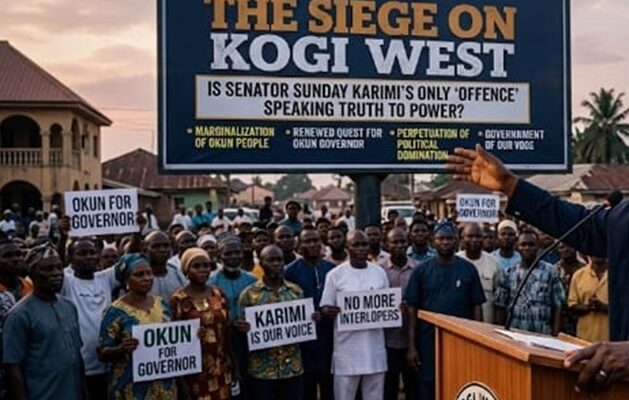

Since 2016, Kogi West has served as a high-stakes political laboratory. It is a region where the democratic will of the people often takes a backseat to clinical experiments in imposition, coercion, and the strategic recycling of mandates. Nowhere is this more evident than in the battle for the Kogi West senatorial seat—a position that has become the frontline for the soul of Okunland.
The current target of these political maneuvers is Senator Sunday Karimi. But as the drums of the next election cycle begin to beat, a critical question arises: What exactly is his offence?
To understand Karimi’s current predicament, one must look at the precedent of interference that has defined the district:

Eyewitnesses still recall the events at the Olonijola Event Centre in Kabba, where the democratic process was effectively suspended. Dr. Toyin Akande was brazenly stripped of a mandate through the active connivance of political appointees, clearing the path for Senator Smart Adeyemi.
Adeyemi was not merely elected; he was deployed as a tactical foil to Senator Dino Melaye. While Melaye initially won the popular vote, judicial intervention eventually handed the seat back to the establishment’s preferred candidate.
By 2022, the cry against the marginalization of the Yagba Federal Constituency became too loud to ignore. Senator Sunday Karimi emerged as the face of this equity movement, securing both the primary and the general election.
The relationship between Karimi and the “powers that be” did not sour because of a failure in representation. By most metrics, Karimi has been a vocal and effective representative. His true “offence” appears to be his refusal to remain silent on the Kogi Governorship question.
Karimi has dared to champion the quest for an Okun Governor. In the eyes of those promoting the ambiguous “16-16-16” argument (a proposal suggesting power should reside in each zone for 16 years), Karimi’s advocacy is viewed as a sacrilege.
“Can a system that reneged on the 2019 promise of an Okun governor be trusted to fulfill a new promise after Governor Ahmed Usman Ododo’s tenure? Without a concrete, signed agreement, a ‘promise’ is merely a placeholder for further marginalization.”
The frustration within Kogi West is rooted in a glaring lack of equity. The arguments used to justify the current status quo are often contradictory:
Kogi East dominance was widely condemned as unfair during their 16-year tenure. If 16 years was unfair for the East, how is its replication in the Central justified?
Despite being a cornerstone of the state’s intellectual and economic fabric, the Okun people have been shut out of the governorship since the state’s inception.
The recent APC State Congress further fueled fears that the system is being rigged for the “perpetuation of political domination,” rather than a rotational shift toward the West.
There is a bitter irony at play in Kogi politics. The external forces currently attempting to dictate who represents Kogi West are often the same powers who find themselves helpless in their own senatorial districts. They cannot determine their own local representatives, yet they seek to act as “kingmakers” and “gatekeepers” for the Okun people.
Senator Karimi’s crime, it seems, is his insistence on being a representative of his constituents rather than a vassal of the establishment.
As the next election cycle approaches, the pattern is repeating. The “powers” have resolved to truncate Karimi’s second term—not because he failed to deliver, but because he refused to follow a script written outside of Kogi West.
Rewarding Karimi with a second term is no longer just about consolidating his legislative achievements; it is about asserting the sovereignty of the Kogi West electorate. Until the district puts a stop to the meddlesomeness of “interlopers,” the Okun people may find their political and economic sojourn in the wilderness extended indefinitely.
– Ponle Adeniyi
ponleadeniy457@gmail.com