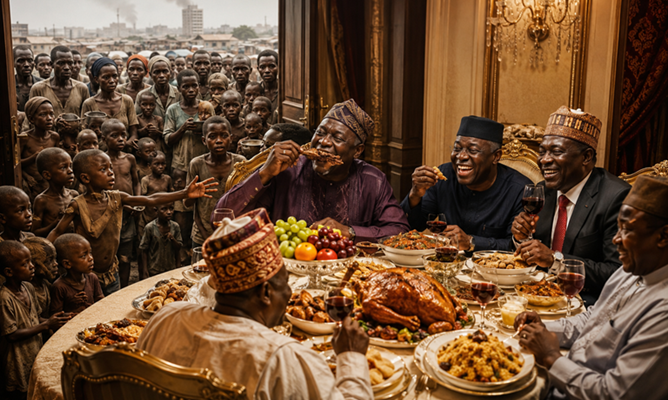

Civilisations rarely collapse because they run out of resources. They collapse when power loses its conscience. The first warning is not an empty treasury but a full banquet table inside the palace while hunger prowls the streets like a restless predator. A nation reaches moral bankruptcy when its ruling class feasts beneath chandeliers as its citizens negotiate with despair over the price of bread. That is not governance. It is political cannibalism dressed in ceremonial robes.
The architecture of modern politics has become a cathedral of privilege. Public office, once imagined as a covenant of sacrifice, has mutated into a marketplace where influence is traded like precious metal and authority is consumed as personal inheritance. Convoys slice through traffic like imperial processions. Official residences rise like fortresses above neighbourhoods where darkness arrives before electricity. Budgets swell with astonishing confidence while household incomes wither into statistical footnotes. The republic is no longer rowing in the same direction. One class sails aboard luxury liners while the other struggles to stay afloat on splintered rafts.
History has always issued the same verdict against insulated elites. Every empire that mistook comfort for permanence eventually discovered that neglected citizens possess long memories. Rome did not decay in a single night. It was hollowed out by a governing class that mistook extravagance for stability. France did not erupt because bread disappeared alone. It erupted because privilege refused to acknowledge hunger. Every civilisation reaches its breaking point when the palace ceases to hear the sound of empty stomachs beyond its walls.

The tragedy is deeper than economic inequality. It is ethical estrangement. Statesmen increasingly inhabit a political ecosystem that bears little resemblance to the lives of ordinary people. Inflation becomes an abstract economic indicator rather than the difference between eating and starving. Fuel prices become policy variables rather than daily hardship. Healthcare becomes a budgetary line instead of a mother watching her child die because essential medicine is unaffordable. Distance does not merely separate rulers from citizens. It anesthetises compassion.
Nothing corrodes a republic more rapidly than the normalisation of excess. Luxury financed by public suffering is not development. It is democratic decay wearing an expensive suit. Every unnecessary convoy becomes a procession through the cemetery of abandoned promises. Every extravagant allowance echoes through classrooms without teachers, hospitals without equipment, roads without maintenance, and communities without hope. The arithmetic is brutally simple. Public extravagance always produces private deprivation.
The greatest deception of political privilege is the illusion of permanence. Marble walls cannot insulate governments from public disillusionment. Bulletproof vehicles cannot outrun economic despair. Protocol cannot suppress history. Nations rarely implode because citizens demand too much. They unravel because leaders mistake silence for satisfaction and obedience for legitimacy. Hunger whispers before it shouts, but when it finally acquires a voice, no fortress is impregnable.
A genuine statesman understands that authority is not a throne but an altar. Leadership demands subtraction before addition, restraint before reward, and sacrifice before celebration. The highest office in any republic should be the loneliest place in government because it carries the heaviest moral burden. Instead, too often it has become the most comfortable address in the nation.
The measure of a republic is neither the height of its government buildings nor the elegance of its state banquets. It is the dignity of the woman selling vegetables under the scorching sun, the graduate searching endlessly for work, the farmer whose harvest cannot feed his family, and the child whose future depends upon decisions made by people he will never meet.
No nation is destroyed first by external enemies. It is consumed from within when privilege devours purpose, when opulence eclipses obligation, and when the banquet of power becomes more sacred than the bread of the people. History buries such governments beneath a single, unforgiving epitaph: they ate while the nation starved.
– Inah Boniface Ocholi writes from Ayah – Igalamela/Odolu LGA, Kogi state.
08152094428 (SMS Only)