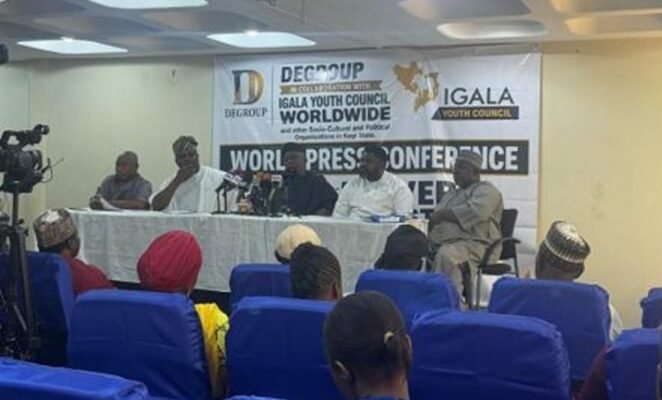

A coalition of socio-cultural and political organisations in Kogi State, led by De Group in collaboration with the Igala Youth Council Worldwide, has strongly rejected any alleged agenda to retain governorship power in a single senatorial district for 16 consecutive years, insisting that power must rotate immediately in the interest of equity, justice, and fairness.
Addressing a world press conference in Lokoja on Wednesday, the coalition—comprising representatives from Kogi East, Kogi Central, and Kogi West—declared that no senatorial zone is superior to another or created to govern indefinitely while others remain sidelined.
In a joint text signed by the Spokesperson of De Group, Col. Kabiru Ndamadu (rtd), and the National President of the Igala Youth Council Worldwide, Hon. Onogu Collins Monday, the groups noted that Governor Ahmed Usman Ododo assumed office on January 27, 2024, immediately following the eight-year tenure of his predecessor, former Governor Yahaya Bello, who hails from the same zone.

According to the coalition, extending that zonal hold to 16 unbroken years is undemocratic and unacceptable to the people of the Confluence State.
The groups dismissed claims of financial constraints by the state government, citing substantial inflows from the Federation Account Allocation Committee (FAAC) and Internally Generated Revenue (IGR). According to figures presented at the briefing, Kogi State received ₦385.27 billion in FAAC allocations between January 2024 and August 2025 alone, comprising ₦212.45 billion for the state government and ₦172.82 billion for the 21 local government areas. They further noted that state FAAC receipts stood at ₦127 billion in 2024, ₦270 billion in 2025, and ₦151.93 billion between January and August 2026, while annual IGR surged from ₦27.73 billion in 2024 to ₦43.94 billion in 2025, bringing combined inflows to well over ₦450 billion within 20 months.
Despite the surge in revenue, the coalition accused the state administration of failing to translate the funds into tangible development or improved welfare for residents. They alleged that for over nine years, spanning the previous and current administrations, civil servants in the state have been denied promotions with corresponding salary increments, leaving workers stagnant on the same grade levels amid rising living costs. The groups also decried the absence of mass recruitment of youths, teachers, and healthcare personnel, accusing the government of running a selective patronage system where contracts, appointments, and empowerment programmes are restricted to a small circle of loyalists while rural roads, primary schools, and hospitals remain in poor condition.
Raising concerns over the state’s debt profile, the coalition stated that Kogi State borrowed ₦95.8 billion between January and June 2026—comprising ₦75 billion in external loans and ₦20.8 billion in domestic borrowing—while projecting under its 2025–2027 Medium-Term Expenditure Framework (MTEF) that over 80 per cent of IGR, or roughly ₦27.9 billion out of ₦35.1 billion in 2025, would go toward debt servicing.
On the political front, the groups condemned what they described as the systematic victimisation and political exclusion of prominent advocates of power rotation across the state. Specifically, they cited the recent Federal High Court judgment nullifying the candidacy of the Senator representing Kogi West, Sunday Karimi, as well as the alleged disenfranchisement of the Senator representing Kogi East, Jibrin Isah Echocho, warning that the suppression of strong voices from the two districts threatens democratic stability ahead of future elections.
They urged President Bola Ahmed Tinubu, the National Assembly, the Independent National Electoral Commission (INEC), security agencies, and the international community to take note of developments in the state.
Turning to grassroots governance, the coalition called on the Economic and Financial Crimes Commission (EFCC) to conduct a comprehensive forensic audit of all local government allocations from January 27, 2024, to date and probe former council chairmen across the 21 local government areas. Citing July 2026 allocations totalling ₦16.44 billion—including over ₦1 billion for Okene, over ₦900 million for Dekina, ₦785.25 million for Yagba East, ₦783.19 million for Kabba/Bunu, ₦770.85 million for Yagba West, and ₦745.86 million for Ijumu—as well as an independent review of five councils by ATI and CODWA, the groups alleged that billions of naira meant for grassroots development remain unaccounted for despite salaries consuming between 15 and 26 per cent of receipts.
Concluding their address, the coalition issued a 12-point demand calling for an immediate end to any 16-year tenure elongation plan, a shift of power across zones, immediate promotion and salary adjustments for civil servants, mass employment for youths, teachers, and health workers, the settlement of outstanding pensions and gratuities, full financial autonomy for local governments in line with the Supreme Court ruling, and a full public accounting of state IGR and council allocations.