
By Innocent Nzeke Waniko
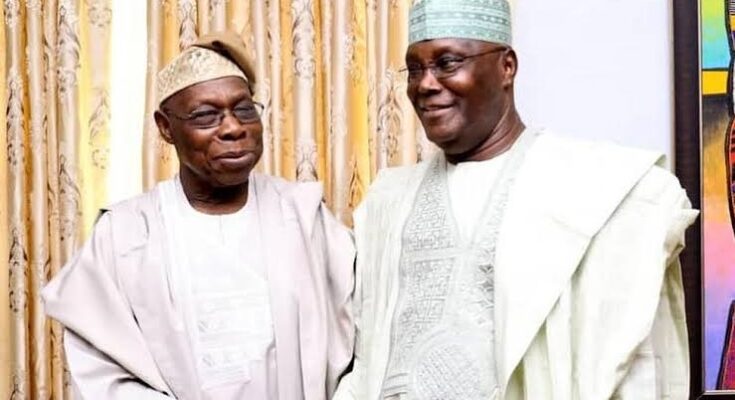
There are political disagreements that history eventually absorbs, and there are others that appear to acquire a life of their own. Nearly two decades after Olusegun Obasanjo and Atiku Abubakar left office as President and Vice-President of Nigeria respectively, their political quarrel remains remarkably alive.
The latest exchange is another reminder that the dispute between the two men was never merely about policy, governance or the ordinary disagreements that occur between a president and his deputy. There appears to be something much more personal beneath the surface.

For years, Obasanjo has described Atiku in deeply unflattering terms—disloyal, corrupt, untrustworthy and, in effect, one of the great mistakes of his presidency. Atiku, for the most part, has resisted the temptation to answer every accusation with an equally personal counterattack.
That restraint appears to have changed somewhat following Obasanjo’s latest intervention.
Through his media aide, Atiku responded forcefully, reminding Nigerians of episodes in which he says he assisted Obasanjo politically, including during the transition to civilian rule following Obasanjo’s release from prison. More significantly, the response placed the old third-term controversy squarely at the centre of the disagreement.
And perhaps that is where the ghost of this relationship truly resides.
The ghost that never left
The third-term controversy remains one of the most consequential political episodes of Nigeria’s Fourth Republic.
In 2006, widespread speculation grew that President Obasanjo was seeking to alter the constitutional limit on presidential tenure. What made the controversy particularly combustible was the refusal of the Presidency to decisively kill the speculation at the beginning.
Contemporary reporting captured the problem: Obasanjo and his supporters were publicly careful neither to confirm nor categorically deny the existence of a third-term project, allowing speculation to grow into a national political crisis.
This matters because a simple, unequivocal presidential statement could probably have changed the political atmosphere considerably:
I am not seeking a third term. I will leave office in 2007.
That sentence, delivered firmly and repeatedly at the beginning of the controversy, would have removed much of the oxygen from the allegation.
Instead, the uncertainty persisted until the controversy became a major struggle involving the National Assembly, governors, political parties and competing factions within the political establishment.
Eventually, the constitutional amendment failed.
And Atiku was not a passive observer.
He openly opposed tenure elongation, describing it as morally wrong and unconstitutional. His opposition became one of the major political obstacles to the success of the third-term project.
Whether one believes Atiku’s opposition was motivated purely by constitutional principle, presidential ambition, political survival, or a combination of all three is a legitimate subject for debate.
But one fact is difficult to dispute: Atiku became one of the most important political obstacles to the success of the third-term project.
That may explain why, nearly twenty years later, the subject still appears to possess extraordinary emotional power in the relationship between the two men.
Atiku may have been disloyal. But was the third term the unforgivable offence?
Atiku does not need to be portrayed as a saint for one to question the longevity of Obasanjo’s hostility towards him.
Atiku has had his own controversies. His political career has attracted serious allegations and criticisms, and his ambitions have placed him at odds with several political leaders. There is therefore no compelling reason to sanitise his record merely because one is examining Obasanjo’s conduct.
But two wrongs do not make a right.
If Atiku was indeed disloyal as Vice-President, Obasanjo had every constitutional and political right to confront him. If Atiku acted against the President’s interests, Obasanjo was entitled to expose it. If there were genuine corruption allegations, they could have been investigated and prosecuted through the appropriate institutions.
Yet it is important to distinguish allegations from established wrongdoing. Atiku’s chairmanship of the National Council on Privatisation generated years of political controversy and accusations that he had improperly influenced the privatisation of public assets. But despite those allegations, Atiku was not prosecuted for corruption arising from his chairmanship of the NCP, nor was he convicted by a court over the privatisation programme.
That distinction matters.
A politician can be controversial without being criminally convicted. A government policy can be criticised without the individual who supervised it being proven corrupt.
The PTDF affair
The PTDF affair deserves a brief distinction of its own. The allegations against Atiku were not simply political whispers; they were subjected to formal investigation during the Obasanjo administration. The EFCC, under Nuhu Ribadu, investigated the matter, and President Obasanjo subsequently constituted an administrative panel headed by then Attorney-General and Minister of Justice, Bayo Ojo. The process produced findings adverse to Atiku.
But the matter did not end there. The findings were challenged in court, and in November 2006, a Lagos State High Court set aside the Administrative Panel’s report, holding, among other things, that the panel’s proceedings amounted to an infringement of judicial powers and a gross abuse of executive power. The court’s decision effectively stripped the report of the legal force the government sought to attach to it.
This does not mean that the courts conducted a fresh trial and declared every allegation against Atiku factually untrue. That would be an overstatement. But it does mean that a significant official indictment relied upon by the Obasanjo administration was judicially nullified.
That history should give even the most persistent critic pause. If allegations of corruption against Atiku were investigated under the government of which Obasanjo was President, and the principal administrative findings were subsequently struck down by the courts, it would seem reasonable for the former President, as an elder statesman, to exercise some restraint before repeatedly presenting those allegations as settled fact. Unless, of course, he no longer has confidence in the very judicial system whose authority he exercised as President.
There is a difference between saying, “I remain convinced that Atiku acted improperly,” and saying, in effect, “Atiku is corrupt” as though the matter had been conclusively established. The former is a political judgment; the latter carries the weight of an adjudicated fact. Nearly twenty years after the events, that distinction matters.
When a political disagreement survives for almost two decades and repeatedly resurfaces in increasingly personal language, one begins to wonder whether the issue has moved beyond political accountability into something more enduring.
The latest controversy is revealing.
Obasanjo recently alleged that Atiku gave the late former Speaker of the House of Representatives, Ghali Umar Na’Abba, five million naira to initiate impeachment proceedings against him. Atiku has denied the allegation and criticised the decision to make such a serious accusation against a deceased man who can no longer respond for himself.
Whatever the truth of the allegation, the episode illustrates how far back the political score-settling continues to reach.
Na’Abba is dead.
Obasanjo is 89.
Atiku is 79.
Yet the political quarrel of 2003–2007 continues to be fought as though the protagonists are still sitting in the Presidential Villa.
At some point, history must become more important than grievance.
A president’s legacy is bigger than his quarrel with his deputy
Obasanjo’s place in Nigerian history is substantial and cannot reasonably be reduced to the third-term controversy.
He was a military head of state. He returned as a civilian president in 1999. His administration presided over important economic and diplomatic developments, including Nigeria’s debt-relief negotiations. He remains one of the most internationally recognised Nigerian statesmen alive.
That legacy should therefore be large enough to withstand criticism.
Indeed, Obasanjo himself has repeatedly denied that he ever sought a third term. In 2023, he said that he never asked for one and argued that, had he genuinely wanted it, he would have been capable of obtaining it.
But history does not always preserve political events according to the intentions of their participants. It preserves them according to the public record, the actions taken, the perceptions created and the consequences that followed.
The third-term episode therefore remains a sore point in the narrative of the Obasanjo presidency—not necessarily because it defines his entire legacy, but because it introduced a question that never completely disappeared:
Did a president who had spent years presenting himself as a defender of democratic governance contemplate extending his own tenure beyond the constitutionally prescribed limit?
That question will remain part of the historical conversation regardless of how strongly Obasanjo rejects the allegation.
And perhaps that is why the subject remains so emotionally charged.
The burden of unforgiveness
There is another dimension to this matter that deserves consideration.
Over the years, a recurring public perception has attached itself to Obasanjo: that he can be remarkably unforgiving towards those whom he believes have crossed him.
That perception is not entirely confined to his political adversaries. Wole Soyinka, who has known Obasanjo personally and has at various times described him as a friend, offered a striking assessment of the former president in his memoir, You Must Set Forth at Dawn. Soyinka described Obasanjo as “basically insecure and thus pathologically in need of proving himself, preferably at the expense of others,” and characterised him as “intolerant of criticism.”
These are strong words, but they are significant precisely because they came from someone who knew Obasanjo personally and was not merely commenting from the distance of partisan politics. Soyinka’s assessment does not establish that every criticism directed at Obasanjo is justified, nor does it diminish the former president’s considerable place in Nigerian history. But it does provide an important lens through which the persistence of some of Obasanjo’s political antagonisms can be considered.
A disposition towards intolerance of criticism, when combined with a strong sense of personal rivalry and a tendency to remember political injuries, can make the passage of time insufficient to extinguish an old dispute. It may help explain why some political disagreements survive long after the immediate circumstances that produced them have disappeared.
And this is where the question becomes less about Atiku and more about Obasanjo himself.
This is not a new perception. The late Sunday Awoniyi, himself a prominent Nigerian statesman and opponent of the third-term project, publicly appealed to Obasanjo during the controversy to simply declare that he was not interested in a third term and return to Otta after his tenure.
Other accounts have similarly portrayed Obasanjo as a man who remembers political injuries for a very long time.
One particularly striking account concerns the late Lieutenant General Victor Samuel Leonard Malu and Major General Felix Mujakperuo.
In In the Name of Victor, Malu recounted an incident following President Obasanjo’s visit to Monrovia in July 1999. Mujakperuo, who was then serving as Force Commander of ECOMOG, was among those who received and attended to Obasanjo during the visit.
According to Malu’s account, immediately after Obasanjo returned to Nigeria, he directed Malu, who was then Chief of Army Staff, to retire Mujakperuo.
Malu was reportedly puzzled by the instruction. He therefore sought clarification from Mujakperuo as to whether anything had happened during the President’s visit.
Mujakperuo then reportedly told him that he had served as Chairman of the Special Military Tribunal that sentenced Olusegun Obasanjo to imprisonment following the 1995 alleged coup plot.
Malu’s reaction, as recounted in his book, was one of bewilderment. He reportedly wondered how Obasanjo could still hold on to such an old grievance after surviving prison and emerging into national leadership.
The episode is especially striking because of the symbolism surrounding it. A man who had once been imprisoned, who had subsequently returned to the presidency and who frequently spoke of providence and divine intervention in his life, was being portrayed as still capable of remembering an injury from years earlier.
The account should, of course, be understood as Malu’s recollection and interpretation of events rather than as conclusive proof of Obasanjo’s personal motive. But it contributes to a long-standing public perception of Obasanjo as a man who can carry political grievances for an extraordinarily long time.
And that perception brings us back to Atiku.
The dignity of letting go
Nobody is suggesting that Obasanjo should forget history.
Nor should he.
History must remember political betrayal, corruption, constitutional controversies, abuse of power and every other wrongdoing committed by public officials.
But remembering is not the same thing as remaining consumed by an old grievance.
A statesman is not judged only by how effectively he defeated his enemies. He is also judged by whether, after leaving office, he acquired the wisdom to rise above them.
There comes a stage in life when the ability to forgive becomes more dignifying than the ability to retaliate.
At 89, Obasanjo has lived through virtually every major political chapter of modern Nigeria. He has witnessed military coups, civil war, military dictatorship, imprisonment, democratic transition, presidential power and the emergence of several generations of Nigerian politicians.
What, ultimately, is gained by carrying the battles of 2003, 2005 and 2006 into 2026?
There is something particularly undignified about seeing two men who once occupied the highest offices in the country repeatedly return to political wounds that occurred nearly twenty years ago.
Obasanjo does not need Atiku’s approval.
Atiku does not need Obasanjo’s forgiveness to remain politically relevant.
Nigeria, however, needs its former leaders to demonstrate that political disagreements can eventually be put to rest.
That is especially important because Obasanjo’s stature is considerably larger than his quarrel with Atiku.
The former president has become a global elder statesman. His opinions are sought internationally. African leaders consult him. Nigerians continue to look to him for political guidance.
Such stature comes with an expectation of restraint.
Atiku’s own burden
None of this makes Atiku innocent.
He too must answer for his political history. His record should be examined critically. His conduct as Vice-President deserves scrutiny, just as his subsequent political decisions deserve scrutiny.
He cannot simultaneously demand historical fairness for himself while asking Nigerians to overlook uncomfortable aspects of his own record.
But there is a difference between holding a politician accountable and remaining personally fixated upon him.
That distinction is important.
The public does not need to choose between “Obasanjo is right about everything” and “Atiku is right about everything.”
Both men can have been wrong.
Both men can have acted out of political ambition.
Both men can have contributed to the collapse of their relationship.
And yet, after nearly twenty years, one of them can still choose to let the matter go.
That would not be weakness.
It would be maturity.
The final irony
Perhaps the greatest irony of the Obasanjo-Atiku saga is that the third-term controversy—which was ultimately defeated—may have become one of the most enduring elements of the political relationship between the two men.
Atiku’s opposition to it undoubtedly damaged whatever remained of his relationship with Obasanjo. It also helped establish Atiku as one of the most visible opponents of the attempt to alter the constitutional order at the time.
Obasanjo, meanwhile, has spent years insisting that he never actually sought a third term.
Yet the subject refuses to disappear.
It has become a ghost.
And ghosts have a peculiar habit: the more one attempts to chase them away, the more visible they become.
Perhaps the better course now is not another accusation, another rebuttal or another excavation of political battles from 2003 and 2006.
Perhaps it is simply to close the chapter.
Obasanjo has lived long enough to have witnessed the rise and fall of several political generations. He has experienced prison, military power, civilian power, international recognition, political triumphs and political defeats.
At 89, his greatest legacy need not be that he defeated Atiku.
It can be that, having spent a lifetime in Nigeria’s turbulent political arena, he eventually learned to transcend the battles that once consumed him.
That would be a far greater victory.
And perhaps, in the end, the most statesmanlike response to the ghost of third term is not another fight with Atiku.
It is forgiveness.
– Innocent Nzeke Waniko
nzekwaniko@gmail.com