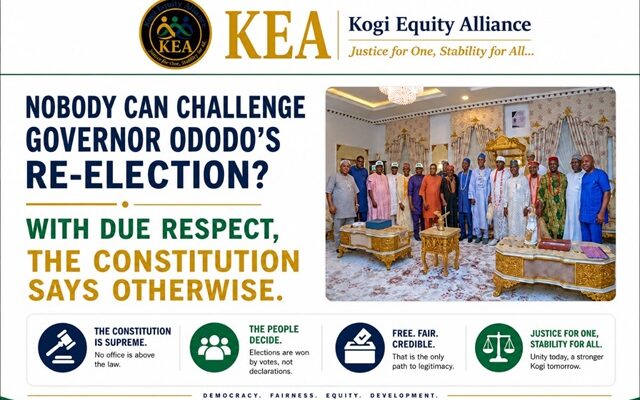

The recent statement attributed to the Elulu of Mopa, Oba Muyiwa Ibeun, that “nobody can challenge the re-election of Governor Ahmed Usman Ododo in 2027” raises important constitutional and democratic questions that deserve thoughtful reflection.
With due respect to the revered traditional institution, no incumbent governor is beyond challenge in a constitutional democracy. No public office is beyond contest. Elections are not won by declarations or endorsements. They are won through the votes of the people after citizens have assessed a government’s performance and determined whether it deserves another mandate.
One of the defining principles of democracy is that no election is decided before it is conducted. Every election remains open to competition, persuasion, and ultimately, the sovereign verdict of the electorate. Any suggestion that an election is beyond challenge risks undermining public confidence in the democratic process itself.

The Constitution of the Federal Republic of Nigeria guarantees every qualified candidate the right to contest for public office and every eligible voter the right to freely choose who governs them. To suggest that no one can challenge an incumbent is inconsistent with both the letter and spirit of constitutional democracy.
Whether Governor Ododo deserves a second mandate is a constitutional question that only the electorate can answer through the ballot. No endorsement, however influential, can substitute for the sovereign will of the people.
As 2027 approaches, the electorate will assess the administration’s record in infrastructure, education, healthcare, agriculture, security, economic development, youth empowerment, job creation, and the overall quality of governance. They will compare promises with outcomes and determine, through the ballot, whether another mandate has been earned.
In every constitutional democracy, incumbency is not a guarantee of renewal. Re-election is not an entitlement. It is a privilege that must be earned through measurable performance, public confidence, and the freely expressed will of the people.
The people will ask difficult questions. Has governance met public expectations? Have public resources translated into visible improvements in the lives of citizens? Has development reached communities equitably? These are legitimate questions that only the electorate can answer on election day.
THE THRONE IS STRONGEST WHEN IT BELONGS TO EVERYONE
President Bola Ahmed Tinubu has consistently encouraged traditional rulers to remain pillars of peace, unity, security, and national cohesion while leaving partisan politics to politicians. That counsel reflects a long-standing democratic principle. The moral authority of the traditional institution rests on its neutrality and its ability to remain a father to all, irrespective of political affiliation.
With due respect, when a royal father publicly predicts the outcome of an election or appears to endorse one political tendency over another, he risks drawing the revered traditional institution into partisan political contest. The palace should remain the one institution where every citizen, regardless of political persuasion, feels equally represented, equally respected, and equally welcome.
Kogi State needs its traditional rulers as custodians of peace, reconciliation, justice, and social harmony. Politicians should campaign. Political parties should canvass for votes. The electorate should decide. The throne should remain above partisan competition as a symbol of fairness, wisdom, and moral authority.
WHY 2027 MATTERS FOR KOGI WEST
The suggestion that Kogi West should postpone its governorship aspiration until after another eight years deserves careful examination. Since the creation of Kogi State in 1991, Kogi West remains the only senatorial district that has not democratically produced an elected governor. Every election cycle presents a constitutional opportunity for every qualified district and candidate to seek the mandate of the people.
The question, therefore, is not whether Kogi West should wait. The question is whether fairness, inclusion, and political balance are better served by extending an imbalance that has endured for more than three decades or by allowing the democratic process to determine whether the time has come for a new chapter in Kogi’s political history.
Equity is not a demand for automatic victory. It is a call for an open contest in which no senatorial district is told in advance that its aspiration must be postponed irrespective of the wishes of the electorate. Democracy does not operate on predetermined succession plans. It operates on the free choice of the people.
The comments also suggested that Kogi West should pursue its future through a West-Central political alliance. Such propositions are legitimate subjects of political debate, but they should be evaluated on the basis of constitutional realities, electoral arithmetic, and the long-term interests of Kogi State, not on assumptions or political nostalgia.
Political alliances should be built on constitutional viability, broad public support, mutual respect, and inclusive governance. Those are questions for political actors and the electorate to determine, not for the traditional institution to prescribe.
Kogi State does not need predetermined political outcomes. It needs free political competition.
It does not need declarations of inevitability. It needs accountability.
It does not need endorsements that appear to predetermine the people’s choice. It needs an electoral process in which every qualified candidate can compete fairly and every citizen can vote freely.
Ultimately, no endorsement, prediction, or political declaration can substitute for the sovereign will of the people.
The 2027 governorship election will not be decided by predictions.
It will not be decided by endorsements.
It will not be decided by declarations of inevitability.
It will be decided by the people of Kogi State, voting freely under the Constitution of the Federal Republic of Nigeria.
That is the essence of democracy.
That is the supremacy of the Constitution.
That is the rule of law.
And that is the principle every institution should protect.
– Yusuf M.A.
Kogi Equity Alliance (KEA)
Justice for One, Stability for All