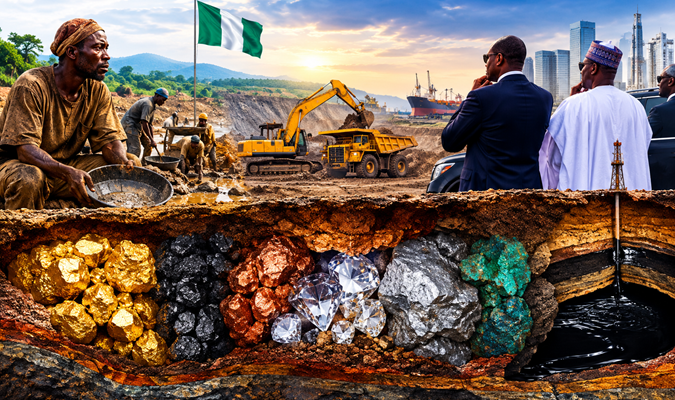

Nigeria’s central contradiction is buried beneath its own soil: a country rich in minerals can remain poor in the communities where those minerals are extracted. Gold, iron ore, limestone, baryte, coal, lead, zinc and other deposits are economic assets. Yet the existence of wealth underground means little if extraction leaves communities with damaged land, weak infrastructure and little lasting prosperity.
Under the Nigerian Minerals and Mining Act, mineral resources are vested in the Federal Government. The law also provides for compensation, environmental protection, reclamation and Community Development Agreements. The framework therefore recognises that mining carries obligations beyond extraction. The question is whether those obligations are enforced strongly enough to convert mineral wealth into public value.
The cost of failure is not abstract. In mining communities, farmland can be disrupted, water sources polluted and roads overwhelmed by heavy vehicles. In one Niger State community examined by The ICIR, residents reported destroyed farms, inadequate basic amenities and fear of miners. The community leader said residents received no benefit from the mining activity.

The human cost has become even harder to ignore. In September 2026, at least 37 suspected illegal miners died while in the custody of the Nigeria Security and Civil Defence Corps in Minna after raids on suspected illegal gold mines in Niger State. Reuters reported that many victims were children; the circumstances of the deaths remain under investigation, and the Niger State NSCDC commandant was suspended.
That tragedy should not be reduced to a debate about illegal miners versus government enforcement. Illegal mining is a serious problem, but enforcement cannot become a substitute for governance. If people enter dangerous mines because legitimate economic opportunities are scarce, simply arresting miners does not resolve the economic conditions that sustain the activity. Nigeria needs lawful mining that makes legality economically viable.
The deeper question is what Nigeria does after extraction begins. Digging ore from Nigerian soil and exporting it in a minimally processed form captures only part of its potential value. The greater opportunity lies further along the chain: processing plants, refining, manufacturing, technical services, skilled employment, research, logistics and domestic industries that use Nigerian minerals as inputs.
This is the difference between possessing resources and building an economy around them. A tonne of mineral leaving Nigeria may generate export revenue; a domestic processing ecosystem can generate wages, corporate activity, taxes, engineering expertise and manufacturing capacity repeatedly. The objective should not be to prevent exports. It should be to ensure Nigeria captures more value before those resources leave its shores.
The government’s own mining portal identifies strategic minerals including iron ore, gold, limestone, baryte, bitumen, coal and lead zinc. Official policy has also acknowledged problems including informal mining, community challenges, weak infrastructure and revenue leakages. These are not merely geological questions. They are questions of institutions, investment, enforcement and economic design.
Nigeria therefore needs a mining model that treats communities as stakeholders rather than scenery. Host communities should see measurable benefits through enforceable development agreements, employment, infrastructure, environmental safeguards and transparent compensation. A mine should not leave behind an abandoned pit, contaminated water and exhausted farmland while the extracted wealth disappears elsewhere.
Nor should the state confuse licensing with governance. A licence is permission to operate, not permission to externalise costs. Regulators must know who owns the operation, what is being extracted, how much is leaving the country, what royalties are due and whether environmental and community obligations are being met. Transparency must follow the mineral from the ground to the market.
The deaths in Niger State should therefore force a wider question. What kind of mining economy is Nigeria building? One in which desperate people enter hazardous pits while middlemen capture value? One in which communities bear environmental costs without corresponding benefits? Or one in which formalisation, investment and regulation create a legitimate route from mineral deposits to decent livelihoods?
Nigeria does not need another catalogue of minerals. It needs an economic architecture around them. The wealth beneath the soil becomes national wealth only when it produces value above the soil: factories instead of endless raw exports, skilled jobs instead of desperation, public revenue instead of leakage, and stronger communities instead of abandoned landscapes.
The ultimate question is not whether Nigeria owns minerals. The legal framework already answers much of that. The harder question is whether Nigerians can own the value those minerals create. Until extraction becomes processing, processing becomes industry, and industry becomes broad prosperity, Nigeria will continue to possess enormous underground wealth while asking why so little of it is visible above ground.
– Inah Boniface Ocholi writes from Ayah – Igalamela/Odolu LGA, Kogi state.
08152094428 (SMS Only)