
By Muhammed Sherifdeen Omeiza
Every time violence breaks out against foreigners in South Africa, Nigeria plays the same old tape. Politicians issue warnings, the media shows the chaos, and the government flies terrified citizens back home. But relying on rescue flights after the damage is done is a backward way to solve a problem. It only treats the symptoms of a crisis while ignoring the real issues underneath.
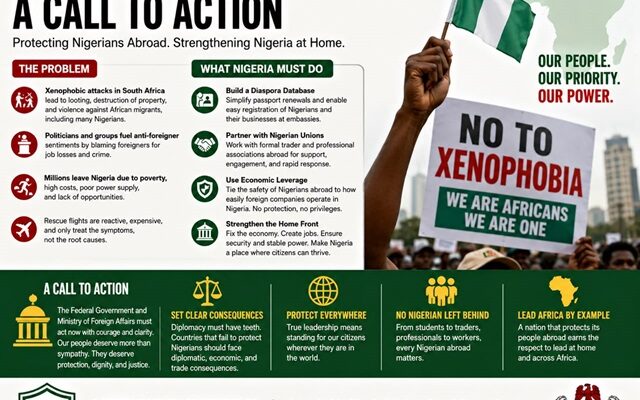
The current xenophobic attacks follow a deeply troubling pattern. Over the years, sudden waves of anti-foreigner anger in South African cities have repeatedly led to the looting of shops, burning of property, and physical violence against African migrants, including many Nigerians. Local political groups often trigger these riots by blaming foreigners for deep local problems like job shortages and crime.

This vulnerability on the streets is directly tied to the economic situation back home. Millions of Nigerians do not leave the country just for fun; they run away from high prices, poor electricity, and a lack of good jobs. When domestic leadership fails to build a working economy, it inadvertently pushes citizens into dangerous places across the border. Therefore, the most basic way to protect the diaspora is to fix Nigeria, so that moving away becomes a choice rather than a desperate struggle to survive.
A major gap in Nigeria’s current approach is the lack of a proper system to keep track of its people abroad. Xenophobic groups always use the excuse that Nigerians are undocumented or hiding in the dark. The government can easily stop this by simplifying passport renewals and making it seamless for citizens to register their businesses with local embassies. When the state maintains clear data and works directly with formal Nigerian trader unions in host countries, it can offer quick, legitimate legal help before street anger turns into a riot.
Furthermore, Nigeria must begin to use its economic power as a shield. Big South African companies make huge profits from the Nigerian market every single year. The safety of Nigerian citizens abroad should be tied directly to how easily these foreign companies do business in our country. If a host government cannot protect Nigerian lives on its streets, its businesses should not get special privileges in our markets. Using trade as leverage is a normal tool in world politics that Nigeria must start using.
This is a direct call to action for the federal government and the Ministry of Foreign Affairs. True leadership is about a state’s ability to protect its people wherever they are in the world. Nigeria must move away from slow diplomacy and set up clear consequences for countries that allow these attacks to happen.
Ultimately, a nation that wants to lead Africa cannot treat the safety of its citizens like a minor detail; the real strength of a country lies in how safely it defends the lives of its people.
– Muhammed Sherifdeen Omeiza is a Nigerian researcher and writer whose work explores the intersection of humanitarian action, human rights, gender equality and global governance. With a keen interest in public policy, democracy, and political economy, he examines how local experiences and global decisions shape humanitarian outcomes in times of crisis. His writings draw from African and international contexts, reflecting a commitment to justice, accountability, and people-centered governance in global affairs.
Email: sherifdeenmuhammed001@gmail.com