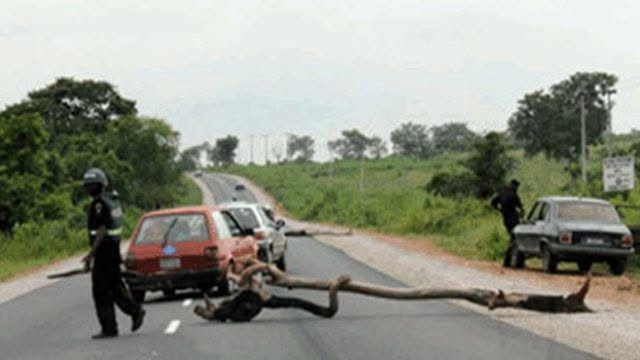

There is a 15-kilometre stretch of road in Kogi East that most Nigerians outside the state have never heard of, and that is exactly the problem. The Itobe–Ochadamu road, connecting Ajaokuta to Ofu Local Government Area, is the gateway that carries traffic from the North through Anyigba and Idah, down toward Enugu and the South-East. It should be unremarkable infrastructure. Instead, it has quietly become one of the most dangerous corridors in the state.
The shift is recent, and it is a shift in kind, not just degree. What used to be sporadic highway robbery has hardened into a pattern of mass abduction. An 18-seater bus was hijacked at Ajegwu, just before Ochadamu, its passengers marched into the bush. Separately, reports emerged of fifteen passengers kidnapped on the same corridor while travelling from Abuja to Anyigba. Police and vigilante teams have since carried out joint rescue operations along the Ochadamu–Itobe–Anyigba axis — evidence that the state is responding, but also evidence of how often it now has to.
Three forces explain why this particular road became the target. Geography does the first half of the work: thick forest presses in on both sides, visibility is poor, and bad sections force vehicles to slow to a crawl at exactly the points where an ambush is easiest to spring. Economics does the second half: this is a South-East to Abuja route, so buses run full, and full buses are a higher-value target than empty ones. The third factor is displacement rather than growth — when the Okene–Lokoja–Abuja highway was militarized, armed groups did not disappear, they relocated to less policed feeder roads like this one. Kogi East did not become dangerous in isolation. It became dangerous because Kogi West got safer.

There is also a quieter cause worth naming: this road was not always a den. Farms once lined much of the corridor, and a populated farming landscape is, in effect, a natural surveillance network. Fear has since emptied those farms, and the abandoned land has given the criminals more room to operate. Security and livelihood on this road are not separate problems; they are the same problem, feeding each other in a loop that only a security intervention can break first.
A serious response has to work in layers, on different timelines. In the next thirty days, government needs a permanent forward operating base at the Ajegwu/Ochadamu junction — not roving patrols, but a fixed joint presence of Army, Police Rapid Response, and vigilante hunters who actually know the terrain. The bush along the road should be cleared back 50 to 100 metres on both sides to remove ambush cover, and until the corridor is secured, buses should move in escorted convoys at fixed times, a model already used with some success on the Birnin-Gwari road in the North-West.
Over the following months, intelligence has to catch up with geography. The forest between Itobe and Ochadamu is not infinite, and drone surveillance already deployed in Kogi West should be extended east. Kidnappers still need food, fuel, and phone credit, which means they still pass through communities that can be turned into an intelligence network if informants are paid and protected, backed by a toll-free line dedicated to this specific axis. Existing checkpoints, many of which extract bribes from drivers without stopping any actual crime, should be consolidated into two or three properly equipped tactical posts with CCTV and communications gear.
The long-term fixes are less dramatic but no less necessary: repairing the potholes that force vehicles to slow down, lighting known flashpoints, registering herders and forest users along the corridor, and mapping the forest so it can be combed regularly rather than treated as unknowable terrain.
None of this will hold, though, without visible consequences. The public’s current impression — that arrests happen but convictions rarely follow — corrodes trust in every other measure. If four suspects are arrested and ten victims rescued, as reportedly happened around Ajaokuta, the public needs to see that process end in a courtroom, not in silence. Kogi should also be coordinating with Enugu, Nasarawa, and the FCT, since the same networks that kidnap on this road often move victims toward neighbouring forests.
Until then, road users are largely on their own: avoid the corridor after 4pm, be wary of buses that linger to fill every seat before departing, and share live location with family before travelling. But that is a coping strategy, not a solution. The solution is a state that treats a 15-kilometre road as seriously as the people who have to travel it every day.
– Benjamin Ibrahim writes from Lokoja, Kogi state.
+2348069596250