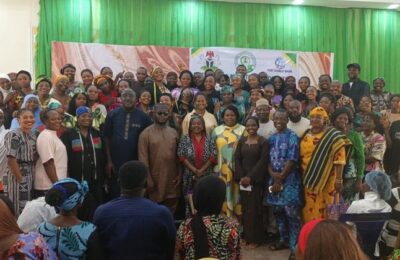

Political leaders, elders and grassroots mobilizers from Kogi East have launched a new coalition aimed at strengthening the region’s engagement with government and pressing for infrastructure investment and a more equitable power-rotation arrangement within the state.
The Kogi East Strategic Stakeholders Coalition (KESSC) was unveiled this week, bringing together veteran political figures, former 2015 Local Government Area chairmen of the All Progressives Congress (APC) from across the nine local government areas of Kogi East, and longtime followers of the late Prince Abubakar Audu, whose political philosophy the group says it has upheld since 1991.
According to a statement announcing the coalition’s formation, KESSC traces its roots through 35 years of political history, having moved through a succession of parties — the National Republican Convention (NRC), the United Nigeria People’s Party (UNPP), the All People’s Party (APP), the All Nigeria Peoples Party (ANPP) and the Action Congress of Nigeria (ACN) — before arriving at the ruling APC.

The coalition said it would pursue Kogi East’s development goals through “strategic, negotiated alliances,” in line with a roadmap earlier proposed by the Kogi East Critical Stakeholders Assembly. It also pledged support for the re-election of the APC-led administrations of President Bola Ahmed Tinubu and Governor Ahmed Usman Ododo, framing this as part of a broader push for what it called “negotiated power restoration” in the region.
Central to the coalition’s formation is frustration over what stakeholders described as a decade-long infrastructure impasse in Kogi East, which they attributed in part to weak strategic positioning by the region within state politics. Rather than dwell on past grievances, KESSC said it intends to pursue disciplined negotiation and stakeholder coordination to secure measurable development outcomes.
The coalition outlined a set of infrastructure priorities it wants translated into a monitored, reviewable roadmap:
Power supply: Accelerated construction of a National Electric Transmission Substation in Kogi East to address chronic power shortages and support industrial and commercial growth.
Roads: Urgent work on intra-district corridors, including the Ankpa–Abejukolo Road, the Idah–Onyedega (Ibaji) Road, the Anyigba–Iyale–Abejukolo Road, the Odenyi–Oguma–Sheria Road, and the Ejule–Alloma–Otukpa Junction Road. The coalition also called on the state government to lead advocacy for federal rehabilitation of major corridors such as the Itobe–Anyigba–Ankpa–Otukpa Road, the Idah–Odolu–Nsukka Road, and the Dekina–Shintaku Road.
Healthcare: An overhaul and modern re-equipping of general hospitals at each of the nine local government headquarters — Idah, Onyedega (Ibaji), Ankpa, Dekina, Oguma (Bassa), Abejukolo (Omala), Okpo (Olamaboro), Ugwolawo (Ofu) and Ajaka (Igalamela-Odolu).
Water: Implementation of sustainable potable water schemes across rural and semi-urban communities.
Security: Deployment of intelligence-driven security measures along boundary communities, farming corridors and transit routes to protect lives and agricultural activity.
“These are capital-intensive priorities, but they are achievable where government commitment, stakeholder discipline, and public support are aligned,” the coalition said, adding that it would pursue the objectives through “respectful engagement, clear documentation of priorities, and periodic feedback to the people of Kogi East.”
To track progress, KESSC said it would coordinate consultations with community leaders, professional groups, youth and women representatives, elected officials and relevant government agencies, while maintaining records of agreed priorities and implementation milestones.
A Renewed Push for Power Rotation
Beyond infrastructure, the coalition and the 2015 APC local government chairmen reaffirmed their push for what they described as an inclusive and equitable power-rotation framework among Kogi State’s senatorial districts. The group said this advocacy would be pursued “with respect for all existing political blocs, leaders, and stakeholders committed to the peace and progress of Kogi State.”
Stakeholders invoked the legacy of Prince Abubakar Audu, arguing that he built leadership bases across all 21 local government areas of Kogi State rather than operating within an isolated regional stronghold.
On that basis, they said power rotation should serve as “a broad-based instrument of unity, demographic balance, and shared confidence,” rather than a source of sectarian friction or personal rivalry among leaders.
The coalition called on indigenes, party faithful, youth and women leaders, professional groups, and traditional and community voices across the nine local government areas — Ankpa, Bassa, Dekina, Ibaji, Idah, Igalamela-Odolu, Ofu, Olamaboro and Omala — to rally around a coordinating platform aimed at restoring Kogi East’s political relevance.
Coalition Participants
Leaders named as participants in the coalition include:
Ankpa: Alhaji Karim Odawn Bassa: Hon. Alhassan Adakeke; Dr. Tim Diche Dekina: Hon. Abdulahi Haruna (SAN); Hon. Dan Okolo; Dr. Johnson Musa; Alh. Jibrin Yusuf Ibaji: Mr. Emmanuel Inielo Igalamela: Hon. Elder Friday Sani Ofu: Malam Muhammad Gambo Ejule; Mrs. Anaja Fatima Omala: Alhaji Musa AbdulKarim
Also, the coalition includes Forum of Kogi East Pioneer APC Party Chairmen: Ankpa LG – Alhaji Abdullahi Kamilu Ahmed; Bassa LG – Mallam Umar Alhassan; Dekina LG – Hon. Peter Akubo; Ibaji LG – Chief Isaac King-Gay Abah; Idah LG – Alhaji Abdullahi Abubakar A.; Igalamela LG – Malam Musa Yahaya; Ofu LG – Malam Abubakar Yunusa; Olamaboro LG – Mr. Dickson Agada and Omala LG – Malam Danjuma Baba Muhammed.