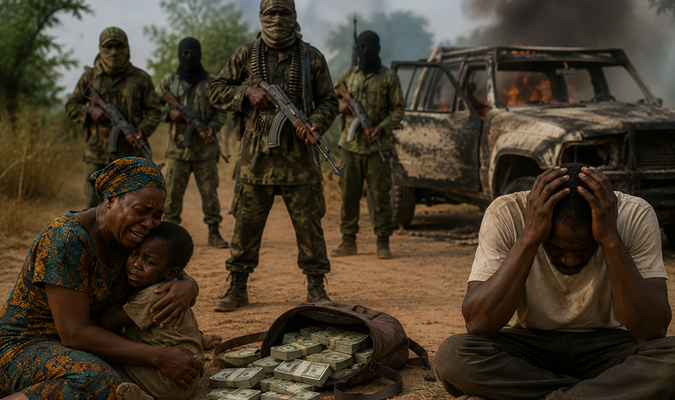

Reported as “suspected” because conflict zones are hard to investigate. The pattern that authorities and researchers describe:
Academic and human rights reports specifically mention insurgency:
“Several reports from Northern Nigeria indicate that some kidnapping syndicates are involved in organ harvesting.
Victims of Boko Haram and other insurgent groups are believed to have been subjected to illegal organ trade.

Although these reports are often difficult to verify due to the conflict zones, there have been multiple accounts from survivors and humanitarian workers suggesting that organ harvesting is being used to fund these groups’ activities.”
The paper also notes that Internally Displaced Persons from the Boko Haram conflict are particularly vulnerable to exploitation for organ harvesting.
Police cases that linked kidnapping and organ trade:
Ogun State forest discoveries: bodies found in forests with organs removed, pointing to possible trafficking
Imo State, Oct-Dec 2024: Police sealed a hotel and private mortuary in Douglass area owned by a suspected kidnapper. Over 100 decomposed, mutilated corpses found.
Police said: “Further investigations linked the hotel to the mortuary, where victims were allegedly taken, killed and dismembered for organ harvesting” and opened a formal probe into suspected organ harvesting.
Edo State, 2021: children rescued who were kidnapped for organ harvesting intended for sale locally or internationally
Abuja 2018, Ikorodu 2017 Badoo cult, Delta 2019 12-year-old girl: cases where bodies were found with vital organs missing
The US State Department Nigeria 2023 Human Rights Report also notes: Reports of organ harvesting by criminal groups persist.
For insurgency groups, the direct threat of “pay ransom or we harvest organs” is commonly used as intimidation by bandits.
Security analysts note kidnapping for ransom is now a leading security challenge, and in 2025 reports claimed over 2 million people were abducted for either ransom or organ harvesting across North-West and North-Central.
So it is not just rumor, NAPTIP, Police, and Federal Ministry of Health treat it as a real, growing criminal economy.
What is the law, especially for medical personnel who assist?
Nigeria has 3 overlapping legal regimes that punish both the insurgents/traffickers AND any doctor, nurse, hospital that participates.
National Health Act (NHA) 2014, Sections 51-56
This is the main law. It regulates donation and transplantation and prohibits sale and illegal harvesting.
Penalty stated by Federal Government:
Persons who contravene or fail to comply with the provisions of the section commit an offence and is liable on conviction or a fine of N1,000,000 or imprisonment of not less than two years or both.”
And crucially:
It is pertinent to note that both the seller and the buyers of this illegal trade as well as the medical practitioners and facilities where this criminal act is being performed will face the full wrath of the law.
Requirements are:
informed, unequivocal and verifiable consent, altruistic donation only, no payment.
Trafficking in Persons (Prohibition) Enforcement and Administration Act (TIPPEA) 2015
Explicitly prohibits all forms of human trafficking, including trafficking for organ harvesting. Penalty is up to life imprisonment for trafficking, and up to 7 years for coercion or manipulation for organ removal.
Criminal Code / Penal Code and Medical ethics
Unauthorized removal is also charged as murder, grievous harm, kidnapping, conspiracy.
In Medical and Dental Council v. Okonkwo (2019) Supreme Court stressed consent must be unequivocal and verifiable.
For medical personnel, involvement creates multiple liabilities:
Criminal liability: as principal or accessory to trafficking, murder, conspiracy.
Example: In the UK Ekweremadu case, the middleman was a medical doctor, Obinna Obeta, convicted under the Modern Slavery Act for organ trafficking.
Professional liability: Medical and Dental Council of Nigeria (MDCN) investigates and can withdraw license.
Federal Ministry said MDCN was looking into allegations against practitioners engaged in such activities.
Facility liability: hospital/clinic can be sealed, as seen in Imo.
International law Nigeria has ratified Declaration of Istanbul on Organ Trafficking,
WHO- Guiding Principles that payment for organs should be banned” also applies.
In short: a doctor cannot claim “I only did the transplant.” If the organ source is a ransom victim, the law treats the doctor as part of the trafficking chain same as seller and buyer.
In case you in notice any of the act Report immediately to NAPTIP (short code 627), Nigeria Police Force, or DSS.
Document ransom demands if safe to do so.
For victims’ families, NAPTIP runs shelters and medical screening for rescued persons.
– Benjamin Ibrahim writes from Lokoja, Kogi state.
+2348069596250