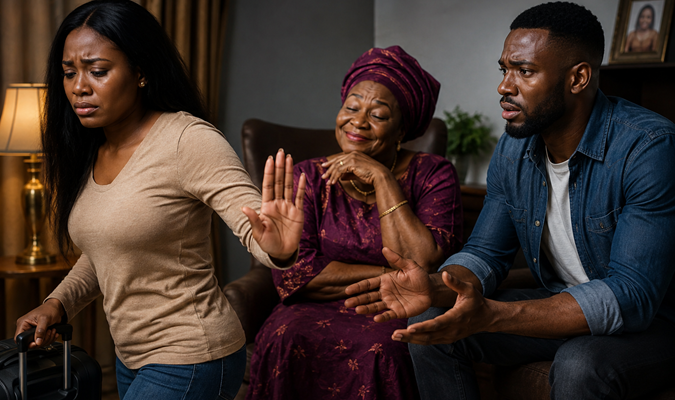

“I suffered in that marriage that I didn’t have a choice than to leave him to marry his mother.” With those words, Onovo Chika Sandra distilled seven years of marital frustration into one devastating metaphor.
Her account, published on Facebook on 14th August 2026, is deeply personal, yet the question it raises extends beyond one failed marriage: what happens when, in a spouse’s perception, parental influence becomes so powerful that the marriage struggles to establish its own emotional and decision making boundaries?
Sandra says she married an Enugu man while she is from Imo State, and that their marriage lasted seven years before she eventually left. In describing the circumstances surrounding the separation, she attributes significant difficulties in the marriage to what she regarded as her former husband’s excessive dependence on his mother.

“He was a mummy’s boy, he does anything his mother asked.” The statement is blunt, even abrasive, but it introduces a serious question about boundaries, adulthood and marital allegiance within contemporary African families.
This is not an indictment of mothers, first born children or traditional family structures. It is an examination of what can happen when, according to one spouse’s account, parental influence becomes difficult to reconcile with the autonomy required within marriage.
African societies rightly esteem filial responsibility. Children are expected to honour parents, support them, respect their counsel and remain connected to extended families. These values possess considerable social and moral significance and have sustained communities across generations.
Yet even a legitimate virtue can become problematic when practised without proportion. Respect can become unhealthy when it is interpreted as permanent obedience; filial loyalty can become corrosive when it repeatedly places a spouse’s legitimate interests beneath parental demands.
Parental counsel becomes intrusive when a married couple, in their own perception, can no longer exercise independent judgement. Family solidarity can become oppressive when the boundaries between a marital household and the extended family become persistently blurred.
Marriage represents a profound transition in adult identity. A person does not cease to be a son or daughter after marriage, but marriage creates new obligations, responsibilities and priorities that require psychological independence.
Genesis 2:24 captures this transition with remarkable economy: “Therefore shall a man leave his father and his mother, and shall cleave unto his wife.” Leaving does not mean abandoning parents; it signifies a new relational priority and the assumption of responsibility for a new household.
A married man can honour his mother without allowing her opinions to determine every decision in his home. Likewise, a married woman can respect her parents without surrendering the independence and confidentiality necessary for a healthy marriage.
The deeper issue is emotional individuation: the capacity of an adult to maintain meaningful family relationships without surrendering personal responsibility, independent judgement and appropriate boundaries.
Sandra’s testimony provides one illustration of what can happen when those boundaries, from the perspective of one spouse, become difficult to maintain.
In some families, a husband may appear to be caught between the expectations of his childhood household and the responsibilities of his marriage. His wife may consequently feel that decisions affecting the marriage are being shaped elsewhere, even when the husband himself may understand the situation differently.
That distinction matters. An opinion article should not transform one person’s testimony into an established verdict about another person’s character. Sandra has described her experience; the former husband and his family may have their own account of the events.
Her reflection is particularly revealing: “Na because I still small then, nobody go follow me do that rubbish again now.” Beneath the anger is an admission that maturity has changed her understanding of what she once tolerated.
Hindsight often exposes what experience previously concealed. People sometimes recognise unhealthy patterns only after enduring their consequences. That is why emotional preparation for marriage deserves as much attention as attraction, ceremony and family approval.
Marriage demands more than affection, age, religious compatibility or social respectability. It requires emotional competence: communication, negotiation, conflict management, financial responsibility, psychological independence, confidentiality and the courage to establish reasonable boundaries.
Without these qualities, marriage can become an institution in which two adults struggle to establish an independent household because unresolved loyalties, expectations or dependencies from their previous family systems remain powerful.
The challenge can become particularly complicated where a first born carries substantial expectations. In many African households, first born children may shoulder financial, cultural and emotional responsibilities. Such obligations can be legitimate and even noble, but they still require appropriate boundaries after marriage.
Being a first born does not automatically mean that a parent should determine the direction of an adult child’s marriage. At the same time, a married child should not interpret marital independence as permission to disregard ageing parents or abandon legitimate family responsibilities.
The balance is difficult, but maturity lies precisely in navigating that difficulty.
A husband may need to tell his mother, respectfully, that certain matters belong between husband and wife. That is not necessarily rebellion. It can be an expression of adult responsibility.
Likewise, a mother who genuinely wants her married son to thrive may sometimes need to recognise that protecting his marriage requires restraint rather than constant involvement. Love does not always require proximity to every decision.
Many marital crises develop without dramatic betrayal. They accumulate through private disagreements being taken to relatives, financial decisions becoming family disputes, spouses being compared with relatives, competing loyalties emerging and domestic conflicts becoming matters for the wider family.
Over time, such patterns can generate resentment and erode emotional intimacy. One spouse may begin to feel displaced within the very institution that should provide companionship, belonging and security.
Sandra’s account should therefore not be consumed merely as another social media complaint against a former husband. It should provoke a broader examination of how African societies prepare young people for marriage and whether sufficient attention is given to emotional maturity.
Society often invests enormous energy in preparing couples for weddings, while devoting comparatively less attention to preparing them for marriage itself. Ceremonies receive elaborate planning; emotional boundaries, conflict resolution, financial responsibility and psychological independence frequently receive far less attention.
A spectacular wedding can conceal an immature relationship. A beautiful photograph can conceal profound incompatibility. A respectable family background cannot compensate for emotional irresponsibility, just as religious language cannot substitute for character.
Sandra’s observation that “it’s good to be mentally and emotionally matured before going into marriage” may therefore be the most instructive element of her testimony. Marriage requires preparation for responsibility, not merely readiness for romance.
Yet responsible commentary must preserve fairness. The public knows only what Sandra has chosen to disclose. Her testimony should therefore be understood as her account of the marriage, not as an independently established finding against her former husband or his mother.
That distinction is not a weakness in the argument. It is precisely what makes the discussion intellectually credible. A serious society should be capable of listening to a person’s experience while resisting the temptation to pronounce judgment without hearing all sides.
The broader lesson nevertheless remains important. Marriage should not require a wife to compete with her husband’s mother, nor should a husband be forced into an artificial choice between filial honour and marital responsibility.
The mature solution is neither generational warfare nor parental exclusion. It is ordered responsibility: parents remain honoured, adult children remain accountable, and spouses retain sufficient autonomy to build their household with dignity and mutual respect.
Parents should raise children who can eventually stand. Children should become adults capable of responsible decisions. Spouses should enter marriage prepared to become partners rather than permanent dependants of their childhood households.
Perhaps that is the deeper issue beneath Sandra’s anger. She is not merely describing a man who loved his mother; she is describing, from her perspective, a marriage in which she felt there was insufficient room for her to function fully as a wife.
When a spouse begins to feel like an outsider within the marriage to which they belong, the institution has entered dangerous emotional territory. Such displacement may leave no visible wound, yet it can gradually destroy trust, intimacy and companionship.
The lesson, therefore, is not that mothers should be feared, first born sons distrusted, or parents excluded from their children’s lives. It is that love must coexist with boundaries, maturity, discernment and properly ordered responsibility.
Honour your parents, but do not make them the architects of your marriage. Love your children, but do not become the unseen third partner in their homes. Marriage requires adulthood, fidelity, discernment and courage, because a new household cannot flourish indefinitely under the invisible government of another.
– Inah Boniface Ocholi writes from Ayah – Igalamela/Odolu LGA, Kogi state.
08152094428 (SMS Only)