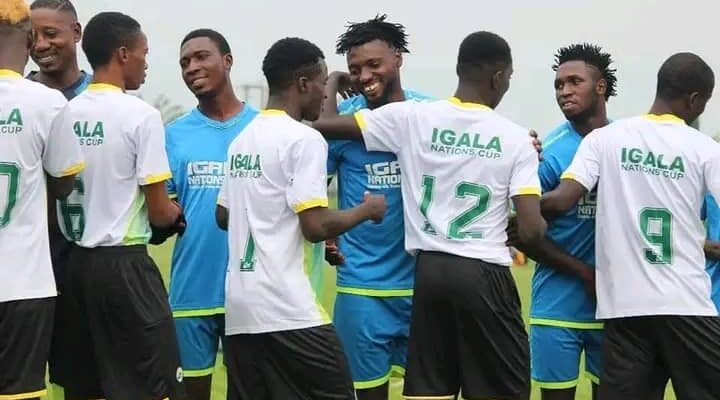

In an era when misinformation spreads faster than truth, one isolated football incident has suddenly turned the Igala Nations Cup — a long-standing beacon of unity — into a subject of unnecessary controversy. Social media pundits, many of whom have never attended a single match, now parade as experts, spreading stories divorced from fact and fairness. Yet, beneath the noise lies a powerful narrative of resilience, vision, and passion — the story of one man who refused to give up on his dream: Abubakar Kamar (Olachene), the founder of the Igala Nations Cup.
I remember growing up in Igalaogba, when Kamar was still just a young guy with a dream bigger than the village field. He would ask us to play so he could learn how to keep — diving in the dust, catching makeshift balls made from rags, sweating under the harsh sun. At Ogah Memorial School field, many mocked him then, laughing at his persistence and calling his passion childish. But he never stopped. He kept training, kept learning, kept believing. Today, the same young man once ridiculed for dreaming too loudly has built one of the most respected grassroots football tournaments in Kogi State — a vision that has united communities and inspired hundreds of young players.
For nearly a decade, the Igala Nations Cup has showcased the best of Igala youth, celebrating talent and peace across every corner of the land. For nine consecutive years, the tournament has run peacefully, with no major crisis — a record many national competitions cannot boast of. But as often happens, one minor incident during the recent encounter between B2K Academy and Abocho United FC suddenly became a storm on social media, with people rushing to assign blame instead of understanding the facts.

Here are the facts: since 2017, when His Royal Majesty, the Attah of Igala, Agabaidu formally blessed and approved the tournament, the royal palace decreed that every final match must be held in Idah — the historical and spiritual capital of the Igala Kingdom. This tradition honours heritage, not favouritism. The records speak clearly: Royal Star Enjema from Ankpa has lifted the trophy twice, Omala United and B2K Academy from Ajaka have also emerged as champions. If playing in Idah meant victory, these diverse winners would not exist. Even in the World Cup or AFCON, the host nation rarely wins.
Earlier this year, Kamar introduced a new initiative — the Igala Super League — a home-and-away competition designed to promote fairness and deepen football roots at the grassroots level. The results were transparent: Idah United, Okpo Starlet FC, and even B2K Academy lost matches on their home turf without incident. A team from Ankpa eventually clinched the league title, proving once again that merit, not manipulation, decides the outcome.
Security has also been handled with discipline and foresight. When intelligence hinted at possible tension between two masquerade groups from communities that qualified for this year’s finals — a lingering issue from Anyigba months earlier — Kamar and his team convened an emergency security meeting. Team managers, captains, and local stakeholders were all invited. Dialogue replaced confrontation, and assurances were given that peace had been restored before kickoff. That is not negligence; that is leadership rooted in restraint and wisdom.
The Igala Nations Cup is far more than a football tournament; it is a social movement, a reawakening of community pride, and a channel for youth engagement. It has become a rallying point for peace in a time when division often dominates headlines. Through the platform, hundreds of young people have discovered purpose, teamwork, and discipline. To attempt to discredit such an initiative with half-truths is to betray the very spirit of progress we should all be nurturing.
As someone who witnessed Kamar’s early passion in the red dust of Igalaogba, I can say this with conviction: he did not build this dream for applause. He built it for love — love of his people, love of his land, and love of a game that unites. Every time the whistle blows, he sees not just a match, but a future — one where Igala sons rise through sport, where communities meet on fields instead of battle lines.
So when critics speak without facts, I remember that boy in Igalaogba who once chased his dream while others laughed. I remember his laughter after every failed catch, and how he would say, “One day, you will play for me — and I will keep for Igala.” That day has long arrived. And today, we all play on the field of his vision.
Abubakar Kamar deserves commendation, not condemnation. He has achieved what speeches and politics have failed to do — unite a people through sport. His humility under fire and calm amid controversy reveal not weakness, but strength. The kind of strength that builds nations, not divides them.
As a son of Igala, I urge all our people — home and abroad — to guard the truth, to celebrate genuine effort, and to remember that progress is born from patience, not propaganda. The Igala Nations Cup remains a beacon of hope and an emblem of peace. And long after the dust settles, the whistle of unity will still echo from Idah to Ankpa, from Anyigba to Ajaka — reminding us that dreams, when pursued with sincerity, can outlive doubt.
Beyond the whistle, beyond the noise, beyond the falsehood — the Igala Nations Cup still stands tall. And its spirit, like the heart of the boy from Igalaogba, refuses to break.
– Inah Boniface Ocholi writes from Ayah – Igalamela/Odolu LGA, Kogi state.
08152094428 (SMS Only)