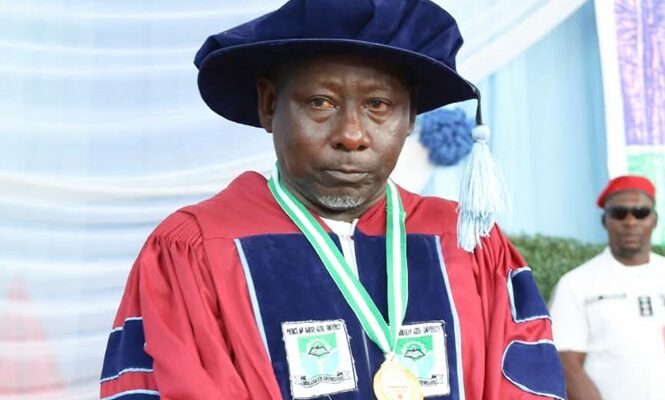

A Professor of Arabic Language and Literature has traced how Arabic travelled along trans-Saharan trade routes to take root in Nigeria’s Confluence Area. He credits traders, Muslim scholars and Islamic schools with sustaining the language, and he is calling for urgent action to preserve its manuscripts.
Prof. Abubakar Salisu Abdullahi delivered the 29th Inaugural Lecture of Prince Abubakar Audu University, Anyigba, on Tuesday, 6 October 2026. His topic was “Developmental Tracks of Arabic Language in the Confluence Area of Nigeria (1960–2008).”
Ancient trade, lasting influence

Prof. Abdullahi said commercial links between North and West Africa moved people, ideas and languages long before Islam spread widely. He cited the Tripoli-Borno, Tunisia-Kano and Morocco-Kano routes through Timbuktu as key channels for Arabic and Islam.
Early trade also introduced Arabic loanwords into local languages, including Hausa and Igala. He noted that Arabic has been used for record-keeping in Nigeria since at least the eleventh century, and he described Arabic manuscripts as vital sources for reconstructing the history of Sub-Saharan Africa.
Markets that connected communities
In Kogi State, the Confluence Area traded with Kano, Katsina, Zaria and Kanem-Borno. North African traders frequented markets in Lokoja, Itobe, Gbagana and Afor Gam Gam, linking Hausa, Kanuri, Arabic-speaking and indigenous communities.
According to the lecturer, Arabic grew notably in Kogi State between 1980 and 2003. He attributed this to commerce, Muslim scholars and preachers, mosques and Qur’anic schools, Sufi organisations, educational mobility, modern Islamic schools, Islamic associations, government schools and technology.
Parents sent children to Sokoto, Kano, Maiduguri and Saudi Arabia for Islamic and Arabic education, and many graduates returned to teach. He identified the 1999 founding of Kogi State University, now Prince Abubakar Audu University, as a major milestone for the formal study of Arabic and Islamic Studies in the state. He also acknowledged the contributions of the Tijaniyyah, Jama’atu Nasril Islam (JNI) and Izala.
Poetry, prose and the push to preserve
Arabic literary activity expanded considerably between 1960 and 2008. Before 1960, output was limited, but scholars and traditional rulers relocated to Lokoja during the colonial period contributed to Qur’anic teaching and literary work. He named Muhammad Kwaso, Emir of Zaria; Emir Abubakar of Bida; Muhammad Bashir; and Ali Dan Sayed.
Local Arabic poetry covered praise, lamentation, satire, preaching, supplication, social occasions and pride, and scholars also used verse to teach and aid memorisation. Prose developed mainly through sermons and correspondence.
Prof. Abdullahi stressed the need to preserve manuscripts and document the works of scholars from Lokoja, Ankpa, Idah, Dekina, Okene and other parts of the Confluence Area. He said the history of Arabic in Kogi State is not merely linguistic but reflects wider religious, educational, cultural and intellectual change.
Recommendations
He called for promoting Arabic education at all levels, increased support for research, more schools and printing presses, Arabic-speaking associations, and employment of qualified Arabic teachers
He also urged Islamic societies and educators to remain committed to preserving the language in Kogi State.
Prof. Abdullahi is the first son of Igala land in eastern Kogi State to become a Professor of Arabic Language and Literature.
University’s reaction
Chairman of the Inaugural Lecture Committee, Prof. S. S. Arogba, congratulated the lecturer. Vice-Chancellor Prof. Salisu Ogbo Usman, represented by Deputy Vice-Chancellor (Administration) Prof. Sani Rufai Abdullahi, called the lecture a reaffirmation of the university’s commitment to rigorous scholarship and the application of knowledge to societal development.
He described the topic as timely and said research of this kind can inform curriculum development, educational planning and language policy. In a plural society like Nigeria, he added, knowing the histories and intellectual traditions of different communities can promote mutual understanding and national cohesion.
The lecture drew members of the University Governing Council, Management and Senate, staff, students, traditional and religious leaders, and other guests.