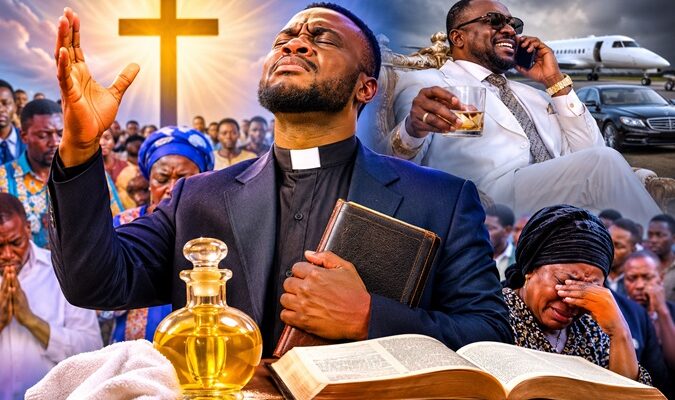

The church has become increasingly skilled at celebrating spiritual power but less willing to confront the character of those who claim to carry it. Across Christian platforms, ministers are ranked by the intensity of their miracles, the size of their congregations, the reach of their influence and the extraordinary claims surrounding their anointing. Believers speak of higher levels, double portions, fresh mantles and unusual dimensions of power. Yet a more uncomfortable question remains largely unanswered: What happens when the language of anointing becomes louder than the evidence of Christian character?
The Bible does not establish a hierarchy of anointing in which believers advance through three, seven or ten spiritual levels. It presents no universal ranking system for measuring divine empowerment. Instead, Scripture reveals different operations of the Holy Spirit, distinct assignments, spiritual gifts and varying responsibilities within the body of Christ. The difference is fundamental. Anointing is not a religious status symbol, and spiritual authority is not a trophy for public display. When the church turns divine empowerment into a competition, it risks replacing service with spectacle and consecration with celebrity.
The biblical foundations of anointing begin with consecration and divine assignment. In the Old Testament, priests, prophets and kings were anointed to fulfil specific responsibilities. Exodus 30:30 records God’s instruction to Moses:

«”And thou shalt anoint Aaron and his sons, and consecrate them, that they may minister unto me in the priest’s office.”»
Anointing marked separation for service. It carried responsibility, not merely recognition. The oil was a visible sign of appointment, but the assignment demanded obedience.
David’s experience makes this distinction even clearer. When Samuel anointed him, the Spirit of the Lord came upon him from that day forward (1 Samuel 16:13). Yet David did not move immediately from the anointing oil to the royal throne. He endured years of obscurity, persecution, uncertainty and preparation. His story challenges the popular assumption that divine appointment guarantees immediate elevation. Between the moment of anointing and the fulfilment of an assignment, there may be a long season in which character is tested and obedience is refined.
Jesus provides the ultimate biblical example of anointing in action. In Luke 4:18, He declared:
«”The Spirit of the Lord is upon me, because he hath anointed me to preach the gospel to the poor.”»
His ministry demonstrated the purpose of divine empowerment. He preached truth, healed the sick, restored dignity and confronted oppression. Acts 10:38 describes Him as one whom God anointed with the Holy Ghost and power, who “went about doing good, and healing all that were oppressed of the devil.”
That final expression deserves attention: He went about doing good. The anointing was not an instrument for building personal empires. It was power directed towards human restoration and the fulfilment of God’s purposes.
The New Testament further explains that the Holy Spirit distributes different gifts to believers. First Corinthians 12:4–6 identifies diversities of gifts, administrations and operations, while affirming that the same Spirit, Lord and God works through them. These manifestations include wisdom, knowledge, faith, healing, miracles, prophecy, discernment, tongues and interpretation.
The implication is clear: diversity of spiritual operation does not establish superiority of spiritual worth. The person who prophesies is not automatically greater than the person who teaches, serves, gives or demonstrates mercy. Paul uses the human body to explain this principle. Every member has a function, and no part can dismiss another as unnecessary (1 Corinthians 12:12–27). The church becomes dysfunctional when it measures spiritual importance by visibility rather than faithfulness.
This does not mean Scripture discourages spiritual growth or greater capacity. In 2 Kings 2:9, Elisha asks Elijah for a double portion of his spirit. The request is often used to support teachings about higher levels of anointing. However, the passage must be understood within its historical and prophetic context. Elisha sought the inheritance associated with the firstborn and the responsibility of continuing Elijah’s prophetic ministry. It is not a universal formula for acquiring twice another person’s spiritual power.
Likewise, John 3:34 declares that God gives the Spirit without measure. In context, this statement concerns the unique authority and mission of Christ. It should not be detached from that context and turned into a promise that every minister can attain unlimited supernatural power through a particular spiritual practice.
The more urgent problem, however, is not the language of spiritual dimensions. It is the failure to distinguish spiritual manifestations from spiritual maturity.
The Corinthian church offers a sobering example. Its members operated in remarkable spiritual gifts, yet Paul confronted their divisions, pride, disorder and moral failures. Their experience exposes a truth that remains relevant: spiritual activity does not automatically produce spiritual maturity.
Paul’s warning in 1 Corinthians 13:1–2 is uncompromising:
«”Though I speak with the tongues of men and of angels, and have not charity, I am become as sounding brass, or a tinkling cymbal.”»
He goes further. Even extraordinary faith, knowledge and supernatural demonstrations cannot compensate for the absence of love.
This passage should trouble every minister who measures success by manifestations alone. A person may command a congregation, deliver an impressive sermon, demonstrate spiritual gifts and attract widespread admiration while failing in humility, honesty and self-control. The pulpit may amplify a person’s voice, but it cannot authenticate that person’s character.
This is not an argument against miracles, prophecy, healing or deliverance. Christianity is rooted in the conviction that God acts in human affairs through the Holy Spirit. The issue is not whether spiritual power exists, but whether those who claim to exercise it remain accountable to the Word of God.
No genuine spiritual manifestation should become a licence for manipulation. No prophetic declaration should place a minister beyond scrutiny. No claim of divine authority should excuse dishonesty, exploitation or the abuse of vulnerable believers.
Jesus Himself warned against confusing supernatural claims with genuine discipleship. In Matthew 7:22–23, He described people who would point to their prophecies, mighty works and extraordinary deeds, only to discover that these activities had not established their relationship with Him. The warning is severe: impressive religious activity is not the same as divine approval.
The distinction between calling, anointing, spiritual gifts, ministry office and character must therefore remain central to Christian teaching. Calling concerns divine assignment. Anointing concerns empowerment for God’s purposes. Spiritual gifts are manifestations distributed by the Holy Spirit. Ministry offices carry particular responsibilities within the church. Character determines how responsibly a person exercises those responsibilities.
These realities are connected, but they are not interchangeable.
Ephesians 4:11–13 explains that Christ gave ministry gifts to equip the saints, build up the church and bring believers towards maturity. The objective is not to manufacture religious celebrities. It is to develop a body of believers who reflect the character and purpose of Christ.
This is where contemporary Christianity must recover its priorities. A minister’s influence should never become a substitute for integrity. A large following should not silence legitimate questions. A powerful testimony should not exempt anyone from accountability. The church must learn to honour spiritual gifts without surrendering its responsibility to test their exercise.
Paul’s instruction in 1 Thessalonians 5:20–21 provides the necessary balance:
«”Despise not prophesyings. Prove all things; hold fast that which is good.”»
The church must neither reject prophecy out of cynicism nor accept every prophetic claim without examination. Discernment is not rebellion. Accountability is not persecution. Testing spiritual claims is a biblical responsibility.
The same principle applies to the language of anointing levels. Teachers may use different dimensions as illustrations of spiritual growth or ministry function. But they must not present such classifications as an explicit biblical system. Scripture encourages believers to grow in grace, increase in knowledge, walk in the Spirit and mature in Christ. It does not instruct them to compete for superior spiritual rankings.
Second Peter 3:18 offers a more enduring pursuit:
«”But grow in grace, and in the knowledge of our Lord and Saviour Jesus Christ.”»
Growth in Christ is the objective. Faithfulness is the responsibility. Love is the governing principle. Holiness is not an optional addition to supernatural ministry.
The future of Christian leadership depends partly on whether the church can restore this balance. It must raise ministers who understand that spiritual authority carries obligations, not privileges alone. It must develop believers who value truth above applause, service above status and accountability above unquestioning loyalty to personalities.
The oil may identify an assignment, but it cannot manufacture obedience. Spiritual gifts may demonstrate divine enablement, but they cannot excuse defective character. Public influence may attract admiration, but it cannot guarantee spiritual authenticity.
Perhaps the most important question for the modern church is not how many levels of anointing a minister has attained, but how faithfully that minister represents Christ. The evidence of genuine spiritual leadership must extend beyond the platform, beyond the congregation and beyond the moment of public manifestation.
When the applause fades, when the cameras are switched off and when the congregation returns home, what remains of the ministry?
That is where spiritual authority faces its most honest examination.
The church does not need another generation competing to appear more anointed than the last. It needs a generation that understands the weight of divine responsibility. It needs ministers who can carry power without becoming proud, exercise authority without becoming oppressive and demonstrate spiritual gifts without abandoning Christian character.
The oil may announce the assignment. Power may demonstrate the gift. But character reveals whether the responsibility is being faithfully stewarded.
– Inah Boniface Ocholi writes from Ayah – Igalamela/Odolu LGA, Kogi state.
08152094428 (SMS Only)