
The Watchful Eye
By Idris Rufai
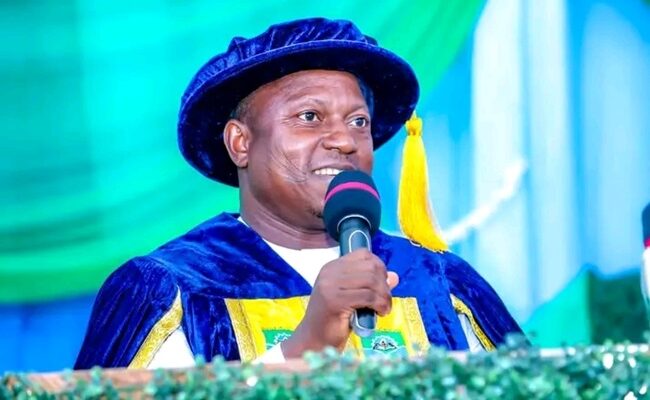
Behind every remarkable achievement is usually a story of consistency, determination, hard work and the courage to believe in one’s dream. For me, Professor Salisu Ogbo Usman represents a living testimony of what is possible when a leader combines vision with action.

His journey is more than a personal success story. It is a reminder that leadership is not simply about occupying a position; it is about what a person does with the opportunity and responsibility that comes with that position.
I consider Professor Salisu Ogbo Usman a role model because his leadership experience at Kogi State Polytechnic demonstrated, in my view, the importance of strategic thinking, resource management and commitment to institutional development.
During his tenure as Rector, his administration benefited from the support and benevolence of His Excellency Alhaji Yahaya Adoza Bello, particularly through interventions involving the Tertiary Education Trust Fund (TETFund). While TETFund had existed long before his administration, what attracted my attention was the manner in which available resources were channelled towards visible projects and institutional development.
One of the statements associated with his administration that particularly impressed me was the commitment that projects should not be abandoned. This principle, in my opinion, was reflected in several projects undertaken or advanced during his tenure. Among them were the Administrative Building, 200-seat theatre twin lecture theatre, School of Applied Science building, School of Environmental Technology studio, Art, Design and Printing building, and the CBT extension building designed to accommodate hundreds of students.
Other notable developments included the construction of a security building at the institution’s gate, the remodelling and expansion of the polytechnic clinic into a larger medical facility, and improvements to the library, including the e-library. Development at the Osara campus also formed part of the broader institutional expansion.
However, what I find particularly interesting about Professor Salisu Ogbo Usman’s leadership approach is not only the physical structures but the thinking behind the management of institutional resources.
The renovation of students’ hostels provides an important example. Rather than viewing every project simply as an opportunity to engage external contractors, his administration, according to the approach I observed, made use of the institution’s internal human capacity through a combination of contract and direct labour.
This approach makes sense in an institution where students are trained in fields such as Building Technology, Architecture Technology, Civil Engineering and Electrical Engineering. If an institution has trained professionals and students acquiring practical knowledge in these areas, why should its own environment not provide opportunities for them to see what they have learnt applied in real life?
For me, that is where education becomes meaningful.
Imagine a Building Technology student watching construction work taking place within the institution and having the opportunity to learn from the process. Imagine students in related technical disciplines seeing professionals from their own institution contribute to projects around them. Such an environment does not merely produce buildings; it can also produce experience, confidence and a stronger connection between classroom learning and practical development.
Another aspect worthy of attention is the reported use of committees involving different sections of the institution, with student representation, to support the achievement of administrative objectives. To me, this demonstrates an understanding that meaningful institutional development should not be the responsibility of one person alone. It requires teamwork, expertise and a sense of belonging.
Accreditation of programmes was also among the areas of institutional development during his tenure. This is important because infrastructure without quality education cannot fully achieve the purpose of a tertiary institution.
But perhaps the biggest lesson I draw from Professor Salisu Ogbo Usman’s leadership is that resources are only as useful as the ideas and discipline with which they are managed.
This lesson should not be restricted to the walls of a polytechnic. It can equally apply to the management of a state.
Kogi State, like every other state, has limited resources and numerous needs. A leader who understands how to manage human and financial resources strategically can create opportunities by looking inward, developing local capacity and ensuring that available resources serve the wider population.
There is also a broader question of self-reliance that his approach raises. If a country builds hospitals but its leaders and citizens must constantly travel abroad for basic medical treatment, then questions about the effectiveness of the system are legitimate. Similarly, if an institution trains professionals but consistently ignores its own human capacity whenever projects are available, there is a missed opportunity for practical development.
The principle is simple: make meaningful use of what you have while developing what you need.
This is why I believe Professor Salisu Ogbo Usman’s leadership experience deserves to be examined beyond the academic environment. Whether one agrees with every decision made during his administration or not, there are lessons to be drawn from an approach that places emphasis on infrastructure, human capacity, resource management, teamwork and practical development.
Leadership should ultimately be measured by its impact on people.
A leader who gives people a sense of belonging, creates opportunities, develops institutions and encourages the use of local capacity leaves behind something more valuable than a title.
As someone who considers Professor Salisu Ogbo Usman a role model, I see in his journey a message of hope: that with consistency, determination, hard work, strategic thinking and belief in one’s ability, meaningful progress is possible.
As he continues his service as Vice Chancellor of Prince Abubakar Audu University, Anyigba, I wish him wisdom, strength and continued success.
My hope is that the experience gained from institutional leadership will continue to inspire ideas that can contribute to the development of Kogi State and Nigeria as a whole.
Professor Salisu Ogbo Usman, to me, represents the possibility of a leadership style that looks beyond position and asks a more important question: What can be achieved with the resources, people and opportunities placed in our hands?
That, in my view, is the kind of question every aspiring leader should be willing to answer.
– Idris Rufai
Email: idrisrufai744@gmail.com