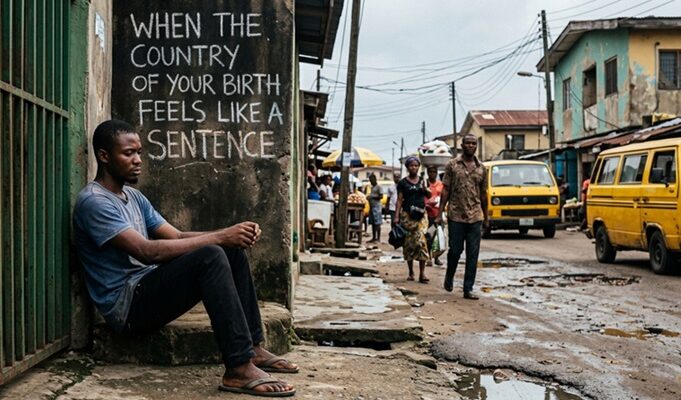

There is a particular kind of regret that comes from being born somewhere you love but struggle to live in. For some Nigerians, the pain is not that Nigeria is without promise. It is that promise seems perpetually trapped beneath conditions that make ordinary life unnecessarily difficult.
Birth is the first lottery nobody chooses. A child does not select a passport, an economy, a school system or the quality of the institutions surrounding them. Yet those accidents of geography can shape education, safety, mobility, income and opportunity. Talent may be universal. The conditions that allow talent to flourish are not.
This is the source of a deeper Nigerian frustration. The country does not lack intelligent people, ambitious young citizens or extraordinary entrepreneurs. It lacks enough reliable systems to convert that human capacity into broad, predictable opportunity. Too many people must fight battles that functioning institutions should have already fought on their behalf.

Consider what that means in ordinary life. A young person can work hard and still confront unreliable electricity, expensive transportation, inadequate infrastructure, limited employment opportunities and economic uncertainty. A family can sacrifice for education and still wonder whether qualifications will translate into work. Effort remains necessary, but effort alone cannot compensate for broken systems.
Then comes comparison. Nigerians who travel or migrate often discover that some daily frustrations they considered normal were not normal at all. Reliable utilities, functioning public transport, predictable public services and stronger institutional protections can reveal something uncomfortable: many hardships were not unavoidable facts of adulthood. They were consequences of where one happened to be born.
That realization can produce a particularly painful question: Was I born in the wrong place? Not because Nigeria has nothing to offer, but because another birthplace might have required less struggle for the same basic chance. The tragedy is not that Nigerians seek better lives elsewhere. The tragedy is when leaving appears more rational than rebuilding home.
And yet Nigeria’s greatest contradiction remains its people. Nigerians succeed across the world in medicine, technology, business, academia, entertainment and the professions. Their achievements demonstrate enormous human capacity. They also expose the uncomfortable gap between what Nigerians can become and what Nigerian institutions currently enable many of them to become.
The answer cannot simply be to tell young Nigerians to love their country more. Love does not switch on electricity. Patriotism does not create jobs. National pride does not repair roads, strengthen schools or make public institutions trustworthy. A country earns durable confidence when its citizens can experience competence, security and opportunity in everyday life.
Nor should migration be treated as betrayal. People have the right to seek safety, dignity and opportunity wherever they can find them. But a nation should eventually ask why so many of its most ambitious citizens believe their futures require physical distance from home. The question is not why Nigerians leave. The question is what Nigeria is losing when leaving becomes the clearest path to possibility.
Nigeria does not need citizens who have been persuaded to stop complaining. It needs conditions that give them fewer reasons to complain. The ultimate test of a country is not how passionately its citizens praise it, but whether ordinary people can build decent lives without extraordinary struggle. No child chooses a birthplace. But a serious nation can choose what that birthplace means.
– Inah Boniface Ocholi writes from Ayah – Igalamela/Odolu LGA, Kogi state.
08152094428 (SMS Only)