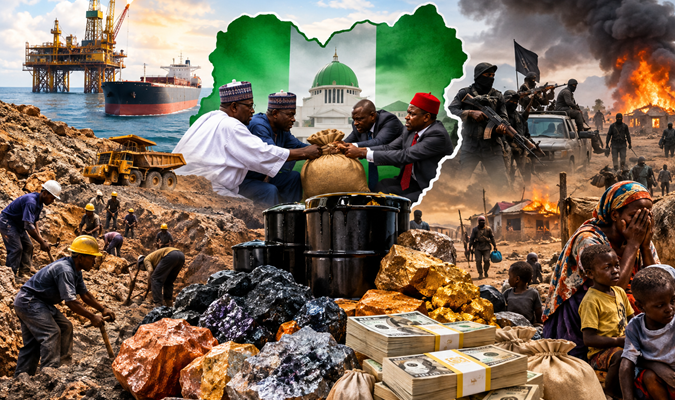

Nigeria is immensely rich, yet dangerously insecure. Our wealth is beneath our feet, but our people live in fear.
The Paradox of Plenty
Nigeria is a geological miracle. We have crude oil and gas in the Niger Delta.
We have gold in Zamfara, Osun and Kebbi.
We have limestone in Sokoto, Benue and Ebonyi.
Bitumen in Ondo, iron ore in Kogi, coal in Enugu, lithium in Nasarawa, tin in Jos.

According to the Ministry of Solid Minerals, Nigeria has over 44 commercially viable minerals in 500 locations across the 36 states.
Yet, how is it that a nation so blessed is listed among the poorest in the world?
How is it that the very communities that host this wealth are the epicentres of violence, militancy, banditry and terrorism?
This is what scholars call the Resource Curse.
The struggle for who controls this wealth is the Genesis of our Insecurity.
Historical Root: The Battle for Resource Control
The struggle is not new. It has three phases:
The First Republic and True Federalism:
At independence, the 1960 and 1963 Constitutions recognized 50% derivation to the regions. Groundnuts from the North, Cocoa from the West, Palm Oil from the East – the regions controlled their resources and developed at their own pace.
There was competition, not conflict.
The Military and the Centralization of Wealth:
The Petroleum Decree of 1969, and later the Land Use Act of 1978, took ownership of all land and minerals from the people and vested it in the Federal Government. Section 44(3) of the 1999 Constitution today says: “the entire property in and control of all minerals, mineral oils and natural gas shall vest in the Government of the Federation.”
This single provision created a landlord-tenant relationship between the Federal Government and the host communities.
The people became tenants on their own ancestral land.
The Niger Delta Agitation:
When oil spillage destroyed farms and rivers in Ogoniland and the entire Delta, and the people saw gas flares burning 24 hours while they had no electricity, they asked a legitimate question: Why? From peaceful advocacy under Ken Saro-Wiwa, the frustration birthed militancy, illegal bunkering, pipeline vandalism and kidnapping.
The state responded with military force, not justice.
How Resource Control Struggle Birthed Today’s Insecurity
What we see today across Nigeria is the same struggle, just in different uniforms.
In the South-South: Militancy and Oil Theft
Over 80% of our national income comes from oil, yet derivation is only 13%.
The youth see oil companies and the federal government take billions, while they have no jobs, no clean water, no roads.
Insecurity there is an economic protest gone violent.
In the North-West and North-Central: Illegal Mining and Banditry
Today, Zamfara, Katsina, Niger, Kaduna and Plateau are bleeding. Why? Because our gold, our lithium, our lead are now controlled by illegal miners, many of them foreign nationals.
They bring in arms to protect their illegal sites.
They pay bandits to secure their mines.
They displace communities.
The Governor of Zamfara himself has said that banditry is directly linked to illegal mining.
The Federal Government owns the minerals on paper, but on the ground, bandits control them.
In the North-East:
Neglect and Extremism
When a region that produces nothing for the centre feels totally abandoned by the centre, extremist ideology finds fertile ground. Poverty caused by exclusion is a recruiting tool for insurgency.
The pattern is clear: When people are alienated from the wealth beneath their feet, they will fight to reclaim it legally or illegally.
Insecurity is the invoice for injustice.
The Legal and Constitutional Failure
Our laws have failed us.
The exclusive legislative list makes mining an exclusive federal affair.
A state governor cannot grant a mining license, cannot regulate mining, cannot even enter a mining site without federal approval.
Yet, when insecurity erupts from that mining site, that same governor is called the Chief Security Officer of the state with no control over the cause.
We cannot continue to run a unitary system in the garment of federalism.
The Way Forward: What We Must Advocate For
We are not here to lament.
As Advocates, we must propose.
First: Restructure Resource Governance – Not Just Derivation.
We must amend the Constitution to move mining from the Exclusive List to the Concurrent List.
Let states manage their solid minerals, regulate them, and pay royalties and taxes to the centre.
This is how we will kill illegal mining. When the state has a stake, the state will secure it.
Second: Increase Derivation and Create Host Community Trust.
13% derivation for oil in 2025 is insulting.
It should be progressively increased to at least 25% with a transparent management framework.
The Petroleum Industry Act’s Host Community Development Trust must be implemented to the letter – not as corporate charity, but as a legal right of the people.
Third: Formalize Artisanal Mining.
We have over 2 million illegal miners. Arresting them has not worked.
We must license them into cooperatives, give them equipment, buy their gold through the Central Bank like Ghana does, and take arms away from the pits.
Fourth: Environmental Justice.
No resource extraction without environmental audit and restoration.
We need a special Environmental Crimes Court.
You cannot destroy a community’s farmland and expect them to remain peaceful.
Fifth: Security Sector Reform Around Resources.
Our security architecture must protect resources for the people, not just for the federation account.
The Mines Surveillance Task Force must be strengthened, and community policing must be involved in securing mining host communities.
Conclusion
The gun in the hands of a bandit in Zamfara, the militant in the creeks of Bayelsa, and the oil thief in the Gulf of Guinea are all asking the same question, though in different languages: Where is my share of the wealth of my fatherland?
Nigeria will not know peace until we answer that question with justice, equity, and true federalism.
Our minerals should be a blessing that unites us, not a curse that kills us.
The struggle for wealth through resource control does not have to end in insecurity.
It can end in prosperity if we have the courage to reform our laws and listen to our people.
– Benjamin Ibrahim writes from Lokoja, Kogi state.
+2348069596250