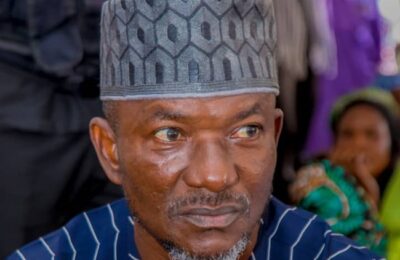

By Dr. Tom Ohikere
ENOUGH IS ENOUGH: ARISE KOGI WEST!
A new political conversation is gathering momentum across Kogi State as concerns over power rotation, equitable representation and the place of Kogi West in the state’s political architecture increasingly take centre stage ahead of the 2027 elections.

For Dr. Tom Ohikere, the message is blunt: “Enough is enough.”
In a forceful appeal to the people of Kogi West and political stakeholders across the state, Ohikere argues that the time has come for the people of the senatorial district to demand what he describes as their rightful place in the leadership equation of Kogi State.
“For 26 years of uninterrupted democracy in Kogi State,” he contends, “we have practised a political arrangement that was meant to foster unity, equity and a sense of belonging. But the records show a painful imbalance.”
A POLITICAL EQUATION UNDER SCRUTINY
According to the political narrative advanced by Ohikere, the governorship distribution since the return to democratic rule in 1999 has been dominated by Kogi East and Kogi Central, while Kogi West has not produced a democratically elected governor.
His political arithmetic is presented as follows:
- Kogi East — 17 years
- Kogi Central — 12 years
- Kogi West — 0 years
For Ohikere, the figures are not merely statistics. They represent what he sees as a fundamental question of political inclusion and fairness.
He argues that a rotation formula that consistently excludes one of the major political blocs cannot credibly be described as equitable rotation.
“To tell over 1.1 million citizens, taxpayers and critical stakeholders in the Kogi project that for 26 years you are not qualified to lead is an insult to the sensibility of the people of Kogi West,” he declares.
BEYOND PARTY POLITICS
At the heart of the emerging argument is a call to move the 2027 contest beyond conventional partisan calculations.
Ohikere insists that the coming election should be viewed through the wider lens of equity, competence and collective interest, rather than simply through the colours of political parties.
“2027 should not be about party. It should be about Kogi West,” he says, while challenging political parties to present credible and capable candidates from the district.
His position is not framed as a demand for political isolation. Rather, he describes it as an appeal for what he considers a necessary correction within the broader Kogi political project.
THE DEVELOPMENT QUESTION
The campaign for greater political inclusion is also being linked to development.
From the condition of major road networks to rural infrastructure, education, agriculture and economic opportunities, Ohikere argues that Kogi West possesses enormous human and natural resources but deserves stronger governmental attention commensurate with its contribution to the state.
He points to the Kabba–Ilorin Road, rural infrastructure challenges across Yagba and Ijumu, and the need for stronger institutional investment as examples of issues requiring sustained political attention.
Kogi West, he argues, occupies a strategically important position in the state’s economy, with significant agricultural potential, tourism assets such as the Ogidi Hills, and deposits of solid minerals.
The central question, therefore, is whether political representation has translated into proportionate development.
THE PSYCHOLOGY OF REPRESENTATION
For Ohikere, however, the argument extends beyond roads, projects and budgetary allocations.
It is also about hope.
Political representation, he argues, tells young people that leadership is attainable and that their communities are not permanently locked outside the corridors of power.
“When leadership reflects the people,” the argument goes, “representation builds hope.”
That sentiment could become particularly significant as political parties begin positioning themselves for the 2027 electoral contest and politicians across the state intensify consultations, alliances and mobilisation.
“ARISE KOGI WEST”
Ohikere’s message to the people of Kogi West is therefore unmistakable: organise, mobilise and speak with one voice.
He calls on political actors across the district to put aside narrow interests and pursue a common agenda centred on equity and credible leadership.
But he also extends an olive branch to Kogi East and Kogi Central, stressing that the campaign should not be interpreted as an attempt to fracture the state.
“A united Kogi is a stronger Kogi,” he says, urging citizens from the other senatorial districts to support what he describes as a necessary correction to the political balance.
2027: A TEST OF KOGI’S POLITICAL CONSCIENCE
The political argument now emerging is larger than one candidate, one party or one election.
It raises a fundamental question about the meaning of power-sharing in a diverse state: Can political stability endure when one major bloc believes it has been permanently excluded from the governorship?
As the 2027 political calendar gathers momentum, Kogi West is being challenged to transform its numerical strength, human capital and political influence into a coherent electoral strategy.
Ohikere’s proposition is straightforward: capacity must meet equity; competence must meet inclusion; and political power must ultimately serve the collective interest of the state.
The battle for 2027, therefore, may well become a defining referendum on Kogi’s understanding of fairness.
And from Kogi West comes the rallying cry:
Enough is enough.
Arise, Kogi West.
The time is now.
Kogi West deserves a sense of belonging.
#AriseKogiWest #KogiWest2027 #OneKogiFairKogi
– Dr. Tom Ohikere
Coalition for Better Kogi State