
By Rotimi Phillip
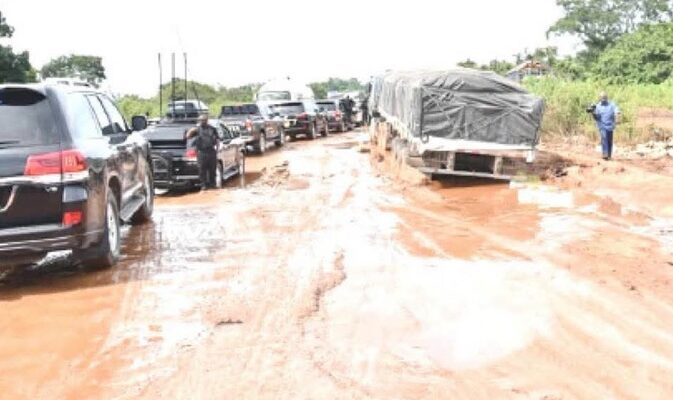
The roads of Kogi West, particularly the Kabba–Egbe–Isanlu–Ilorin corridor, have become a painful daily reminder of years of infrastructural neglect and the increasing burden placed on public roads by heavy-duty industrial activities. For thousands of commuters, farmers, traders, transporters and residents whose livelihoods depend on this strategic route, travelling has become not only difficult but increasingly dangerous.
Across communities along this corridor, the same complaint echoes from motorists and road users: the roads are deteriorating rapidly, vehicles are frequently damaged, transportation costs are rising, and economic activities are suffering. While several factors may be responsible for the poor condition of the highway, many residents believe the continuous movement of heavy-duty trucks servicing Mangal Cement operations has added significant pressure to an already fragile road network.

This is a matter that deserves urgent public attention—not as a political attack on any individual or company, but as a call for responsible governance, corporate accountability and collaborative action in the interest of the people.
A ROAD THAT CARRIES THE ECONOMY OF KOGI WEST
The Kabba–Egbe–Isanlu–Ilorin road is more than an ordinary highway. It serves as a major economic gateway linking several communities in Kogi West with Kwara State and beyond. Agricultural produce moves through this route daily. Students travel on it to schools and tertiary institutions. Traders depend on it to transport goods, while patients and families rely on it during emergencies.
When such a strategic road deteriorates, the consequences extend far beyond potholes and broken asphalt. Every delay translates into lost productive hours. Every damaged vehicle increases transport fares. Every accident represents a potential tragedy that could have been prevented through timely intervention.
For ordinary citizens, infrastructure is not an abstract government policy; it is the road they travel every morning to earn a living.
THE HEAVY-DUTY TRUCK QUESTION
The establishment of industries brings employment, investment and economic growth. Kogi State deserves industrial development, and companies that create jobs should be encouraged. However, industrial growth must go hand in hand with infrastructural responsibility.
The recurring concern among residents is the enormous volume of articulated trucks transporting raw materials and finished products in and out of industrial facilities. Heavy-duty vehicles naturally exert tremendous pressure on highways, especially roads that were not designed or maintained to accommodate sustained industrial traffic over long periods.
It is therefore reasonable for citizens to ask whether adequate arrangements exist between government authorities and major industrial operators to mitigate the impact of such operations on public infrastructure.
This is not about hostility towards investment. Rather, it is about ensuring that development does not become a burden on the very communities expected to benefit from it.
A thriving cement industry should coexist with safe and motorable roads—not collapsing highways that leave residents counting losses every day.
MR. GOVERNOR, THE PEOPLE DESERVE ANSWERS
The Kogi State Government has consistently spoken about infrastructure, rural connectivity and economic development. Those commitments are commendable. But the deteriorating condition of roads within the Kabba–Egbe–Isanlu axis demands visible intervention.
Governor Ahmed Usman Ododo has an opportunity to demonstrate responsive leadership by bringing together all relevant stakeholders—the Federal Government, the Ministry of Works, political representatives, local authorities and Mangal Cement—to fashion out a sustainable solution.
Road infrastructure of this magnitude often involves federal jurisdiction, yet state governments cannot afford to remain passive when citizens are the ones bearing the hardship. Leadership sometimes means initiating dialogue, coordinating advocacy and ensuring that the voices of affected communities are heard at the highest level.
The people are not asking for excuses over constitutional responsibility. They are asking for action.
A CALL TO SENATOR KARIMI, HON. LEKE ABEJIDE AND OTHER REPRESENTATIVES
Political representation must ultimately be measured by the ability to respond to the most pressing needs of the people.
Senator Sunday Karimi, Hon. Leke Abejide and other elected representatives from Kogi West occupy strategic positions through which sustained advocacy can be pursued at both state and federal levels. The reconstruction of this corridor should become a collective legislative priority rather than an issue raised only during political campaigns.
The people of Kogi West expect their representatives to speak with one voice irrespective of party differences whenever issues affecting regional development arise.
This road should unite leaders because its deterioration affects supporters and non-supporters alike.
CORPORATE SOCIAL RESPONSIBILITY MUST GO BEYOND TOKEN PROJECTS
Corporate Social Responsibility should not be viewed merely as donations, ceremonies or isolated community projects. Genuine corporate responsibility means recognising and addressing the environmental, social and infrastructural impact of industrial operations.
If heavy-duty haulage connected with cement production contributes materially to accelerated road deterioration, then there should be a clearly structured partnership for maintenance, rehabilitation and, where necessary, reconstruction of affected corridors.
Such arrangements are not unusual in modern industrial economies. Governments and private operators frequently collaborate to protect infrastructure through road maintenance agreements, dedicated haulage routes, weighbridge enforcement and periodic rehabilitation programmes.
What residents desire is transparency. They deserve to know what framework exists—or will be created—to protect public roads while allowing industries to continue operating successfully.
Mangal Cement, as one of the major industrial players in the area, has an important opportunity to demonstrate leadership by actively participating in long-term infrastructure solutions alongside government.
THE HUMAN COST OF BAD ROADS
Behind every damaged road is a human story.
There is the commercial driver whose vehicle spends more time at mechanic workshops than on profitable trips. There is the farmer whose produce arrives late at the market and loses value. There is the pregnant woman travelling long distances over dangerous roads in search of medical care. There are students who leave home hours earlier simply because transportation has become unpredictable.
These are the real victims of infrastructural decay.
Road conditions also contribute to rising transportation costs, increased vehicle maintenance expenses and reduced commercial efficiency. Businesses pay more to move goods, and ultimately consumers bear the additional cost through higher prices.
In this sense, road infrastructure is directly connected to household welfare.
BEYOND PROMISES, A SUSTAINABLE ROADMAP
The solution must go beyond emergency patchwork repairs that disappear after one rainy season. What is required is a comprehensive and sustainable intervention involving every relevant authority.
First, there should be an immediate technical assessment of the affected sections of the Kabba–Egbe–Isanlu–Ilorin corridor to determine the actual extent of deterioration and the level of reconstruction required.
Second, the Kogi State Government should intensify engagement with the Federal Government since significant portions of the corridor fall within federal road responsibility.
Third, major industrial operators whose logistics depend heavily on the road should be part of a structured infrastructure partnership aimed at supporting maintenance and reconstruction through transparent agreements.
Fourth, haulage regulations should be strengthened to ensure compliance with permissible axle loads and reduce avoidable damage caused by overloaded vehicles.
Finally, communities must be included in discussions. The people using these roads every day possess valuable firsthand knowledge of the challenges and should not be excluded from decisions affecting their future.
DEVELOPMENT MUST NOT DESTROY DEVELOPMENT
No responsible citizen is opposed to industrialisation. Factories create jobs, stimulate local businesses and contribute to government revenue. Mangal Cement represents an important investment within Kogi State’s industrial landscape.
However, development loses its true meaning when the infrastructure supporting communities begins to collapse under the weight of economic activity without corresponding investment in its preservation.
The choice before government and industry is not between economic growth and good roads. Both are possible through responsible planning, effective regulation and genuine partnership.
Kogi West deserves industries that create prosperity and roads that safely connect its people to opportunities.
THE TIME TO ACT IS NOW
The cries of road users along the Kabba–Egbe–Isanlu–Ilorin corridor should no longer be treated as routine complaints. They represent a legitimate demand for accountable leadership and sustainable infrastructure.
Governor Ahmed Usman Ododo, Senator Sunday Karimi, Hon. Leke Abejide, other political leaders, relevant federal agencies and Mangal Cement all have important roles to play in finding a lasting solution.
The people have endured enough hardship.
Our roads are deteriorating. Our commuters are suffering. Our economy is paying the price.
What Kogi West needs today is not another round of promises or ceremonial assurances, but a coordinated, transparent and sustainable intervention that restores this strategic road to the standard the people deserve.
The time for action is now.
– Rotimi Phillip writes from Lokoja.