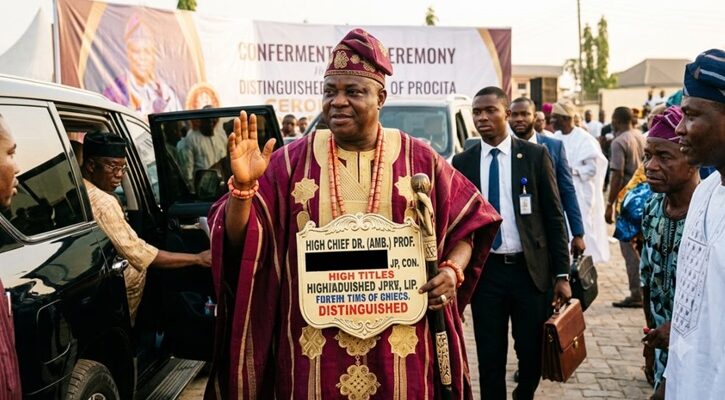

Look closely at a VIP event invitation, a billboard, or a funeral poster in Nigeria, and you might encounter a name that looks less like an identity and more like an alphabet soup. It is no longer enough to be “Mr. Olumide” or “Mrs. Okeke.” Today, they must be introduced as:
“Professor, Engineer, High Chief, (Ambassador) Prince [Name], JP.”
This isn’t just a quirky cultural trait; it has morphed into a national obsession. Nigeria appears to have outpaced the rest of the world in the sheer volume of self-apportioned, purchased, and hyper-inflated titles. But this craze isn’t just about ego—it is a telling mirror of a society grappling with a fractured class system, where respect is rarely given freely, so it must be manufactured.
Things were not always this way. There was a time when titles in Nigeria were earned, rare, and carried the heavy weight of communal responsibility. A traditional title meant you were a custodian of the people’s trust; an academic title meant you had spent grueling years advancing human knowledge.

Today, that meritocracy has been replaced by a transaction.
The modern Nigerian linguistic landscape is filled with titles stretched far beyond their legal or academic boundaries:
The “Doctors” without Doctorates:
Medical practitioners and PhD holders have been joined by an army of “Doctors” who have never written a dissertation or set foot in a medical school. Many of these titles are “honorary,” procured from questionable, unaccredited online universities or local institutions trading paper for prestige.
In political circles, the title Honourable—originally meant for elected legislators—has been hijacked. Now, even temporary, unelected political aides and local committee members demand the prefix, clinging to it long after their brief stint in public office ends.
Walk through Abuja or Lagos, and you will meet “Ambassadors” who have never worked for the Ministry of Foreign Affairs or represented the nation abroad. These are often youth group leaders, NGO founders, or recipients of ambiguous honorary recognitions.
Even tradition has succumbed to inflation. Being a Chief is no longer prestigious enough. To stand out from the crowd, the elite have invented the tier of High Chief, as if adding a vertical modifier somehow elevates them closer to royalty.
Let’s take a look at the anatomy of the Nigerian title craze.
In Nigeria, the journey of a title from its noble origin to its contemporary reality is a masterclass in prestige inflation.
Historically, the prefix “Doctor” belonged strictly to the grueling sweat of medical healers and PhD researchers; today, it is frequently a cash-and-carry status symbol, minted through “honorary degrees” from unverified institutions looking to flatter the wealthy.
Similarly, “Honourable” was an honor reserved exclusively for elected lawmakers serving the public. Now, it has been thoroughly democratized, claimed by any political appointee, ward counselor, or well-connected party loyalist looking for instant deference.
The weight of global diplomacy has suffered a similar fate: the title of “Ambassador,” once the sole domain of seasoned envoys representing a sovereign state, is now casually adopted by anyone who has attended a youth conference or bought a plaque from an ambitious NGO.
Even tradition itself could not resist the upgrade. Where being a standard “Chief” used to signify communal reverence, the modern elite—desperate not to be confused with the common flock—invented the ultimate vertical modifier: the “High Chief.”
What was once earned by merit has become a playground for the vainglorious, proving that when respect isn’t guaranteed by the system, it is simply bought, inflated, and worn like a shield.
And the question is: for what? Why this relentless pursuit of vainglorious prefixes?
This obsession speaks volumes about the current socio-economic fabric of Nigeria. In a country where basic human dignity is often tied to one’s wealth and proximity to power, a title serves as an invisible shield.
“In Nigeria, a title is not just a label; it is currency. It determines how you are treated at a police checkpoint, where you sit at a wedding, and whether you are granted an audience in the corridors of power.”
It reveals a collective insecurity—a subconscious acknowledgment that without a grand prefix, the ordinary citizen is invisible. Because the system often fails to respect the “common man,” Nigerians do everything they can to ensure they are never mistaken for common.
The cost of vanity is that, when everyone is important, no one is. The inflation of titles has diluted the value of actual achievement. True intellectuals, dedicated public servants, and genuine traditional custodians are drowned out by the noise of purchased prestige.
The craze for titles is the psychological twin of the country’s struggle with corruption. It is the desire for the reward without the work, the glory without the grit. Until Nigeria shifts from a culture that celebrates what you call yourself to one that honors what you have actually done, the alphabet soup before the names will only keep growing—hiding the glaring void where substance used to be.
– Ponle Adeniyi
ponleadeniyi457@gmail.com