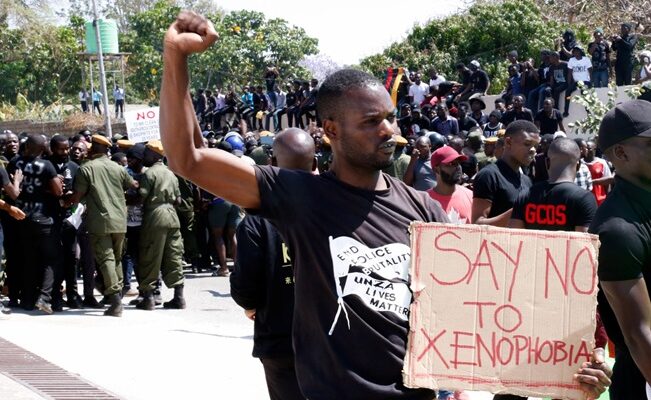

Foreigners must Give their Houses , Cars and All Properties They Own to South Africans 🇿🇦, Those Things Belong To us Because They Came To Our Country With nothing and they must not go back with nothing
We are waiting for them to go on 30 June so that we take over everything they own, we will fight them until they go we want our country back , Says A South African Man.
Does this even make sense?
This is Pure madness
Free Africa

Reactions
It doesn’t make sense legally, economically, or practically. And yeah, calling for forced seizure of people’s property based on nationality is widely considered unlawful and dangerous.
. Legal reality in South Africa
South Africa’s Constitution protects property rights for everyone in the country, not just citizens.
Section 25 says property may only be expropriated for a public purpose or in the public interest, and it requires compensation.
Foreign nationals can legally own houses, cars, and businesses.
There’s no “June 30 deadline” law that strips foreigners of assets. Threatening to “take over everything” would be theft, intimidation, and possibly xenophobic violence — all criminal offences under SAPS jurisdiction.
. “They came with nothing” argument
This claim falls apart on facts:
Many foreigners arrive with capital: Investors, skilled workers, and business owners bring money, pay visa fees, and start companies.
Dept of Home Affairs data shows thousands of foreign-owned SMEs registered yearly.
They pay into the system: Property owners pay rates, transfer duties, VAT, and income tax. Cars require licensing fees, fuel levies, insurance. Seizing those assets removes taxpayers and ratepayers from local budgets.
SA citizens also own property abroad: If “you came with nothing, leave with nothing” became a rule, it would backfire on South Africans who own homes in Namibia, UK, US, etc.
Economic consequences
Forced takeovers destroy the exact things people say they want back:
Investment collapse: If property rights aren’t secure for foreigners, they aren’t secure for anyone.
FDI drops, banks stop giving mortgages, and property values crash.
Job losses: Many foreign-owned shops, salons, factories, and farms employ South Africans.
Seize the business → workers lose income.
International backlash: Violates AU and SADC protocols, trade agreements, and basic human rights law.
SA would face sanctions, tourism hits, and reputational damage.
Zimbabwe’s post-2000 land seizures are the usual case study: agricultural output fell ∼70%, hyperinflation followed, and most citizens got poorer, not richer.
“We want our country back”
South Africa already belongs to South Africans — constitutionally, politically, and demographically. Foreign nationals are ∼4-7% of the population per Stats SA. Issues like unemployment, service delivery, and inequality are real, but they’re not caused by a Nigerian barber owning a car or a Somali spaza owner renting a flat.
Blaming an entire group and threatening violence doesn’t fix housing shortages or joblessness.
It usually creates vigilante attacks, which SAPS and the SA Human Rights Commission have repeatedly condemned as xenophobia.
The statement mixes frustration about jobs and poverty with a proposal that’s illegal, unworkable, and self-defeating.
Property seizure without due process is indeed “madness” — not because of free speech, but because it breaks SA law, wrecks the economy, and puts everyone’s rights at risk.
If you’re seeing this circulating before June 30, treat it as incitement. You can report threats of violence or intimidation to SAPS 10111 or the SAHRC.
Expected reaction from African union
The African Union doesn’t have direct police power inside member states, but it does have mechanisms for exactly this kind of situation: threats of xenophobic violence and unlawful property seizure targeting foreign nationals.
Here’s how the AU typically responds, and what would make sense here:
- Legal + diplomatic tools the AU can use
AU Body
AU Commission Chairperson
Issue a public statement condemning incitement to violence. Call on South Africa to protect all persons per AU Constitutive Act Article 4.
Sets continental norm: “African states don’t strip other Africans of property.”
African Commission on Human and Peoples’ Rights (ACHPR)
Investigate violations of the African Charter: Art 14 = right to property, Art 2 = no discrimination by nationality. Can send urgent appeals to SA govt.
The threat targets property based on nationality. ACHPR has done this for xenophobic attacks in SA before, 2008 and 2015.
AU Peace and Security Council
If violence breaks out, can put “xenophobic violence” on the agenda, mandate fact-finding mission, or request early warning action.
Prevents escalation into regional instability.
ECOSOCC + Diaspora Division
Engage civil society and migrant orgs to de-escalate, counter misinformation.
Many affected are from SADC/ECOWAS states.
What a proportionate AU reaction looks like
Immediate public condemnation
The Chairperson would usually release a statement within 24-48h:
Reaffirm that all Africans in AU member states have rights under the African Charter.
Remind South Africa of obligations under AU Free Movement Protocol and SADC Protocol on Facilitation of Movement.
Call for protection of lives and property, and prosecution of incitement.
Engage South Africa bilaterally
AU Commission + SADC Chair typically phone the SA President/Minister of International Relations.
Message: “This threatens continental integration, Agenda 2063, and your own economy. Contain it.” SA has always publicly distanced itself from xenophobic calls when AU pressure mounts.
Early warning + monitoring
AU’s Continental Early Warning System can flag the June 30 date.
If threats trend online, AU + APRM may coordinate with SAPS and SA Human Rights Commission to monitor hotspots.
Support affected member states
If citizens from Nigeria, Zimbabwe, Somalia, etc. are targeted, their governments will raise it at AU summits.
AU often facilitates consular protection + joint messaging to avoid tit-for-tat retaliation against South Africans abroad.
Address root causes
AU’s longer-term tool is the AU Migration Policy Framework and AfCFTA. Both push for legal migration, anti-xenophobia campaigns, and explaining how intra-African business benefits host economies.
The AU knows xenophobia spikes when unemployment is high, so it ties responses to jobs/industrialization programs.
. What the AU cannot do
Seize or give property: AU has no power to redistribute assets. Property law is national.
Deploy troops for this: Peace and Security Council only intervenes in war crimes, genocide, crimes against humanity. Xenophobic threats are handled via diplomacy and human rights bodies unless they become mass atrocities.
Override SA courts: SA Constitution + courts handle criminal incitement. AU can pressure, not prosecute.
Why does the AU take this seriously
Precedent: If one AU state normalizes “foreigners must surrender property,” others could copy it. That breaks AfCFTA and Agenda 2063 goals.
Reciprocity risk: 1M+ South Africans live/work in other African countries. If they get targeted in revenge, it becomes a continental crisis.
Image: AU’s credibility on “African solutions” depends on protecting Africans everywhere on the continent.
In conclusion: Expect the AU to condemn, privately pressure Pretoria, activate ACHPR, and push counter-narratives.
If violence actually starts, PSC meets and may send observers. The AU’s leverage is political/diplomatic, not physical enforcement.
– Benjamin Ibrahim writes from Lokoja, Kogi state.
+2348069596250