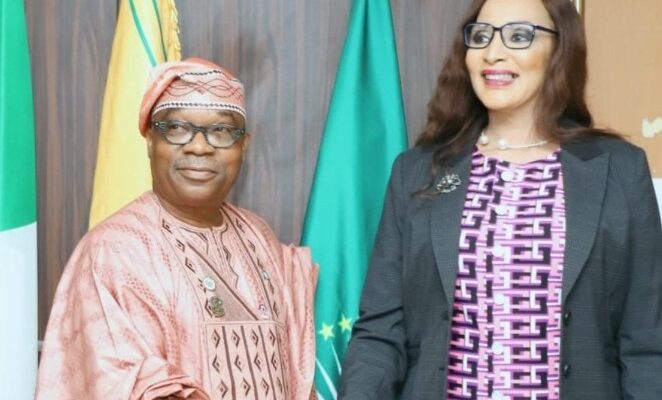

Dr Onibiyo Ezekiel Rotimi
For decades, Nigeria’s foreign policy has been tragically predictable. A Nigerian citizen is brutalised in South Africa, the ministry issues a strongly-worded press release, and the cycle resets. A foreign company extracts billions from our economy, and the only response is a letter or a defensive court filing. This era of passive, reactive statecraft must end. In his maiden policy address,
Minister of State for Foreign Affairs, Ambassador Sola Enikanolaiye reiterated the government’s commitment to the four pillars of the nation’s foreign policy: Demography, Development, Diaspora, and Democracy. With the strategic positioning of a technocrat, Ambassador Sola Enikanolaiye, Nigeria now has the tools and the mandate to transition from a defensive posture to a proactive, multi-dimensional strategy. The question is no longer whether we will react to a crisis, but whether we have already designed and deployed the counter-measures.

The Ojukwu-Enikanolaiye strategy to positively weaponise Nigeria’s Population for Economic Deterrence speaks to the DEMOGRAPHY components of the duos 4D as submitted by Ambassador Enikanolaiye.
The Demography pillar, now the primary driver of the “Tinubu Doctrine,” is Nigeria’s greatest strategic asset. Nigeria is the largest market in Africa; our 220 million people are not just consumers but a formidable lever of influence. The gradual and quicken ending of the twelve-year monopoly of Optasia (Nairatime) in Nigeria telecom and fintech space demonstrates how this pillar can be weaponised protectively without injuring Nigeria’s own economy. The expected cerebral fireworks between Ojukwu-Enikanolaiye and Olubunmi Tunji Ojo the Minister of Interior starts now. Every inch of the Nigeria external and interior must speak to our demography strength to advance the Renewed Hope positions, which this administration is committed to.
For too long, foreign firms like Optasia used Nigeria’s demographic weight to extract value while giving nothing back hosting credit data offshore, stifling local fintech, and repatriating trillions of naira annually. Under the new directive, President Tinubu ordered the dismantling of this monopoly, and the Development pillar is now executing a “Nigeria First” policy that mandates local data hosting and Nigerian equity participation for any foreign firm seeking to access our market.
The message to Optasia and every other predatory monopoly is clear and deep; you will either localise, partner, and comply, or you will be excluded.
On xenophobia, Nigeria must weaponise demography by shifting the narrative from begging for protection to leveraging its immense market power; a tactical first step is the implementation of a “Diaspora Trust Mark” a certification for South African businesses that treat Nigerians fairly, granting them preferential access to Nigerian supply chains and investment, thereby creating a powerful economic incentive for fair treatment. But Nigeria must go further by using the very financial pipelines that fuel South Africa’s pension system as leverage. The South African Government Employees Pension Fund (GEPF) Africa’s largest pension fund and its asset manager, the Public Investment Corporation (PIC), hold substantial stakes in Nigerian crown jewels: a 1.5% stake in Dangote Cement acquired for $289 million, a 19.58% stake in Ecobank Transnational Incorporated (ETI) worth over $250 million, and active interest in the Dangote Refinery’s upcoming IPO (Keshinro et al., 2026). These investments generate dividends and capital gains that are repatriated to South Africa to finance the pensions of over 1.8 million South African civil servants.
Nigeria can therefore declare, through the Ministry of Foreign Affairs, that any future profit or dividend repatriation from these vehicles will be subject to a reviewed process: before approval, South Africa must demonstrate concrete, verifiable actions including investigation, arrest, and prosecution of xenophobic movement leaders from groups like Dudula and March by March.
This is not a threat; it is a pragmatic, bite back strategy. Nigeria no longer pleads it uses its own economic weight and the other country’s dependence on Nigerian assets to enforce the safety of its citizens. The era of empty protests is over.
The Transition from Passive Evacuation to Aggressive Deterrence is long overdue to be activated. The days of merely evacuating citizens after an attack are over. While the government has commendably evacuated over 1000 citizens from South Africa and established a crisis response unit, we must adopt a doctrine of aggressive deterrence. This is not just about evacuating our people; it is about making it catastrophically expensive for any host nation to allow them to be harmed.
Tactically, this means we must move beyond “Not Happy” Statements, Minister Bianca Ojukwu was right to express Nigeria’s dissatisfaction with South Africa over the treatment of its citizens. However, the nation’s reaction including summoning diplomats and considering sanctions remains defensive. We must escalate by filing a case at the African Court on Human and Peoples’ Rights against the South African state for its consistent failure to protect foreign nationals. The National Assembly’s push for a review of bilateral agreements is a good start. The executive must support the suspension of the Air Services Agreement between Nigeria and South Africa, forcing South African Airways and other carriers to renegotiate.
This would impose tangible economic costs on South African businesses and travellers, forcing them to press their own government for change. The evacuation of 270 passengers highlights a logistical gap that a proactive Diaspora strategy would have pre-emptively filled with bilateral agreements on documentation sharing. With Ambassador Enikanolaiye coming onboard couple with his deep institutional knowledge, the Okun born High Chief, must negotiate permanent “Standing Repatriation Orders” with every country housing more than 10,000 Nigerians. We must not wait for a crisis to agree on exit protocols; this must be part of our standard diplomatic template.
The DEVELOPMENT component of the 4D, is anti-Monopoly offensive against predatory capital. The Development pillar is the sharpest tool in Nigeria’s arsenal to dismantle the neo-colonial economic structures that firms like Optasia represent. We must move beyond a reactive, legal-defensive posture and adopt a proactive, regulatory-offensive stance.
The Optasia blueprint is now our template for permanent war against extraction. The FCCPC’s legal battles with Optasia, who rushed to court to secure an injunction restraining the government from implementing its DEON regulations, must be escalated.
Instead of just defending, the government should compel the Economic and Financial Crimes Commission (EFCC) to investigate Optasia for historical tax evasion, anti-competitive practices, and capital flight over the twelve years of its monopoly. Nigeria now has a government-approved list of nine licensed Nigerian fintech companies ready to participate in the airtime lending market. The Development pillar must now ensure a mandatory quota: foreign-owned players in any digital financial service must have a 30% Nigerian equity threshold and must host all data within Nigeria’s borders. The President Tinubu Renewed Hope Agenda must Internationalise the fight, Nigeria must leverage Ambassador Enikanolaiye’s diplomatic expertise to take the fight to Optasia’s home country. The Nigerian government should approach the South African Competition Commission with a formal complaint about their multinational’s abuse of dominance in a fellow African nation, forcing South Africa to defend its corporate citizen’s conduct.
Democracy is not just a political system; it is the ideological legitimacy for our offensive statecraft. Minister Ojukwu has correctly framed Nigeria’s stance, reminding South Africa that Nigeria’s sacrifice for its liberation gives us moral authority. However, morality without leverage is just a plea. Reciprocity as a Principle must be activated. under the Tinubu administration, the 4D Doctrine is now centred on “firmness, reciprocity and measurable outcomes”. This means that for every South African visa or permit issued, there must be a reciprocal guarantee of safety for Nigerians. Nigeria must activate the early warning mechanism we have negotiated with Pretoria, not as a passive intelligence-sharing tool, but as a trigger for a pre-authorised, immediate response. Consequences Over Condolences must be amplified, the House of Representatives’ call to suspend business permits of South African companies in Nigeria is the language of democracy that Pretoria understands. We must institutionalise the “Bianca Doctrine”: any state targeting Nigerians will immediately face a review of visa rules for its citizens and the suspension of technical aid from Nigeria.
The end of the apologetic diplomat is here, under President Tinubu’s leadership, the theoretical 4Ds must now become a 4-Front offensive. Ambassador Sola Enikanolaiye, the career officer turned Minister, and Bianca Ojukwu, the seasoned diplomat, must now orchestrate a new symphony where Nigeria is the conductor, not the subject. The core of this strategy is proactive conditioning. Whether it is breaking the monopoly of a South African fintech giant or protecting a Nigerian trader, the era of saying “we are not happy” is over. The era of tactical retribution and pre-emptive deterrence has begun. The world must now learn that harming a Nigerian, or extracting from our economy without fair terms, carries a swift, heavy, and multi-dimensional cost.
– Dr Onibiyo Ezekiel Rotimi is a security analyst and a research fellow with APUDI Institute of Peace Studies and Social Rehabilitation (APIS). Author can be reached via temiowa@yahoo.com_