
By Muhammed sherifdeen Omeiza
Imagine a single emergency phone call that could save a life, but the person who can answer it is sitting hundreds of miles away in a different city, totally disconnected from your reality. This is exactly how policing feels for millions of Nigerians today.
When a community faces a sudden security crisis, local leaders must wait for orders from a federal headquarters in Abuja before taking major action.

It is a slow, top-heavy approach to an emergency that moves at lightning speed. Because of this, a powerful conversation is taking over the country: it is finally time to create state police forces.
From a public policy view, this shift is about moving power closer to the people who actually need protection. The current setup was built for a different era, and it simply cannot keep up with today’s local security challenges, like village raids and kidnappings.
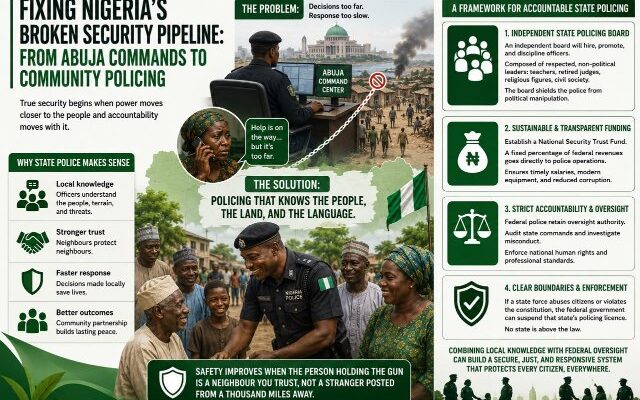
When police officers are hired, trained, and deployed within their own states, everything changes. They speak the local language, understand the terrain, and know exactly who belongs in the community and who looks suspicious. Safety improves when the person holding the gun is a neighbour you trust, not a stranger posted from a thousand miles away who does not even understand the local dialect.
However, changing how a country handles security is like moving a massive ship; it requires careful steering. Many citizens are worried that local governors might use state police forces as personal political weapons to bully opponents and rig elections. Others wonder how poorer states will find the money to pay salaries and buy modern gear when they already struggle to pay the minimum wage. These are valid fears. If we just rush into this without clear rules, we might end up creating thirty-six mini-dictatorships with their own private armies, which would make the country even more dangerous.
To stop governors from turning the police into their personal tools, the law must create an independent state policing board. This board, not the governor, will have the sole power to hire, promote, and discipline local officers. To ensure it remains neutral, the law should mandate that the board consists of respected, non-political community leaders like teachers, retired judges, and religious figures. Because these individuals do not rely on the governor for their careers, they can shield the police force from political manipulation, ensuring officers serve the public rather than the ruling party.
Additionally, the funding model must be completely restructured to prevent corruption and operational failure. Instead of leaving states to fund the police entirely from their internal revenues, Nigeria should establish a National Security Trust Fund. This fund would automatically channel a fixed percentage of federal revenues directly into police operations, ensuring officers receive competitive salaries and modern equipment on time. When officers are well-paid and well-equipped through an independent financial stream, they are far less likely to resort to highway extortion or succumb to bribery from wealthy local politicians.
Ultimately, the true success of state policing will depend on strict accountability and clear boundaries. The federal police must retain the supreme authority to audit state commands, investigate cases of local police brutality, and enforce national human rights standards. If a state force abuses citizens or violates the constitution, the federal government must have the immediate legal power to suspend that state’s policing licence.
By combining local knowledge with federal oversight, Nigeria can finally build a secure, just, and responsive system that protects every citizen, everywhere.
– Muhammed Sherifdeen Omeiza is a Nigerian researcher and writer whose work explores the intersection of humanitarian action, human rights, gender equality and global governance. With a keen interest in public policy, democracy, and political economy, he examines how local experiences and global decisions shape humanitarian outcomes in times of crisis. His writings draw from African and international contexts, reflecting a commitment to justice, accountability, and people-centered governance in global affairs.
Email: sherifdeenmuhammed001@gmail.com