
By Musa Bakare
If history is to be honestly recorded, it is the Yoruba nation more than any other major ethnic group that has consistently fought for the survival, stability, and unity of Nigeria through justice, fairness, and equity.
The Yoruba position has never been the destruction of Nigeria. Rather, it has always been the positive reconstruction of Nigeria.

For decades, patriotic Yoruba leaders have argued that no nation can endure on an unjust foundation. No country can achieve greatness by concentrating overwhelming political and economic powers at the center while reducing its federating units to helpless dependents.
No society can prosper when one section continually benefits from a structure that leaves others feeling disadvantaged and alienated.
The truth remains that the structure inherited from British colonial rule was neither balanced nor sustainable. It was an administrative contraption designed primarily for colonial convenience, not for the long term stability of a complex and diverse nation of over 250 ethnic nationalities.
The restructuring during military interregnum through state creation was at best cosmetic.
Successive governments merely managed the contradictions. They lacked the courage to confront them.
Today, Nigeria stands at a defining moment in its history.
The economic distortions are obvious. The political imbalances are glaring. The over centralization of power has weakened initiative, crippled productivity, and fueled endless ethnic suspicions.
For years, every serious discussion about national development has returned to one unavoidable conclusion: Nigeria must restructure or risk perpetual instability.
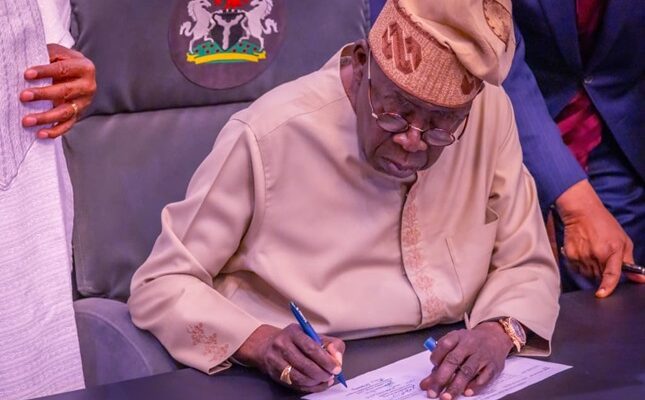
This is where President Bola Ahmed Tinubu deserves objective historical recognition.
Long before he became President, Tinubu stood among the strongest advocates of true federalism, devolution of powers, fiscal federalism, and constitutional restructuring.
While many politicians merely mouthed these principles during campaigns, he consistently championed them as a matter of conviction.
Today, under the Renewed Hope Agenda, Nigeria is witnessing a quiet but profound revolution.
Many may not immediately recognize it because genuine transformation often begins beneath the surface before becoming visible to all.
The removal of economic distortions, the bold reforms in public finance, the empowerment of subnational governments, the expansion of infrastructure, the push for local resource development, and the gradual dismantling of decades old structural inefficiencies are all parts of a broader national rebirth.
Predictably, beneficiaries of the old order resist change. Those who have profited enormously from the status quo will deploy every political, economic, and psychological weapon available to preserve their privileges. Every reform threatens entrenched interests. Every restructuring agenda challenges established beneficiaries.
The fundamental question remains: Should Nigeria continue with a structure that has repeatedly produced poverty amid abundance, insecurity amid vast resources, and dependence amid enormous human potential? Or should the nation embrace a new path built on productivity, healthy competition, accountability, genuine federalism, and a holistic Renewed Hope Agenda?
The answer is obvious. A truly restructured Nigeria will not diminish any ethnic group. It will liberate all ethnic groups. It will allow every region to maximize its strengths. It will encourage healthy competition.
It will reduce unhealthy dependence on Abuja. It will unleash innovation. It will deepen national unity through fairness rather than coercion.
Most importantly, it will give future generations a country founded on justice rather than perpetual political bargaining.
This is why the Yoruba position remains morally compelling, politically sensible, and spiritually righteous.
Yoruba demand restructuring because they love Nigeria enough to tell the truth about its imperfections. They understand that unity imposed by imbalance is fragile, but unity built on justice is enduring.
President Bola Ahmed Tinubu’s administration represents the boldest attempt to confront the structural contradictions that have held Nigeria back.
The journey may be difficult. The resistance may be fierce. The sacrifices may be considerable. But nations are not transformed by cowardice. They are transformed by courage.
Nigeria must therefore move beyond empty slogans and confront reality. Restructuring is not a threat to Nigeria. Restructuring is Nigeria’s greatest opportunity for survival and renewal.
History will record that when the moment of decision arrived, the Yoruba nation stood firmly on the side of national rebirth, constitutional justice, and the creation of a stronger, fairer, and more enduring Nigerian federation.
– Musa Asiru Bakare, a Political Analyst, writes from Lokoja, Kogi State.