
By Muhammed Sherifdeen Omeiza
Nigeria stands at a frustrating crossroads where the desire for national transformation is universal, but the willingness to change personal behavior is remarkably scarce. It is easy, and entirely justified, to point fingers at leadership. The government has undeniably broken its social contract with the people, failing to provide basic security, steady power, and reliable infrastructure.
However, a honest public policy diagnosis reveals a harsher truth; a broken system is not maintained by leaders alone, but also by the everyday actions of the citizens who live within it. A nation cannot rise above the collective morality of its populace, and right now, the micro-level desperation of everyday Nigerians is mirroring the macro-level corruption of the state.

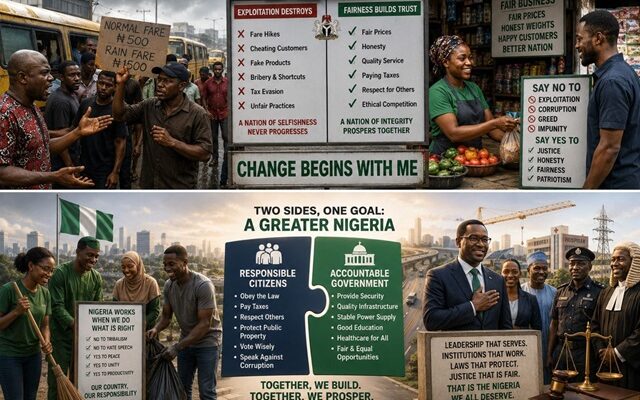
This civic decay shows up in the smallest daily transactions, where exploitation has been normalized under the guise of survival. The moment a brief rain shower hits Lagos or Abuja, transport fares triple instantly. When a local business or individual finds a loophole, the immediate instinct is often to extort or exploit the next person.
We see citizens dumping household refuse into drainage channels, thereby blocking the very infrastructure meant to prevent flooding, and then blaming the state when the streets overflow. Public spaces like bridges and roadsides are defaced and used as open toilets. While it is true that the government has failed to provide adequate waste management systems or public sanitation, the individual decision to destroy the immediate environment reflects a deeper collapse of civic responsibility.
From a public policy perspective, this creates a vicious cycle that makes sustainable development nearly impossible. Laws, regulations, and public infrastructure cannot function effectively without voluntary compliance from the public. No government has the capacity to place a police officer behind every citizen to ensure they do not dump trash in gutters or scam their neighbors.
When citizens abandon ethical standards in a desperate rush to make money at any cost, they actively erode the social capital required to build a functional society. The prevailing mindset has become highly individualistic ‘get yours by any means necessary, and blame the system for making you do it’ .
Ultimately, fixing Nigeria cannot be a one-sided affair. True structural reform requires a dual approach where institutional accountability meets civic awakening. The government must take the lead by rebuilding trust, enforcing the rule of law without bias, and providing the basic amenities that make civic pride possible.
Simultaneously, citizens must realize that patriotism is not just a sentiment expressed during football matches, but a daily practice of self-regulation. We cannot demand accountability from the state while practicing impunity in our neighborhoods.
For Nigeria to work, both the leaders and the led must collectively agree to sign a new ethical contract, realizing that the country we desire is exactly the country we choose to build through our daily choices.
– Muhammed Sherifdeen Omeiza is a Nigerian researcher and writer whose work explores the intersection of humanitarian action, human rights, gender equality and global governance. With a keen interest in public policy, democracy, and political economy, he examines how local experiences and global decisions shape humanitarian outcomes in times of crisis. His writings draw from African and international contexts, reflecting a commitment to justice, accountability, and people-centered governance in global affairs.
Email: sherifdeenmuhammed001@gmail.com