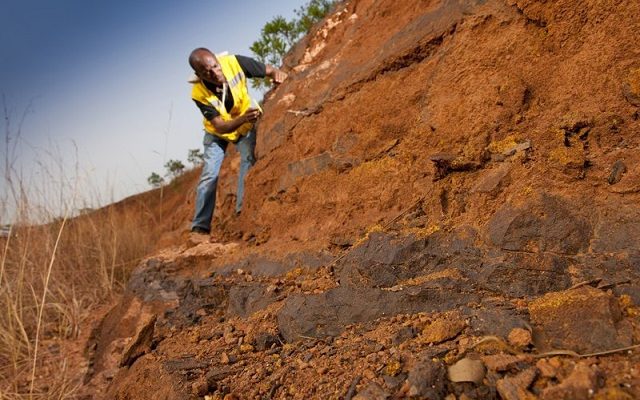

Managing Director of Macro Metals Limited, Simon Rushton, says its Agbaja iron ore project has the capacity to be a significant project for Kogi State and Nigeria and will provide a lot of employment for the local community and the state.
Rushton said it will also provide a lot of steel making materials, or steel, for the country because steel can’t be exported from Nigeria.
He explained that the proposed integrated plant in Kogi state is intended to produce steel billets with a focus on supplying Nigeria’s domestic steel market, which is currently heavily reliant on steel imports.

Speaking with Mining Review’s Bruce Montiea, he said having taken the Agbaja iron ore project in Nigeria to a level where there is a scoping study establishing its viability, and confirming its financial metrics, Macro Metals has decided to divest from the project and secure another entity to build the mine.
Rushton said the scoping and market feasibility studies have indicated strong potential returns and viability.
“We have taken the project to the point where we know the technical side of it, we understand the ore body, we’ve drilled it out, we’ve got a JORC compliant resource, we have the intellectual property and process flow based upon metallurgy testing to take the iron ore out of the ground and turn it into steel, and so now we’re looking for a new owner to come and take it from what is effectively a greenfield site that’s been drilled and had all the test work done and the design done, and then actually execute construction and operation of the project,” he said.
Macro Metals Limited, formerly Kogi Iron Limited, is an Australian public company whose shares are listed on the Australian Securities Exchange (ASX). Initially, the sole focus of the business was as a dedicated Nigerian-based project owner, specifically run to fund and manage the development of the project.
Macro Metals plans to divest its interest in the Agbaja project through a sale of shares in its Nigerian subsidiary, KCM Mining Limited and its Australian subsidiary, KCM Mining Holdings which in combination own 100% of the project as well as all associated licenses.
While a 100% sale of shares is the preferred option for the company, Rushton said it is also open to alternatives that provide compelling commercial constructs.
“Our sole focus is now Western Australia, both mining services and our own portfolio of assets. We are actively finding the right partner to take over the development of the project.
“We’ve spent a lot of money on it, approximately $70 million AUD has been invested through acquisition and development costs, so we are currently running through a process to find the right partner to carry the project forward, for the benefit of the local community as well as the wider Kogi State and Nigeria.
“So, with the right owner, it has the potential to be a significant project for the state. I personally believe it would be best suited to have an African owner, preferably a Nigerian owner,” he said.
Agbaja’s mineral resource estimate shows 586.3 Mt at 41.3% Fe, which Rushton said is of suitable quality and size to feed a long-term, multi-decade, operation.
There is a capital requirement of approximately $557 million at $1 024/t steel billet price, with an IRR of approximately 33% after-tax and payback of four years after-tax from start of development.
“The updated scoping study has demonstrated the potential for strong financial metrics for the Agbaja project based on a proposed stand-alone open pit mine supplying a conventional crushed, screened, scrubbed iron ore product to a steel billet plant located at the project site.
“We consider the project to be technically low risk given the present understanding and the amount of test work completed on the metallurgy of the conversion of iron ore into a steel billet product.
“While the Agbaja iron ore deposit is of low quality compared to the average of seaborne traded iron ores, this quality disparity is easily dealt with through existing well-understood steelmaking technologies by right-sizing each process step to appropriately remove the diluents effectively.
“This is best demonstrated by the process of removal of phosphorus, inherent in Agbaja iron ore, which is easily dealt with in the final refining step of the hot metal processing.
“The updated scoping study demonstrates that the additional cost associated with processing lower grade ore is offset by the low strip mining and significant capital and operating cost savings by selling final product domestically rather than shipping iron ore internationally and shipping finished product back into the country.
“The project cost of iron ore fed to the mill is less than $20 t/t of billet. By comparison an alternative international steel mill would need to import the iron ore for $100/t for 62% Fe, which is $160 dmtu of iron to compete with that primary economic metric. This is a key competitive advantage for the Agbaja project,” Rushton concluded.