
By Ayobami Omole-Iyagin.
In the political history of Yagba and the wider Okunland, few communities have carried the weight of marginalisation as persistently as Mopamuro.
Rich in culture, human capital, and historical relevance, Mopamuro Local Government has remained paradoxically poor in political rewards especially in terms of representing Yagba in the House of Representatives.

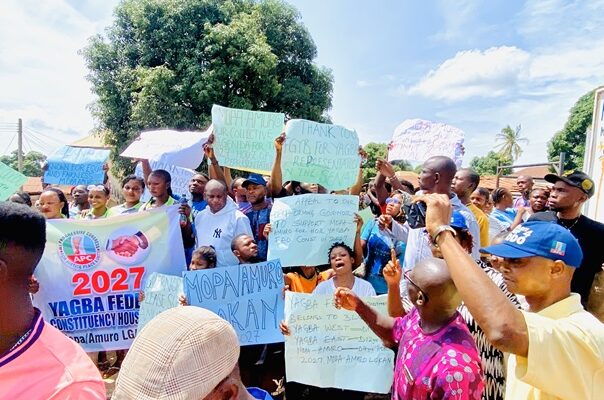
Its story is not one of absence, but of exclusion; not of silence, but of voices consistently ignored. The cry of Mopamuro is therefore not mere political agitation—it is a demand for justice long denied.
Mopamuro’s experience in Yagba and Okunland politics reflects a pattern where contribution has never translated into representation. Despite being an integral part of Yagba federal constituency and a loyal stakeholder in Okunland’s collective political journey, Mopamuro LGA has often been treated as a political afterthought. Elections come and go, alliances are formed and dissolved, yet Mopamuro remains trapped in the margins of power since the return of Democracy.
One of the most visible ways Mopamuro LGA has been cheated is in unequal political representation. In the distribution of elective offices at the federal and even senatorial levels—Mopamuro LGA has frequently been sidelined.
Key positions such as House of Representatives, Senate slots have often rotated between other local governments in Okunland, while Mopamuro watches from the sidelines. This imbalance is often justified under the guise of “political strategy” or “zoning convenience,” but the outcome remains the same: systematic exclusion.
Closely linked to this is the manipulation of zoning arrangements. Zoning, when applied fairly, is meant to ensure inclusiveness and equity. However, in Yagba and Okunland politics, zoning has often been selectively interpreted. When it favours Mopamuro, it is suddenly declared irrelevant or impractical. When it benefits other blocs, it becomes a sacred principle. This inconsistency has robbed Mopamuro LGA of opportunities that should rightfully come through rotational justice.
Another deep wound is electoral exploitation without political reward. Mopamuro has consistently delivered votes—often bloc votes—for candidates and parties at both state and federal levels. During elections, politicians troop into Mopamuro communities with promises of inclusion, development, and recognition. Campaigns are vigorously supported; rallies are attended; votes are cast. Yet, once power is secured, Mopamuro is quickly forgotten.
Roads remain untarred, health institutions underfunded, and promises abandoned. The community is good enough to win elections but never good enough to enjoy the dividends.
Mopamuro has also suffered from developmental marginalisation, which is both a cause and consequence of political exclusion. Infrastructural projects within Yagba and Okunland often bypass Mopamuro or arrive in token form.
While other areas benefit from strategic projects, Mopamuro LGA is left with neglected schools, overstretched health facilities, and poor connectivity. Political power determines development priorities, and Mopamuro’s lack of representation has translated directly into underdevelopment.
Equally troubling is the internal weakening of Mopamuro’s political voice through divide-and-rule tactics.
Worthy of note is the fact that External political forces have often exploited internal differences within Mopamuro to weaken its bargaining power. By supporting factions, promoting parallel leaders, or encouraging rivalry among elites, Mopamuro’s collective demand for equity has been diluted. A divided Mopamuro becomes easier to ignore, and this has been strategically encouraged by those who benefit from the status quo.
In Okunland politics more broadly, Mopamuro has also been cheated through symbolic inclusion without real influence.
Another dimension of the cheating lies in historical narrative distortion. Mopamuro’s contributions to Okunland’s political struggles and development efforts are rarely acknowledged in collective memory. From grassroots mobilisation to political financing and conflict mediation, Mopamuro has played roles that are often erased or minimised. This selective remembrance has reinforced the perception that Mopamuro is less deserving of leadership, a narrative that has no basis in truth.
Talented young people with ideas, education, and capacity are locked out of political pathways. Without mentors in power or access to political structures, many withdraw into apathy, migration, or non-political pursuits. This loss of political capital weakens Mopamuro further, creating a vicious cycle of exclusion.
Yet, the cry of Mopamuro is not a cry of hatred or division. It is a call for fairness, equity, and recognition. It is a reminder that democracy thrives not when a few dominate, but when all feel a sense of belonging. Mopamuro does not seek to dominate Yagba or Okunland politics; it seeks its rightful place within it.
The future of Yagba and Okunland politics depends on how communities like Mopamuro are treated. Continued marginalisation will only breed resentment and weaken collective progress. Inclusion, on the other hand, will unlock new energy, ideas, and unity. Mopamuro has the human resources, the loyalty, and the historical stake to contribute meaningfully to leadership if given the chance.
“Voice of Mopamuro: A Cry of the Cheated” is therefore more than a political feature—it is a moral indictment of an unfair system and a challenge to conscience. The question before Yagba and Okunland is simple but profound: how long will Mopamuro remain cheated, and when will justice finally speak louder than convenience?
– Ayobami Omole-Iyagin MNIM, PGD is a Journalist, Multimedia Professional and a Mass Communication Lecturer.