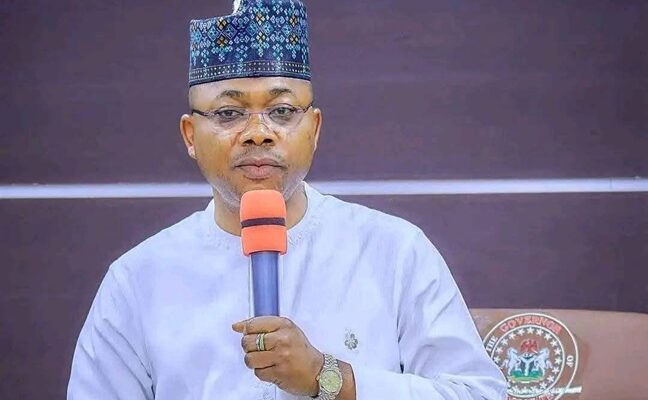

In recent days, a video clip circulating widely on social media has reignited an old but sensitive debate in Kogi State politics: the influence of “cabals” in governance. In the clip, Governor Ahmed Usman Ododo is seen speaking candidly about political power blocs, declaring proudly that he is a member of former Governor Yahaya Bello’s cabal.
That statement, whether meant as reassurance of continuity or loyalty, has generated mixed reactions among Kogites. For many citizens, the word cabal evokes images of shadowy decision-making, limited accountability, and policies detached from the everyday realities of the people.
These concerns were clearly articulated in a lengthy post published on a Facebook page reportedly based in Kogi Central Senatorial District. Addressed respectfully to Governor Ododo, the post urges him not to allow any inner circle or cabal to mislead his administration or set him on a path of future regret.

At the heart of the intervention is a simple but powerful message: governance should be measured not by political alliances but by tangible outcomes that improve the lives of citizens.
The writer raises a number of pressing issues, beginning with access to water. In Lokoja, the state capital, residents have endured prolonged water shortages with no clear timeline for restoration. Ironically, Kogi Central—home to the perceived leader of the cabal—has reportedly suffered water scarcity even before the administration of former Governor Yahaya Bello, and the situation remains unchanged. The question posed is direct: are those advising the governor fully aware of, or responsive to, this basic human need?
Electricity supply is another point of contention. The state government’s takeover of electricity distribution from the Abuja Electricity Distribution Company (AEDC) was expected to improve service delivery. Instead, many residents complain that supply has worsened. If true, this raises concerns about planning, execution, and oversight within the administration.
On environmental management, the post offers a rare note of partial praise. The Ministry of Environment is described as one of the more visible ministries, yet the writer insists that a simple tour of Lokoja would reveal persistent sanitation challenges requiring more strategic and sustainable solutions.
Attention is also drawn to unfulfilled policy directives. Governor Ododo had reportedly instructed each commissioner to construct three boreholes in their respective local government areas. How many of these projects have been completed? Who is monitoring compliance? These questions underscore a broader concern about supervision and performance tracking within government.
The legacy of former Governor Yahaya Bello is another sensitive area. While his administration reportedly initiated over 51 projects across the state, Governor Ododo has been quoted as suggesting that less than one per cent of those projects were effectively executed. The writer calls for a more objective assessment—perhaps a “CGPA-style” evaluation—to guide future decision-making and avoid blanket judgments.
Youth unemployment features prominently in the critique. Every year, the National Youth Service Corps (NYSC) injects thousands of young people into an already saturated labour market. Without deliberate strategies for job creation, skills acquisition, and entrepreneurship, the state risks deepening social and economic frustration among its youth population.
Infrastructure deficits also loom large. From deplorable rural roads—such as the Ihima–Ege–Iruvuochinomi–Agassa junction bypass—to urban routes across the state, poor road conditions continue to hinder mobility and economic activity. The call here is for firsthand assessment and prompt intervention.
Education, too, is flagged as an area of neglect. Many public primary and secondary schools reportedly lack adequate teachers, functional classrooms, desks, laboratories, and ICT facilities. For a state seeking long-term development, such gaps threaten the very foundation of human capital growth.
Finally, the writer recalls a specific promise: that something would be done about the Lokoja–Abuja road before Christmas. As the festive season arrived, travelers—including Kogites and other Nigerians—were instead trapped for hours due to failed sections of the road. While the road is federally controlled, the plea is for stronger advocacy and intervention, especially as federal attention appears focused on other flagship projects like the Calabar Coastal Road.
Underlying all these concerns is a cautionary reflection on power and responsibility. Decisions taken during the Bello administration, the writer notes, were often collective, yet accountability rested largely on the former governor alone. Governor Ododo is therefore urged to be deliberate, inclusive, and transparent in his decision-making, ensuring that those who advise him also share responsibility for outcomes.
The message concludes on a hopeful note: a prayer that Governor Ododo will be guided to succeed beyond his predecessor, not for personal glory, but so that Kogites can take pride in an administration that truly delivers.
In the end, the debate is not merely about cabals. It is about governance—who influences decisions, how priorities are set, and whether leadership remains firmly anchored to the needs and aspirations of the people.
– Ibrahim Ahmad writes from Lokoja.