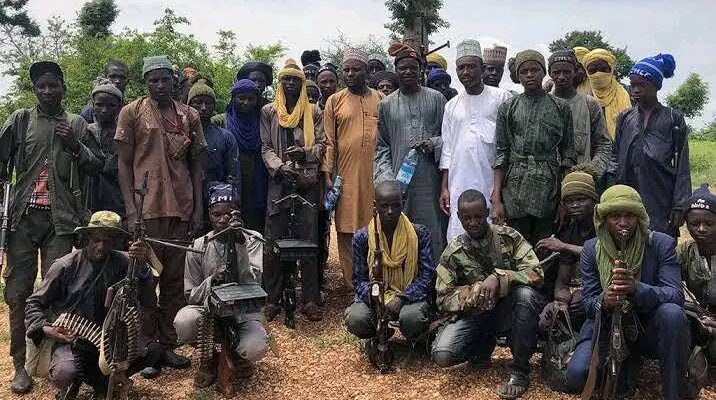

Nigeria is witnessing an unsettling contradiction: while its military forces are combing the forests in search of terrorists, local government officials in Katsina are sitting at negotiation tables, signing peace deals with the very groups the state claims to be fighting. It is a double reality that exposes deep fractures in governance. This raises serious questions about the durability of peace built on fear.
The latest pact, signed by Kankia Local Government with armed terrorists, arrives at a time when attacks and kidnappings in Katsina State are rising sharply. A video obtained by SaharaReporters shows terrorists riding motorcycles and firing into the air freely, without a single military officer intervening. It is the kind of imagery that would be unthinkable in a functioning security system: state-sanctioned dialogue unfolding alongside state-sanctioned pursuit.
Local officials call it “peace.” Many Nigerians call it betrayal. Globally, it reads like a nation negotiating with its own instability.

In neighbouring Gatakawa, farmers are already paying the price. Terrorists have imposed a ₦20 million levy, effectively transforming access to farmland into a ransom business. Families are selling goats, borrowing heavily, and breaking their small savings — just to harvest crops they planted with their own sweat. Even after payments, the bandits reportedly return with fresh demands.
Security analyst Bakatsine warns that these levies are not only financially crippling — they carve deep psychological wounds. Fear now walks hand-in-hand with survival; people farm with anxiety and sleep with uncertainty. The peace deals, instead of easing tension, are tightening the noose around rural livelihoods.
Meanwhile, Nigeria’s military continues daily search operations in the forests. Some are being killed leaving loved ones behind. But how can a government fight an enemy in the bushes while the same enemy is holding town-hall meetings with local authorities? It is like fetching water into a basket — effort without impact. A contradiction that weakens public trust and emboldens those profiting from chaos.
A Ghanaian adage captures the absurdity perfectly: “When a pedestrian helps a car owner change a flat tyre, he doesn’t hope to continue his journey on foot.”
Yet that is exactly what Katsina’s communities are being asked to do — helping terrorists dictate the terms of peace, while hoping to regain the safety that has long been stolen from them.
In another Nigerian metaphor, these deals look like a goat signing a peace accord with the lion.
On the surface, it may sound hopeful. But deep down, everyone knows the truth: the goat is not negotiating peace; it is negotiating survival. And survival under fear is not peace at all.
Katsina’s state government continues to distance itself from the agreements, refusing to take responsibility while failing to provide real alternatives. In the vacuum of leadership, terrorists are mutating into unofficial administrators — taxing farmers, dictating movements, and setting the terms of coexistence.
This is how states lose control: slowly, quietly, through desperation disguised as peace.
Food security now stands at the edge of a cliff. Nigeria cannot confront rising prices, shrinking farmlands, climate-driven disruptions, and terrorist-imposed taxes at the same time. Something has to give — and if the government does not act urgently, it may be the nation’s food basket.
The global community has seen this pattern before: in Somalia, the Sahel, Afghanistan, and the DRC. Once armed groups gain negotiating legitimacy, they rarely return to the shadows. Instead, they demand more space, more money, more obedience.
Katsina’s peace deals are not solutions; they are stopgaps. They do not heal the wound; they cover it with a bandage soaked in fear.
Nigeria must rise above this contradiction. A government cannot fight terror in the forest while its grassroots officials shake hands with the same terror in the towns. It cannot claim sovereignty while ceding authority to guns. And it cannot build peace on foundations that tremble with every motorcycle roar in the night.
Katsina is the frontline of a national crisis. What happens there will determine what happens next across northern Nigeria. The stakes are high, the people are suffering, and time is running out.
– Inah Boniface Ocholi writes from Ayah – Igalamela/Odolu LGA, Kogi state.
08152094428 (SMS Only)