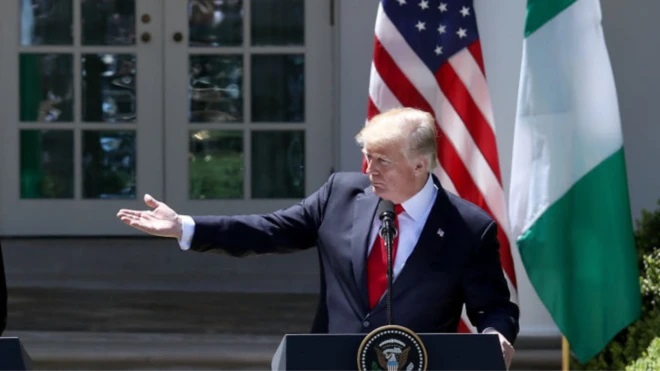

Nigeria is once again standing at the crossroads where foreign voices collide with domestic anxieties, and this time the loudest voice is Donald J. Trump—a man whose words can spark markets, unsettle governments, or ignite political storms across continents. His sudden commentary on Nigeria’s insecurity, governance failures, and electoral inconsistencies has pushed the nation into a new vortex of debate: Is Trump merely inciting political tension, or is he pointing at a reality Nigeria has refused to confront?
The weight of this question sits at the top of the national conversation because Trump’s tone does not come wrapped in diplomacy. It comes raw, unfiltered, and intentionally provocative—yet disturbingly close to truths many Nigerians whisper but rarely say publicly. As one American political theorist once observed, “When powerful men speak recklessly, the weak suffer; but when they speak truth harshly, the powerful tremble.” Nigeria is caught between both possibilities.
The disturbing tragedy is that Trump’s comments gain traction not because he is right or wrong, but because Nigeria has left too many wounds open. A stable nation does not fear foreign commentary. A grounded democracy does not panic when outsiders speak. But Nigeria’s political environment is fragile; economic hardship is rising, insecurity is mutating, and political trust is collapsing. In such an atmosphere, even a single foreign statement sounds like an earthquake.
His intervention came at a time when Nigerians are already asking difficult questions: Why is insecurity metastasizing? Why are soldiers still dying on highways and in forests? Why do elections appear like rituals rather than reflections of the people’s will? Trump’s words simply amplified what the ground realities have been shouting for years. In some regions, citizens welcomed the comment as overdue international pressure. In others, political elites dismissed it as foreign meddling. And between these reactions stands a nation trying to interpret the line between incitement and reality.
Critics argue that Trump’s intervention is reckless, that his style thrives on agitation, not accuracy. They warn that such statements can widen ethnic anxieties, embolden extremists, and cast Nigeria as a weakened state incapable of handling its own affairs. And truly, foreign commentary on fragile nations has triggered violent outcomes in global history. One European diplomat once noted, “Words from the wrong mouth can turn a tense country into a burning one.”
But to dismiss his remarks as mere incitement is to ignore the deeper truth: Nigeria’s internal problems are already loud enough to attract global interest. There is nothing foreign commentators can say today that local communities have not said with tears, fear, and frustration. The reality is already here; Trump only amplified it with global volume.
Nigeria’s political class often reacts defensively to foreign critique because such critique exposes their internal failures. Yet global actors intervene when domestic governance leaves too much space unanswered. When terrorists thrive, when elections divide, when poverty expands like wildfire, when soldiers die in avoidable ambushes and silence becomes a privilege the world refuses to maintain.
Foreign commentary, whether from allies or antagonists, becomes inevitable.
The sharp truth is that Trump’s intervention hits harder because Nigeria has not articulated a strong national narrative. There is no unified voice powerful enough to drown external criticism. No clear strategy to restore public trust. No national triumphs strong enough to overshadow political cracks. In such vacuum, every outsider becomes a megaphone.
Whether Trump is inciting or simply observing depends on where one stands politically. But the consequences remain the same: Nigeria must confront its own vulnerabilities. A nation that reacts emotionally to external statements is a nation unsure of its internal reality. A nation angered by criticism is a nation aware of its wounds.
Trump has triggered a storm, but storms only expose structures already weakened by neglect.
Nigeria must now decide:
Will it dismiss his intervention as mere provocation, or will it see it as a mirror reflecting uncomfortable truths?
For in the end, the danger is not Trump’s voice but Nigeria’s silence. A country that has not answered its own questions should expect others to ask them loudly.
– Inah Boniface Ocholi writes from Ayah – Igalamela/Odolu LGA, Kogi state.
08152094428 (SMS Only)