
By Adams Yusuf
There is a set of photos emerging from Egbe this Easter weekend that deserves more than casual attention. They demand serious political reflection.
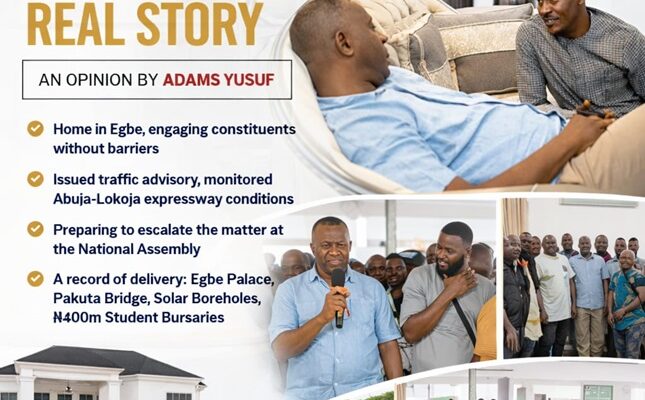
At the center is the Distinguished Sunday Steve Karimi, seated among his constituents. No podium. No barricades. No staged optics. Just a Senator in direct conversation with the people he represents.

In Nigeria’s political culture, this is not routine. It is exceptional.
Too often, elected officials engage their constituencies like visiting dignitaries. Brief appearances, controlled environments, carefully managed optics, and swift returns to the capital. The distance is deliberate. The disconnect is visible.
Sunday Karimi’s Easter weekend offered a contrast.
He was home. Not for ceremony. Not for spectacle. But for engagement. Listening. Interacting. Remaining accessible.
The images from Egbe reinforce this reality. A Senator seated among his people. Standing with them. Listening without barriers. Responding without distance. No performance. No pretence. Just presence.
And within that simplicity, something more instructive emerged.
He issued a public advisory on traffic conditions along the Abuja Lokoja expressway. On the surface, a routine gesture.
It was not.
He did not stop at issuing a warning. He followed up, monitored the situation in real time, and is now preparing to escalate the matter at the National Assembly.
A traffic advisory may appear routine. In reality, it reveals a deeper governing instinct. Attention, follow through, and a willingness to translate everyday challenges into legislative priorities.
This is the difference between expressing concern and operational leadership.
In a system where responsiveness is often delayed, such immediacy is not just notable. It is rare.
The pattern is consistent. Immediate response, sustained attention, and institutional follow through.
The Abuja Lokoja expressway is not merely a local inconvenience. It is a national economic artery. When it fails, the consequences are widespread, affecting mobility, safety, and productivity.
The Abuja Lokoja corridor remains one of Nigeria’s most critical transit routes, linking the Federal Capital Territory to the South and serving thousands of commuters daily.
While physically present in Egbe, engaging constituents without barriers, the Senator was simultaneously attentive to a broader infrastructural challenge affecting thousands.
That dual awareness, local presence and systemic thinking, is what defines serious representation.
It aligns with an established record:
Completion of the Egbe Palace within 12 months after a 12 year delay
Personal financing of the ₦23 million Pakuta Bridge
Installation of 150 solar powered boreholes across communities
Disbursement of over ₦400 million in bursaries to more than 4,000 students
From infrastructure delivery to real time situational response, the approach is consistent. Identify, engage, and resolve.
The Easter images from Egbe show proximity.
The traffic advisory demonstrates awareness.
The anticipated legislative intervention signals intent.
Together, they form a coherent pattern.
Not statements, but sequences.
Not gestures, but follow through.
Leadership, in its most credible form, is measured by what follows after the statement.
Representation is not defined by visibility, but by responsiveness.
As the 2027 electoral horizon approaches, the distinction before voters becomes clearer: between leaders who simulate service and those who operationalize it.
The scenes from Egbe offer a case study in that difference.
He is not merely present.
He is attentive.
And increasingly, he is prepared to act.
– Adams Yusuf writes on politics and governance from Abuja. He is Convener of the Kogi Equity Alliance.