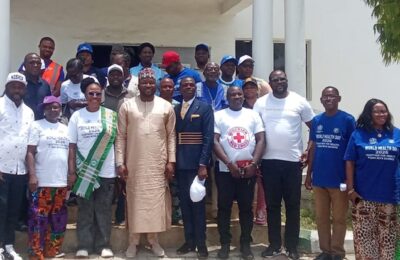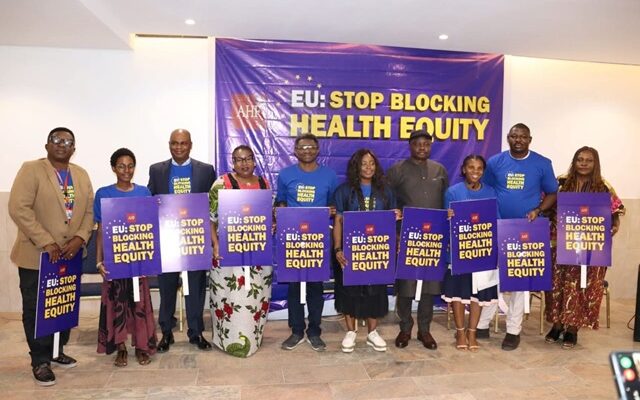

AIDS Healthcare Foundation (AHF), and other stakeholders in the health sector, have urged the European Union (EU) to stop blocking countries in the global south from accessing vaccine.
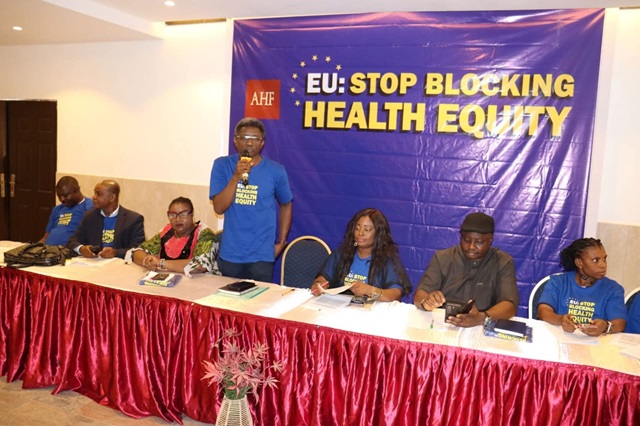
Speaking on Tuesday in Abuja, the partners called for equity, justice and fairness in accessing vaccine.
Specifically, AHF Country Director, Echey Ijezie, said the WHO Pandemic Agreement, adopted in May 2025, cannot be ratified until the Pathogen Access and Benefit Sharing (PABS) Annex is finalized.

“The Annex establishes rules for sharing pathogen samples and genetic data used to develop vaccines, diagnostics, and treatments- and how the resulting benefits from the use of this system are shared. Negotiations are at a critical juncture.
“Major EU powers are resisting binding equity provisions.
“Time is running out because the PABS Annex is expected to have its final round of negotiations at the end of March 2026, and failure to reach agreement could force a weakened compromise or delay the Pandemic Agreement’s ratification.
“What is decided now will shape whether the next global health emergency is handled more fairly than COVID-19.”
Speaking further, he said the countries in the global south will not support the agreement if there is no equity.
“The Pandemic Agreement cannot be ratified without the PABS Annex, and this Annex should not be approved without binding equity provisions.
“Also, those who profit from the system must contribute to the system. Participating manufacturers and all commercial users must be subject to mandatory benefit-sharing with real accountability and legal certainty through binding contracts.
“Mandatory Benefits must be meaningful-at mimimum, they should include:
“Equitable access to vaccines, diagnostics, and treatments; Non-exclusive licenses and relevant technology transfer for manufacturers in developing country regions during major health emergencies, and annual financial contributions.
“If we do not know who is accessing the system, we cannot hold them accountable. The EU’s current position supports anonymous access, compromising system integrity and creating real biosecurity risks.
“Countries must support mandatory user registration and traceability to protect the system and ensure it cannot be exploited anonymously.
“Civil society must be included-civil society must have access to the process and all relevant documents. Transparency and community voices are essential to ensure equity is delivered in practice and not negotiated away.”
Also speaking, General Secretary of the Nigerian Union of Allied Health Workers (NUAHW), Comrade Martin Egbanubi, said the corona virus pandemic is a huge lesson and that countries must be well prepared for any pandemic.
“Nigeria was poorly prepared. We had serious gaps in health infrastructure and in human resources, and we even had to recall retired health workers, nurses, doctors, pharmacists, therapists and laboratory scientists ,to return to the frontline.
“If another pandemic happens and we are not prepared, the situation could be worse than what we experienced.”
He also stressed the need for local vaccine production: “In Nigeria, we used to manufacture vaccines in those days. We had a medical research institute in Lagos where vaccines were produced. We must begin to look at how we can restart vaccine production in this country.
“Nigeria, as the so-called big brother of Africa, must be committed to investing in research and development and building production across the entire value chain so that we can develop and produce our own vaccines instead of always depending on others.”
Egbanubi called on developed countries to support the Global South through fair partnerships and knowledge sharing: “A lot of resources that support global production come from the Global South, especially Africa, and many of our trained health workers are now working in Europe after being educated with our own national resources.
“Because of this, the Global North must reciprocate by supporting the Global South through knowledge sharing, research collaboration and access to vaccines. It is not too much for us to demand equity and health justice.”
President of Lawyers Alert, Barr. Romy Mum, emphasized the importance of equity in global pandemic frameworks:
“When we are collecting pathogens, we do that from all over the world. But when the drugs, diagnostics are ready, then you are saying the benefits should not be equa.
The exclusivity of licensing for only the Global North is unfair. A pandemic does not ask about license; it hits everyone. Equity must be built into the framework to solidify the right to life.”
He added that global cooperation cannot be conditional: “You cannot do this by saying, oh, we will keep the benefits… when these drugs are eventually produced, let Africa and other global sub-nations not have it.
“Let there be inclusivity from the beginning, not years later. Life is universal; benefits must cross across all nations.”
Miss Amber Itohan, National Coordinator of the Nigeria Network of Religious Leaders Living with HIV/AIDS (NINERELA), called for civil society inclusion and equity in the annex:
“It is important that equity and justice be given to all countries. Everyone matters. No country is superior to another. No life is higher than the other life. We are all human beings and our lives matter.
“So, before any approval, it is important to come to the table and let there be equity, fairness and justice.”