
- “Write Women into History, Write Them into the Future”
Sen. Natasha Akpoti-Uduaghan has declared that the future of women’s leadership in Nigeria depends on how deliberately their stories are documented today.
Speaking at the just-concluded WikiGap Nigeria Symposium 2026 in Abuja, she not only called for stronger documentation of women’s achievements but also pledged a monthly donation of one million naira to support a writing competition aimed at digitally preserving the stories of notable women, past and present.
Delivering one of the most compelling interventions of the high level symposium, Senator Natasha Uduaghan emphasized that the marginalization of women in knowledge systems is a direct pathway to their exclusion from power structures.

“When women are invisible in knowledge, they are excluded from power,” she declared. “That is why WikiGap is not just a project… it is a movement to correct historical silence.”
Her remarks struck a chord with participants drawn from government, media, civil society, and the development sector, many of whom described her contribution as both urgent and transformative.
The senator painted a vivid picture of the paradox facing Nigerian women leaders, innovators, and change makers whose impacts remain largely undocumented.
“Across Nigeria, women are leading, innovating, and transforming communities. Yet too many of their stories remain undocumented, their contributions unrecognized, and their impact undervalued,” she said. “What is not recorded is often forgotten… and what is forgotten is rarely rewarded.”
She further stressed that initiatives like WikiGap go beyond merely filling informational voids.
“By creating and improving articles about notable Nigerian women, WikiGap is doing more than filling gaps in content. It is advancing rights, strengthening justice, and expanding opportunity,” she noted. “Because visibility is power. When women are seen, they are heard. When they are heard, they are supported. And when they are supported, they succeed.”
Drawing from her personal journey within Nigeria’s political terrain, She poke candidly about the structural and cultural barriers women continue to face, underscoring the resilience required to navigate such challenges.
“Our stories matter, our struggles matter, and our victories must not go undocumented,” she asserted. “The future of women in leadership depends on how well we preserve and amplify these narratives today.”
In a powerful appeal to content creators and media professionals, the senator charged journalists, writers, and digital contributors to take responsibility for reshaping narratives around women.
“I encourage journalists and authors to keep writing about women, write our journeys, our achievements, and even our challenges because that is how we inspire generations yet unborn,” she said.
She also highlighted the need for women to move beyond being subjects of documentation to becoming active creators of knowledge.
“Women must not only be the subjects of knowledge… they must be its creators. We must encourage more Nigerian women to write, to edit, and to own their narratives in the digital space,” she added.
Perhaps the most defining moment of her address came with a bold financial commitment that drew widespread applause. Announcing her support for the WikiGap initiative, she pledged a monthly sum of one million naira to fund a writing competition dedicated to documenting authentic stories of remarkable women.
“Let us be intentional. Let us document boldly. Because every story we preserve is a step toward equality,” she said. “When we write women into history, we write them into the future.”
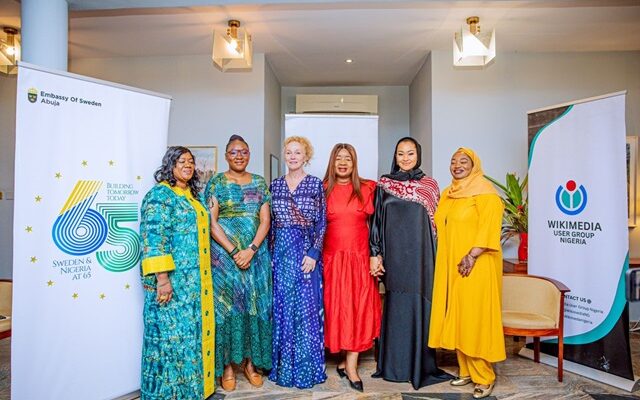
The symposium, organized by Wikimedia User Group Nigeria, served as a strategic platform to address gender disparities in digital knowledge systems. It featured panel discussions, workshops, and collaborative sessions aimed at increasing women’s representation in online knowledge repositories.
The event was hosted by Anna Westerholm, and brought together a distinguished lineup of stakeholders including Neemat Abdulrahim, Ayodeji Aramide Alakija-AJEH, and Omolayo Ogunjimi. The session was moderated by Carolyn Seaman.
Participants at the event unanimously underscored the importance of collaborative action in bridging the gender content gap, noting that digital visibility remains a critical frontier in the fight for gender equality.
Distinguished Senator Natasha Akpoti-Uduaghan’s intervention was a defining highlight of the symposium one that not only inspired renewed commitment but also introduced a sustainable model of support through her monthly funding pledge.
As conversations from the symposium continue to resonate, participants expressed optimism that the outcomes will significantly advance efforts to ensure that women are not only active participants in shaping society but are also duly recognized, documented and remembered in its historical and digital records.
In the words of the senator herself, a statement that now echoes as both a challenge and a promise:
“When women are written into history, they are projected into the future.”